
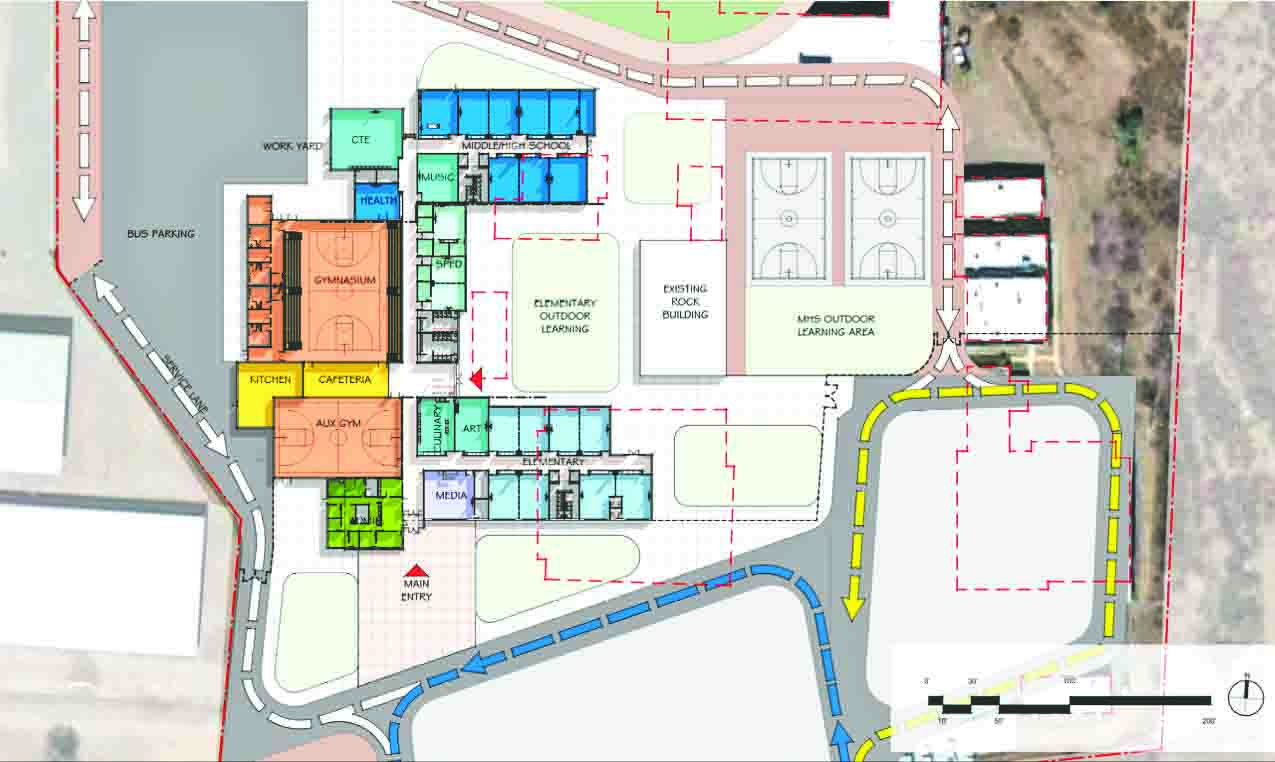
 (Courtesy photo)
This slide from a presentation by architectural firm Dekker at Monday’s Silver Consolidated Schools Board of Education meeting shows a proposed site plan for the new Cliff School. The dashed red lines indicate the existing buildings on the campus.
By JUNO OGLE
Daily Press Staff
Silver Consolidated Schools will potentially receive about six more months of funding from its mental health grant from the U.S. Department of Education, along with more strict requirements and reporting, the Board of Education heard during its regular meeting Monday night.
Cindy Barris, associate superintendent for instruction, told the board the district has received an award notification of $483,000 of the $5 million grant it was originally awarded as part of the 2023 Bipartisan Safer Communities Act, passed by Congress as a response to the 2022 school shooting in Uvalde, Texas.
In May, Silver Schools and other recipients of the grants across the country received notice from the U.S. Department of Education that the grants would be discontinued because the programs conflicted with the Trump administration’s priorities.
New Mexico Attorney General Raúl Torrez and 15 other state attorneys general sued the department, seeking to reinstate the grants. The court has ruled in the states’ favor several times, and in early December rejected an emergency request by the federal government to halt an order to continue the funding before then awarding a summary judgment on Dec. 22 ruling the discontinuation of the grants was illegal.
The latest ruling came in February, when the courts ordered the department to comply with the Dec. 22 ruling.
The attorneys general filed a motion last week asking the court to enforce its December ruling, alleging the Education Department is again in violation by putting new rules in place that effectively result in some of the grants being canceled or hindering other grant recipients’ ability to serve students.
That includes filling out complicated reimbursement forms that historically were required for grant recipients that had been found to mismanage funds, requiring performance reports before any new data is available and threatening to withhold six months of funding needed for the fall semester, according to a press release from the New Mexico Department of Justice.
Barris told the school board that the funds aren’t in the district’s coffers yet.
“The money is there, but how we spend it is very strict, and we have to have approval for anything we want to do,” she said. “My understanding is we’re going to have some new reports that we’re going to have to do in June, and then they will let us know after that if they’re awarding that.
“Everything is very technical,” Barris added. “It was shared that one of the awardees missed the deadline by five minutes, and their notification was canceled — or their award letter was canceled. So they are being very particular.”
Superintendent William Hawkins said if there are new hoops for the district to jump through, it will do so.
“I do want to show my appreciation for the Department of Education and their willingness to proceed with the directives of the court and disperse these funds out to schools and districts, and recognizing that continuing to not [fund the grants] only hurts rural schools and takes away from the intent of the bipartisan act,” he said. “We are going to go through the process, and if there’s some extra hoops, we will jump through them. So long as they’re doing their part to help us take care of our kids, then I’m going to be appreciative of the fact how we got here is not near as important as staying here and continuing to utilize the funds and the resources to take care of the kids in our community.”
Barris credited Joyce Barela, who originally oversaw the mental health grant and is now principal at Silver High School, with using the funds in the first year to provide materials and build up the wellness rooms in each school, where students can receive counseling or even just go to de-stress.
“Because of that, what we need are people, as opposed to the materials,” Barris said. “We still have the benefit of those things.”
The district now has three staff members — down from 10 under the grant — and an intern dedicated to mental health, and will be able to maintain that number for three years through state funding, Barris said. U.S. Sen. Martin Heinrich’s office has also contacted the district about a request for congressional funding that could provide for additional interns, she added.
The district has been billing Medicaid for mental health services, which does not affect any Medicaid benefits received by students or their families. That was part of the plan to make the district’s services self-sustaining, Barris said in answering a question from board Vice President Dr. Michelle Diaz
“We were counting on the next three years fully staffed to bill for that,” Barris said. “It’s not as fruitful as we would like it to be, which is why we want to keep billing as long as we can and as much as we can, to see what we can continue on our own.”
Those Medicaid funds are kept separate in the district’s budget, and are being saved as a “rainy day” fund, she said.
“We will continue to seek additional funding with the legislators we currently have. Mental health continues to be a priority for them,” Barris said.
Juno Ogle may be reached at juno@scdaily press.com.