
ROCHESTER — After years of being misdiagnosed, Janessa Winters got the mental health care she needed for her complex PTSD, bipolar disorder, anxiety and conversion disorder. But something was still missing: community. She sought that through volunteering at a homeless shelter.
“(I) overheard a statement,” Winters said, “‘You don’t become homeless because you have a need for money, you become and stay homeless due to a lack of community.’ I took and applied that motto to my own life and realized that what I lacked was not inside of me, it was outside of me.”
About 70 community members discussed the role of community and social connection in mental health at a community listening session Wednesday, March 25, at the Rochester Public Library.
The event was the third and final listening session focused on the Clubhouse Model of mental health support.
Similar to a drop-in center, Clubhouses are physical spaces where members, who are adults experiencing mental illness, can find work and social opportunities through the Clubhouse’s built-in community.
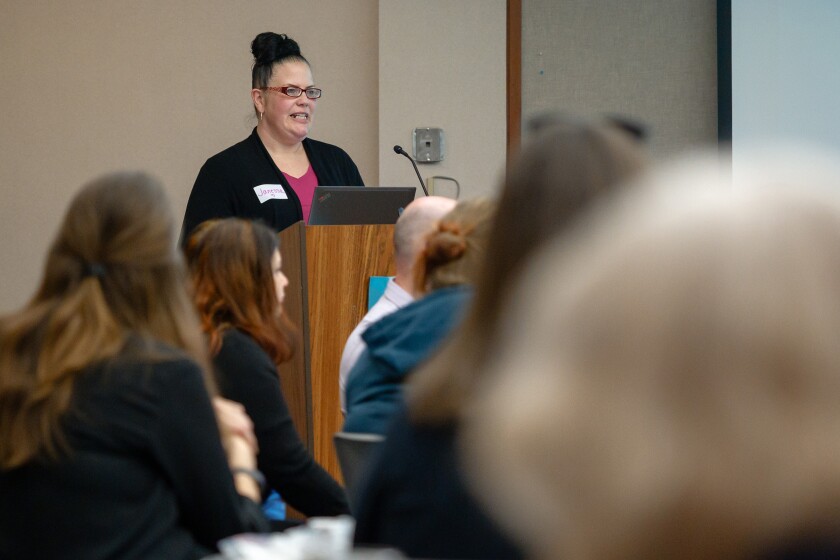
Janessa Winters, an Olmsted County resident and member of the Olmsted County Mental Health Local Advisory Council, speaks during a listening session about the Clubhouse International model for mental health recovery Wednesday, March 25, 2026, at the Rochester Public Library downtown.
Joe Ahlquist / Post Bulletin
More than 370 Clubhouse locations exist around the world, and there are three in Minnesota: Minneapolis, St. Paul and Hopkins. Those three are managed by the nonprofit Vail Communities, which led Wednesday’s presentation.
“This idea of social practice,” said Samantha Sands, manager of the Hopkins Clubhouse, “it’s a non-clinical treatment. And really, what we’re doing is we’re creating a welcoming environment for people.”
The Olmsted County Mental Health Local Advisory Council, of which Winters is a member, began exploring the possibility of establishing a Clubhouse location in Rochester after completing its 2024 unmet needs survey.
“Not having a Clubhouse — some people call it a drop-in center — really is a gap in our community, in terms of that continuum of mental health services,” said Laura Sutherland, regional program coordinator for the Southeast Minnesota Adult Mental Health Initiative.
Sutherland pointed to the
Rochester Police Department’s 2025 Annual Report,
which found that the department is fielding an increasing number of person in crisis calls.
“Our community has done a wonderful job, over the last number of years, bringing more resources on the crisis end,” Sutherland said. “One of the things that this tells us is we need to do more to put resources into the front end of mental health, to put resources into prevention.”
During Wednesday’s listening session, Sands went in-depth on how the model works. One aspect is the work-ordered day: staff and members complete the daily tasks necessary to keep the Clubhouse clean and operational. Members can pitch in by cooking communal meals, working the reception desk or managing the Clubhouse’s social media and email newsletters.
“We’re not just making up work to keep people busy,” Sands said. “All of the stuff that we are doing, we need to do.”
That work can be a bridge to other services, such as finding a full-time job or pursuing higher education.
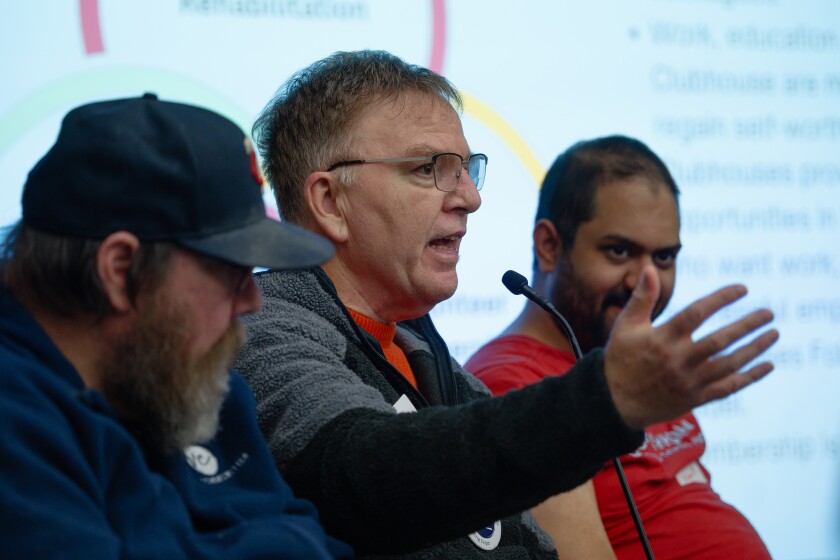
Tom Normile, a member of a Vail Communities Clubhouse program, speaks during a listening session about the Clubhouse International model for mental health recovery Wednesday, March 25, 2026, at the Rochester Public Library downtown.
Joe Ahlquist / Post Bulletin
At the session, seven members of the Twin Cities-area Clubhouses shared some of the ways their lives have changed since becoming involved in their location.
“I’ve been able to go back to work after a 10-year absence in the workforce,” said member Margaret Humphrey. “I’ve also, at the age of 71, went back to college.”
Later in the afternoon, attendees discussed what a Rochester Clubhouse would need to be successful.
Among the many suggestions: a suitable location.
“It’s going to have to be at a location where people can get to,” said participant Laurie Jueneman, who suggested it be located in or near Rochester’s downtown. “Near a bus route, and a simple bus route, not something that you’d have to take six different buses to get to.”
Two meetings later this spring — on April 30 and May 20 — will address the proposal’s next step: recruiting ambassadors and advisory council members.
Ultimately, county mental health leaders plan on making the case for the county’s financial support.
“One of the big reasons that we are making a strong case … that Olmsted County, as an entity, should fund this is so that it truly remains accessible for every member of Olmsted County,” said Megan Toney, executive director of NAMI Southeast Minnesota.
For Winters, it’s a personal endeavor. She said access to a Clubhouse would have been an asset in her community-building journey.
“In the volunteer work that I do in our community,” Winters said, “there are multiple individuals who I know personally, at this moment, that would greatly benefit.”
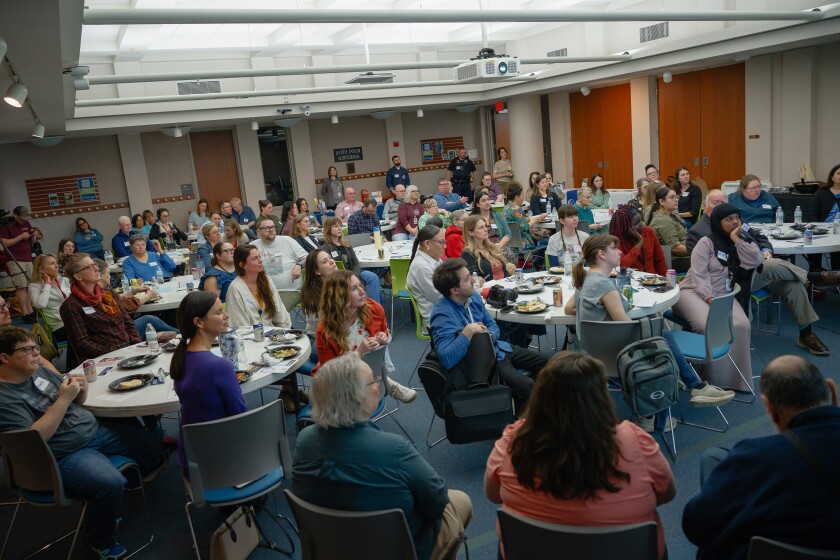
Community members and elected leaders look on during a listening session about the Clubhouse International model for mental health recovery Wednesday, March 25, 2026, at the Rochester Public Library downtown.
Joe Ahlquist / Post Bulletin