
Anoka, MN
In classrooms across Minnesota’s largest school district, a quieter shift is underway. It is not marked by new construction or curriculum changes, but by the gradual thinning of a support system many students rely on long before academic challenges surface.
The Anoka-Hennepin School District, which serves more than 36,000 students across the north metro including parts of Brooklyn Park, is moving forward with an $8.1 million budget reduction for the 2026–2027 school year. The decision marks the third and final phase of a multi-year plan to eliminate approximately $22.2 million from its operating budget since 2024.
For district leaders, the reductions represent fiscal stabilization.
For many families and educators, they represent something far more immediate: the potential loss of critical mental health support inside schools.
The Scope of the Reductions
On March 19, 2026, the district began notifying roughly 75 staff members that their positions would be eliminated as part of the latest budget phase.
While the cuts span multiple departments, the most contested reductions center on student support services:
26 social worker positions identified for elimination, affecting approximately 14 full-time roles
6 secondary school counselor positions
Additional para-educator and instructional support roles
Many of these positions were initially funded through federal pandemic relief programs, particularly Elementary and Secondary School Emergency Relief funds, commonly known as ESSER. With those one-time dollars expiring, districts across the country are confronting the same structural question: whether to absorb those roles into long-term budgets or let them go.
In Anoka-Hennepin, officials chose reduction.
A System Students Depend On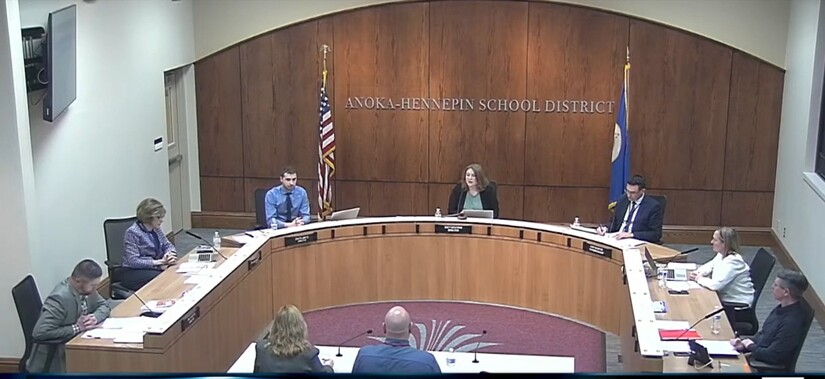
Inside school buildings, social workers and counselors often operate as the first line of response for students navigating anxiety, grief, housing instability, family disruption, or behavioral challenges.
Their work is rarely visible in standardized test scores, but it is deeply embedded in whether a student is ready to learn at all.
At Oxbow Creek Elementary in Brooklyn Park, one of the schools most directly affected, families say the proposed staffing levels raise serious concerns about capacity.
During a March 23 school board meeting, parents and educators spoke with unusual urgency.
“We were shocked to hear that a school of 1,114 students would be required to have only one social worker,” said Sarah Nelson, a parent and teacher at the school. “We were shocked that social workers were ever considered expendable.”
The concern is not simply about presence, but about scale.
A single social worker assigned to a large student population must triage need, often prioritizing crisis intervention over preventative care.
District Justification: A Rebalancing Under Constraint
District leadership has framed the cuts as a necessary “rebalancing” shaped by converging financial pressures:
The expiration of federal COVID-19 relief funding that temporarily expanded support staff
Persistent inflation affecting operational costs
Enrollment trends that have not kept pace with funding needs
New state-level mandates, including paid family leave requirements, without corresponding funding increases
School board members have also emphasized a strategic priority: protecting classroom instruction and avoiding increases in class sizes, even if it requires reducing specialized support roles.
Officials have stated that every elementary and middle school will continue to have at least one full-time social worker, though staffing ratios will be significantly stretched.
Brooklyn Park Voices and Community Response
The response from families, particularly in Brooklyn Park, has been swift and organized.
Parents and educators describe the proposed reductions as misaligned with current student needs, especially in the years following the COVID-19 pandemic, when schools saw measurable increases in student mental health challenges.
In response, a parent-led nonprofit, Parents for Good, has begun mobilizing around a potential levy referendum. The group argues that the district’s current funding model is insufficient to sustain both academic programming and essential student services.
Their proposal is straightforward: take the question directly to voters.
A levy, if approved, could provide a dedicated revenue stream to restore positions and stabilize staffing levels. But it would also require broad public support in a district already navigating competing priorities.
Leadership Transition Adds Uncertainty
The budget decisions are unfolding alongside a significant leadership transition.
Superintendent Cory McIntyre has announced his departure, effective June 30, 2026, leaving the district with a narrow window to appoint new leadership while managing ongoing financial constraints.
Compounding the challenge is a projected $6 million budget deficit for the following year, suggesting that the current round of cuts may not be the last.
Leadership turnover during a period of fiscal contraction introduces an added layer of uncertainty for staff, families, and policymakers alike.
A Broader Reckoning in Public Education
What is happening in Anoka-Hennepin is not isolated.
Across Minnesota and the United States, school districts are entering a post-pandemic financial reality where temporary federal investments are disappearing while student needs remain elevated.
The tension is structural:
Mental health needs among students have increased
Federal relief funding has ended
Local and state funding mechanisms have not fully adapted
In that environment, districts are forced into difficult trade-offs between maintaining academic staffing levels and preserving the broader ecosystem of student support.
What Comes Next
The 2026–2027 budget is still moving through final stages of implementation, and district officials have indicated they will continue to assess impacts in the months ahead.
But for many families, the timeline is already real.
Layoff notices have been issued.
Staffing models are being recalibrated.
Schools are preparing for a fall with fewer support personnel than in recent years.
What remains unresolved is a question that extends beyond one district:
What happens when the systems designed to support students’ well-being begin to shrink at the very moment they are needed most?
In the Anoka-Hennepin School District, that question is no longer abstract.
It is unfolding now, in counseling offices, in classrooms, and in the lives of students who may soon find that the support they once relied on is no longer as close, or as available, as it once was.
MinneapoliMedia
Community. Culture. Civic Life.