
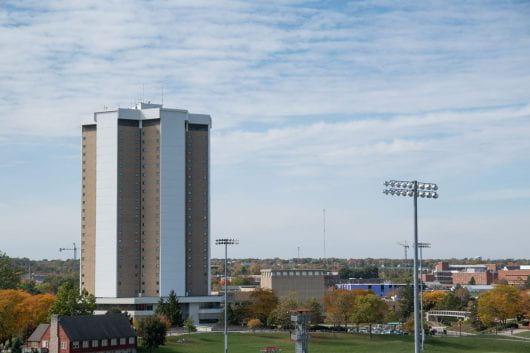
Ohio State’s Counseling and Consultation Service has offices in 1030 Lincoln Tower on west campus. Credit: Christian Harsa | Lantern File Photo
When students reach out to Ohio State’s Counseling and Consultation Service for mental health resources, they expect to be met with quick response times and unconditional support — sometimes, these expectations are not met.
Kylie Stuart, a second-year in strategic communication, contacted CCS in fall 2025, expecting her request for an appointment to be met in a timely manner.
Before the start of winter break, Stuart said she had her first appointment — it was a positive experience. Her next appointment was scheduled for a month in advance, and the morning of it, she said her counselor canceled on her.
“They couldn’t reschedule me for another month,” Stuart said. “They literally had nothing available.”
While Stuart said CCS offered to book a virtual counseling appointment for her over spring break, she would not be in Ohio, which goes against CCS policy.
“That’s the thing with a lot of therapists,” Stuart said. “They’re only licensed in the state that they’re in.”
Harry Warner, associate director and director of outreach for CCS, said while he is unable to pinpoint the exact number of students that contact CCS, they have a multitude of resources available that students pursue.
“We are a brief therapy model at CCS,” Warner said. “The bulk of concerns that students come to us with, they can get counseling right here at the office.”
Warner said in urgent cases, CCS is able to get students connected to mental health resources at the Wexner Medical Center, where they can access more immediate care.
“College can be exciting, but it also can come with a lot of stress,” Warner said. “Students will reach out to us when, for example, they’re juggling too much, having trouble staying motivated, dealing with relationship issues or just trying to make sense of everything that’s going on in their lives.”
Warner said this time of the school year, particularly, can be stressful for students as they navigate exams and strive to make it through to the end of the semester.
“It’s really in the middle of the semesters — fall and spring — when we’re the busiest,” Warner said.
Stuart said despite her complaints with appointment scheduling and availability, she enjoyed the first appointment she had with her assigned counselor.
“The person that I talked to was great,” Stuart said. “I felt like I got a lot out of it, which I really appreciated. The problem is they’re just so backed up that it’s so hard to get another appointment.”
Warner said CCS is a beneficial first stop for students seeking mental health resources.
“We’re going to get you connected in the best way possible,” Warner said.
If a student’s appointment is canceled, Warner said CCS has counselors on staff who could speak with them the same day.
“When we reach out to you to let you know your counselor is out of office, we’ll give you the phone number to our office and that email,” Warner said. “You can call and be like, ‘No, I have got to talk to somebody today.’”
Warner said the dynamic between CCS and Ohio State students is a partnership.
“We’re always telling students that we’re available,” Warner said. “We would work together. On our end, we’re letting you know, ‘Hey, please reach out,’ and then you can reach out.”
Warner said as an Ohio State alumni and a former client of CCS, he believes in their services.
“We’re available, 24/7, to students,” Warner said. “For example, let’s say it’s three o’clock in the morning, and you’re in a residence hall, and something awful happens. You could call CCS right then and get connected to a counselor, 100 percent.”
Stuart said she did not feel CCS made their availability clear to her, as she was frequently redirected to outside resources.
“They kept saying, ‘If you have a more immediate crisis,’ or whatever, they had more immediate, one-time counseling,” Stuart said. “They were sending me all these links to places when I was waiting a while.”
However, Stuart said the reasoning for which she was reaching out to CCS did not require urgent attention, so she did not reach out to other recommended resources.
When Stuart’s CCS counseling appointment was cancelled, she received an email redirecting her and encouraging her to reach out to either Ohio State Uwill, a free teletherapy service, the Behavioral Health Urgent Care clinic or the Student Wellness Center.
Prior to being able to schedule an appointment with a counselor, Stuart said she had to go through two separate virtual mental health screenings.
“They made me do a second one, which was kind of annoying,” Stuart said. “They asked me all the exact same questions they asked me the first time.”
Warner said following these phone screenings, which serve to assess a student’s needs and match them with a counselor, they’re added to a therapist assignment list and are then able to schedule an appointment, typically within one to three weeks from their initial contact date.
“You can still talk to someone in the meantime,” Warner said. “Worst case — your appointment is two, three weeks out — you could use our Let’s Talk service in the meantime, or you can call and talk to someone urgently … You never have to wait to talk to someone.”
Warner said while someone may not be able to contact a CCS counselor on the spot, they often take same-day calls. However, the circumstances that cause them to redirect students to outside resources can vary on a case-by-case basis.
“The most important factor is safety, because if a person is unsafe, we’re helping them right away,” Warner said. “There’s a ton of variables that go into who and when and why someone is meeting with a professional.”
Stuart said looking back, she feels CCS should make a more prominent effort to schedule students’ counseling appointments on a regular basis — suggesting an increase in clinical staff members.
“There’s a lot of students that need or want to use these counseling services, which is great,” Stuart said. “I think they definitely need more staff in order to actually accommodate all of the students that they’re trying to help.”
Compared to Stuart’s past experiences with therapy, she said the ability to build a consistent schedule with a therapist is lacking in CCS.
“Other therapists I’ve seen in the past, you have a consistent time every time you go in,” Stuart said. “If you had to miss one, you would have the next one waiting for you, because that time slot is kind of reserved for you. But with this, they kind of would squeeze you in wherever they could.”
Stuart said it can also be difficult to build a trusting relationship with a therapist, especially with appointments scheduled far in advance.
“I felt like I needed to be in there a lot more often,” Stuart said. “By the time the month rolled around, I kind of forgot everything we had really talked about in the first one, so it’s hard to make any real progress.”
In reflecting on her experience, Stuart said she would recommend CCS services to students without an urgent need for mental health attention.
“Don’t be afraid to do it,” Stuart said. “It’s really great to have a free resource to use. I think a lot of people are ashamed to go to therapy, and I really don’t think that’s something you need to be ashamed of. However, be prepared to have some weird times, and if you are in more of an urgent need, it might not be worth it to take the time to wait.”
Warner said he encourages students to reach out to CCS, no matter their circumstance.
“It can be a little bit scary, and if you don’t understand what’s going to happen, then you might hesitate to reach out,” Warner said. “We have so many ways that we can support you — just reach out.”
If you or someone you know is in immediate danger, visit your nearest Emergency Room or call 911. The Suicide and Crisis Lifeline can be reached at 988. The National 24/7 Suicide Hotline is 800-784-2433. For the 24/7 free and confidential Crisis Text Line, text “4HOPE” to 741-741.