
Estimates show 13 million Americans are living with Post Traumatic Stress Disorder. Millions more suffer from depression, anxiety and other mental health conditions that affect their quality of life. One organization has a furry solution for those who are struggling.
“Having him lick my hand like that really helps redirect my attention from whatever I am panicking on to Meatball’s here, he is licking my hand, and I am safe,” said 19-year-old Kai Spiller.
Meatball, is a psychiatric service dog. Spiller is his human.
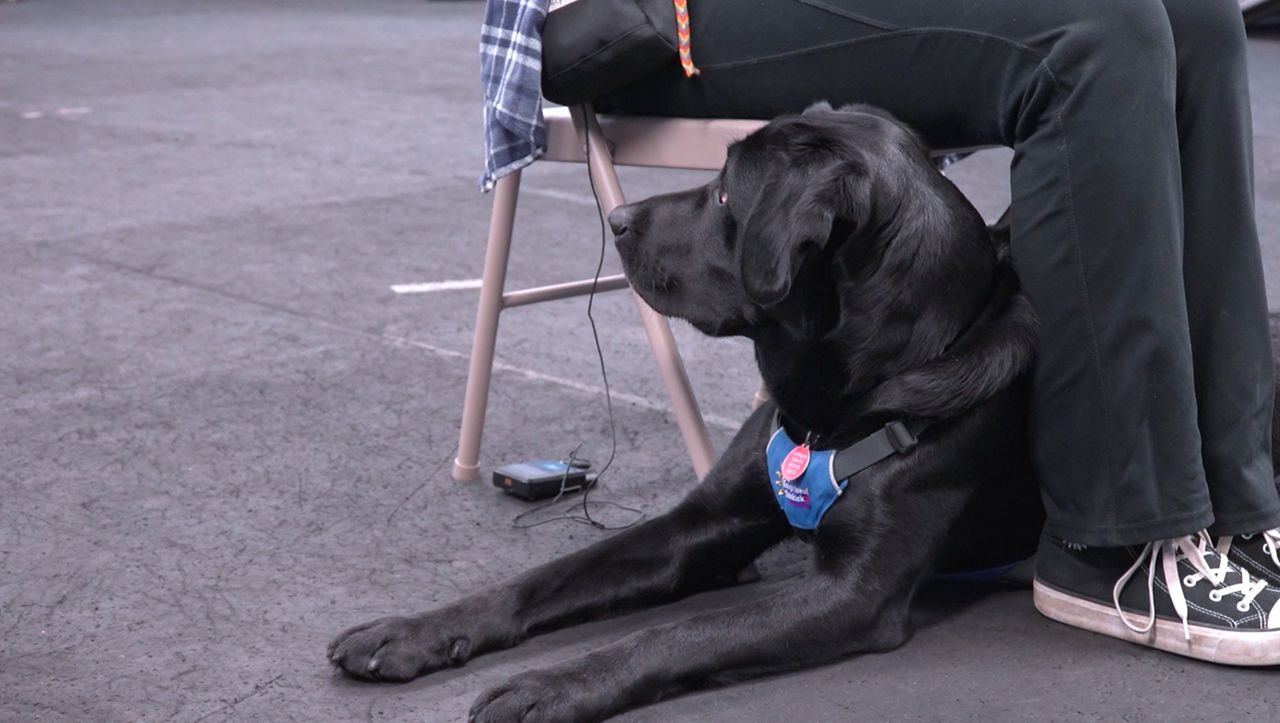
Meatball, a psychiatric service dog, has been a huge help to his owner, Kai Spiller (Spectrum News)
“Just going to get groceries like a normal person chore, it’s really difficult for me to do those kinds of things,” Spiller said.
Spiller is a survivor of the 2012 Sandy Hook shooting, and still struggles with trauma from the event, but says that Meatball has made it all much easier.
Abby Hill, the owner of The Exceptional Sidekick in Newtown, Connecticut knows the difference a dog can make.
“When I see an 18-year-old wanting to learn how to drive because their dog is giving them that independence, that’s the greatest feeling on earth,” she said.
Hill started training psychiatric service dogs after the Sandy Hook tragedy. Now, she provides dogs for people dealing with a range of mental health challenges.
“We’ve got the self-harm interruption,” she explained. “We train the dogs to wake some of the kids. They can guide to exits. We do deep pressure therapy where the dog lays across their lap or hugs them.”
Their impact goes beyond helping with physical tasks.
“Just having an animal beside you, we know, changes how your body is responding to things,” said Hill.
“We see oxytocin release, cortisol regulation, and we see kind of a calming of the nervous system,” said animal-assisted therapy expert Nancy Gee.
Gee is the director of the Center for Human-Animal Interaction at Virginia Commonwealth University. She said more research is needed, but early evidence is promising.
“The severity of PTSD symptoms are reduced by those psychiatric service dogs, and that’s really important. That’s what they’re for,” she said. “In fact, there’s 66% lower odds of these PTSD diagnostic symptoms when they have a psychiatric service dog.”
“When we have parents come in with their kids for the first time, some of the kids won’t make eye contact with me, they won’t shake my hand, they’re hiding behind their parents,” Hill said. “And I say, ‘you want to see a dog?’ And it’s like a completely different kid that comes out.”
Access to psychiatric service dogs is limited – training takes two years and can cost close to $50,000. Currently, most programs are designed to serve military veterans.
But Hill is focused on expanding access – and giving her clients a new sense of freedom and the dogs a sense of purpose.