
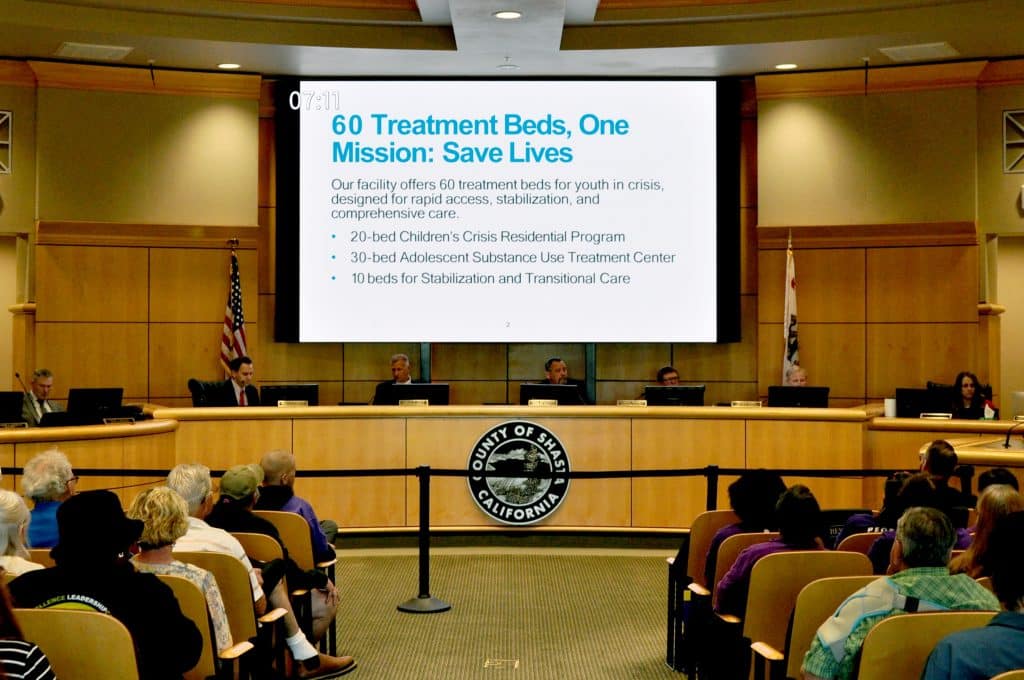
 A slide from Sandra Wilson’s presentation at the Shasta County Board of Supervisors meeting on March 24. Photo by Annelise Pierce
“This project saves lives,” said marriage and family therapist Sandra Wilson during a March 24 county board meeting, as she presented to supervisors on her Redding-based nonprofit Family Dynamics Resource Center.
The board provisionally agreed to provide Family Dynamics with almost $2 million in funding from Shasta County’s opioid litigation settlement. The funds will serve as a community match to draw in another $25 million in state Behavioral Health Continuum Infrastructure Program (BHCIP) funds. Together, the funding will be used to build a 60-bed behavioral health campus in Anderson, focused on care for youth in crisis including those with substance use disorders as well as other mental and behavioral health needs.
Wilson’s presentation indicated that of the 60 beds in the facility, 20 would go toward a children’s crisis residential program, 30 toward an adolescent substance use treatment center, and 10 towards what is described as “stabilization and transitional care.”
A staff report provided to supervisors said the new campus will “establish a comprehensive continuum of care for youth experiencing substance use and mental health challenges.” But Wilson’s presentation did not detail the types of substance use treatment — medical or nonmedical — that youths would be receiving while housed at the facility.
The presentation also lacked both a capital and operational budget for the project, information about licensure requirements, and a data-based assessment of the need for such a facility. It’s also unclear at this point how youth will be referred to the center. Wilson could not be reached by phone and did not respond to questions sent by email after the meeting.
Family Dynamics, which was founded in 2010, lists its mission as being to “reduce incidences of child maltreatment through positive parent education and interventions; to help strengthen the bonds between parents and children.” The nonprofit does not currently list substance use disorder treatment among its therapy and counseling services.
After Wilson’s presentation, the board discussed the nonprofit’s viability to facilitate this type of treatment for youths. Supervisor Allen Long — who declined to join other supervisors in voting to approve allocating the $2 million in opioid settlement funds — probed Wilson on her nonprofit’s credentials and relevant experience. Wilson described the youth behavioral health campus as an unlocked facility, prompting Long to ask how the organization would deal with runaways.
“We have the power of over 300 mentors to help children regulate and control their emotions,” she said. “We are not forcing treatment,” Wilson added, saying that both the youth clients and parents will have signed an agreement before they are admitted to the program.
During his questions, Long referenced his experience as a former police officer, having frequently responded to runaway calls from similar facilities in the past. He said Wilson’s presentation left him with “a lot of unanswered questions for this project.”
Other supervisors took a very different stance. To refute Long’s point that clients could leave an unlocked opioid treatment facility, Supervisor Kevin Crye asked Wilson how many youths have run away from the one-week camp her organization has been operating for 10 years. Wilson’s answer was zero.
Crye was also optimistic about the involvement of Les Baugh with the project. The former county supervisor and Anderson pastor also spoke briefly to the board, noting that he had donated a parcel of land assessed at $550,000 for the new facility, and that several of his church’s volunteers are ready to help out.
“I think the government needs to get out of more mental health, and churches need to start stepping up,” Crye said, to which several people in the audience booed. “Sorry, all you guys hate church,” he retorted.
Crye, who opposed another recently proposed behavioral health facility because it would have drawn clients from outside the county, took no issue with Family Dynamics proposal to do the same. It’s unknown at this point how many of the 60 beds are needed to serve Shasta youth, both Wilson and Health and Human Services Director Christy Coleman said.
Supervisor Corkey Harmon also expressed his unfettered support for this facility saying he’s known the folks behind it for years.
“It’s kind of scary, but I love the idea that it’s not a lockdown,” he said, adding that locking children in a facility is not the right approach to helping the vulnerable. He urged other supervisors not to politicize the issue, and vote unanimously in support.
Supervisor Matt Plummer asked hard questions about the project’s past 990 tax filings and pushed Wilson on why she hadn’t yet gotten a letter of support from the Anderson Police Department for the project. He ultimately voted to support designating the $2 million in opioid funds to the project, but not before convincing other supervisors to compel Wilson to attain a letter of support from both law enforcement and probation to gain the funds.
While Plummer expressed mixed feelings about the proposal, he said his concerns weren’t enough to hold him back from designating funds to support youth in crisis.
“I think that oftentimes we don’t have an option where we’re like, yes, this checks all the boxes and we feel 100% comfortable with it,” Plummer said, “but is it better than what we currently have?”
Do you have information or a correction to share? Email us: editor@shastascout.org.