
Sonoma County health officials this week released the latest accounting for the highly pressured, voter-approved tax revenue stream that helps bolster local mental health, substance abuse and homeless services.
The quarter-cent, countywide Measure O tax, adopted in 2020, generated $33.1 million during the 2024-25 fiscal year for services across five voter-approved categories, according to the county.
County spending of Measure O dollars in that same period amounted to $54.7 million, offset by $22.1 million in state and federal reimbursements.
Measure O funds key local government and nonprofit programs that would otherwise be greatly diminished or not exist, said Nolan Sullivan, director of Sonoma County Department of Health Services. On Tuesday, Sullivan presented the 2024-25 annual report for Measure O to the Board of Supervisors.
On the county side, the covered programs include local mobile psychiatric crisis teams, the county’s psychiatric emergency department, inpatient psych beds and homeless housing services. The 10-year tax, billed at the time as a stopgap measure to shore up local services amid state and federal funding shifts, expires in 2031.
“Measure O, every single day, is helping some of the most sick, most behaviorally needy folks here in the county,” Sullivan said. “If we didn’t have this resource, quite frankly, the behavioral health team would be sunk.”
Sonoma County
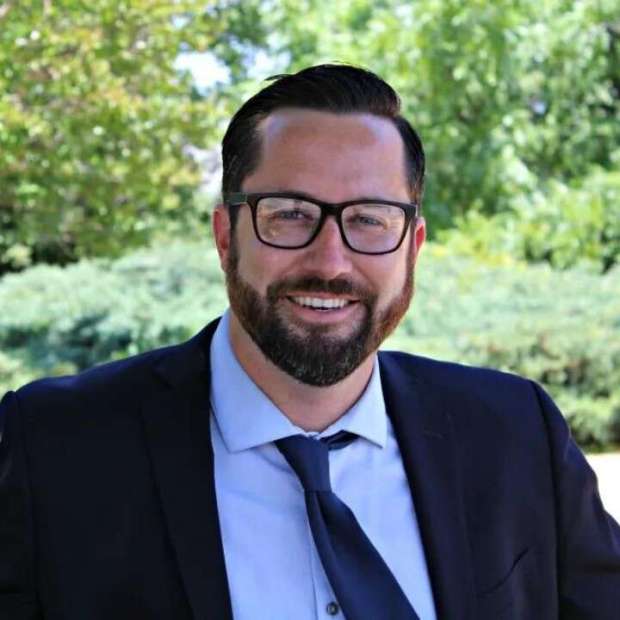
Sonoma County Health Services Director Nolan Sullivan (Sonoma County)
Increasingly, and especially over the past year amid sharp social-safety net funding shifts under the Trump administration, local cities have been lobbying the county to share more of the funds to support their own mobile crisis intervention teams and homeless services.
Several school districts in the county have been requesting Measure O money to help fund their behavioral health programs. The county’s Crisis, Assessment, Prevention & Education program, which provides a mobile crisis response program serving local high schools and some junior and elementary schools, received $1.5 million in Measure O funds last year but only operates on about 34 campuses.
Sullivan said last year, the CAPE team responded to 56 different crises, including 33 on-campus crises and 23 phone consultations; 109 early intervention referrals; and served 2,240 prevention participants through education and outreach activities.
“You have a lot of your constituents and partners asking for funding to support programs — I wish we had the money to do it,” Sullivan said. “But I want to remind the county that we were injecting our services into 34 different campuses across Sonoma County.”
Supervisor David Rabbitt, whose district covers southern Sonoma County, raised concerns that no Petaluma City Schools campuses are currently participating in the CAPE program.
Supervisor Lynda Hopkins noted that the three rapid-response, mobile crisis teams funded by Measure O offer different services in their respective jurisdictions. She was joined by other supervisors who called for greater uniformity in the delivery of Measure O services, even as they acknowledged that the sales tax will expire in a few years.
Sullivan raised concerns about the impact to the region once the tax sunsets.
“Ultimately, I just want to thank the voters and the taxpayers of Sonoma County,” Sullivan said. “Without their support, we would not be able to serve thousands of people…probably some of the the most intensive support for people in Sonoma County that really, really need it.”
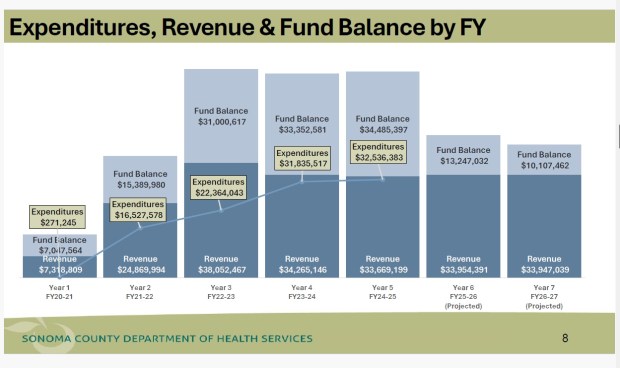 This chart shows fiscal year revenue generated by Sonoma County’s Measure O sales tax for mental health, substance use and homeless services.
Measure O generates more than $30 million a year and has for the past few years maintained a fund balance. However, that fund balance is expended to be depleted over the next few years and should be at zero by the time the tax expires.
The absence of any replacement funding or extended measure could be “devastating” to thousands of local residents who receive services, Sullivan said, calling on the county to launch a campaign in support of a tax renewal.
In addition to Measure O, the county has six other countywide, voter-approved taxes that help fund libraries, SMART, transit and road projects, park upgrades, open space protection and fire services.
During the supervisors’ meeting, Sullivan detailed fiscal year 2024-25 Measure O expenditures. The largest share of the Measure O funds, nearly $30 million a year, goes to emergency psychiatric and crisis services.
That includes nearly $10 million for the county’s Crisis Stabilization Unit, an emergency department for psychiatric patients; more than $9 million for adult inpatient hospital services; $5 million for mobile crisis services; $1.5 million for the CAPE program; and $3 million for residential crisis services, an alternative to hospitalization.
Other 2024-25 fiscal year expenditures by category include:
$15.4 million for mental health facilities.
$3,671,981 for mental health and substance use disorder outpatient services.
$5,164,950 for behavioral health homeless and care coordination
$625,740 for transitional and permanent supportive housing.
Funds that go to mental health facilities include $5.8 million for psychiatric hospital facilities that served 208 people; $9 million for residential care facilities that served 328 people and amounted to 81,448 bed days; and $348,976 for placing 325 people in transitional housing after they were discharged from crisis facilities.
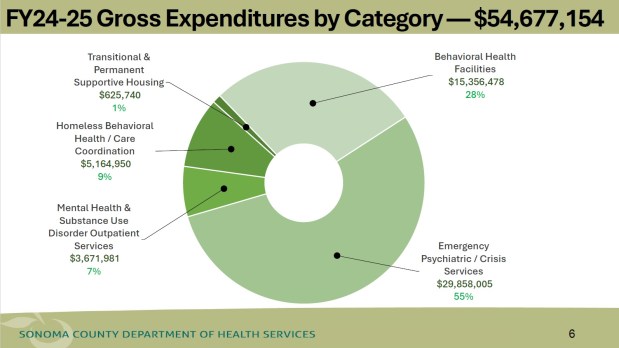 This chart shows Sonoma County Measure O expenditures for the 2024-25 fiscal year by category.
The nearly $3.7 million for mental health and drug addiction services covered peer & family supportive housing at Women’s Recovery Services, a recovery program for pregnant and parenting women; mental health services for children and youth at Santa Rosa Junior College; mental health services at Valley of the Moon Children’s Shelter; and expansion of existing drug addiction services.
The 2024-25 fiscal year report marks the fourth full-year accounting of Measure O funds, which are reviewed by a oversight committee headed by former Sonoma County Supervisor Shirlee Zane, a longtime mental health services advocate.
Gregory Fearon, a member of the oversight committee who attended Measure O presentation at the Board of Supervisors meeting Tuesday, called funds raised by the tax a “saving grace” for behavioral health and substance use disorder services.
He expressed the need to better communicate with the public about the importance of the funds and how they are being spend.
Supervisors James Gore and Chris Coursey sit on the board committee formed to review implementation of Measure O expenditures and programming.
Coursey also raised concerns about how to best communicate the importance of Measure O spending and the impact of losing that funding in a few years.
“Keep the pedal to the metal with how we’re doing this, but understand that we’re going to run out of gas in a few years,” he said.
“I think its incumbent on all of us to tell this story to our constituents, to the community,” he said.
You can reach Staff Writer Martin Espinoza at 707-521-5213 or martin.espinoza@pressdemocrat.com.