
During my time as a state representative, healthcare was always a central part of the debate. I was proud to serve in the House in 2006 when Democratic legislative leadership worked with Republican Governor Mitt Romney to pass the nation’s first universal healthcare law. That bipartisan effort proved that when elected officials put patients first, we can expand access to care and strengthen our healthcare system at the same time.
That landmark legislation was an example of how Massachusetts has always looked out for vulnerable patients. But even with our best efforts, there are still patients who need help accessing medical care and prescription drugs. For the latter, a federal program known as 340B does an immense amount of good filling in the gaps in drug affordability.
For more than three decades, the 340B program has helped safety-net providers like Community Health Centers and smaller hospitals stretch limited healthcare resources. The program requires pharmaceutical companies that sell drugs through lucrative Medicare and Medicaid contracts to offer discounted prices to healthcare providers that serve vulnerable populations.
340B gives patients access to more affordable drugs while also helping smaller hospitals stay open despite facing major financial pressure. Hospitals use 340B savings to provide free or discounted medications, expand pharmacy services, support cancer treatment programs, and offer addiction and behavioral health services.
Here on my native Cape Cod, the 340B program plays an important role in supporting Cape Cod Healthcare, the region’s largest healthcare provider. The same thing is true of regional health systems throughout Massachusetts, from Western Mass to the Southcoast. These systems face rising costs for labor, medical supplies, and pharmaceuticals. At the same time, reimbursement rates from programs such as Medicare and Medicaid often do not fully cover the cost of care.
The 340B program bridges that gap. By lowering the cost of prescription drugs, the program allows providers to invest more resources into patient services and maintain access to care in communities like ours. In turn, this means that people outside of Greater Boston can access high quality healthcare without having to drive for hours while battling illness.
Unfortunately, this successful program is now under threat from large pharmaceutical companies lobbying to weaken the 340B program. They claim the discounts required under the program cut too far into their profits.
But that argument ignores the structure of the program. It’s basic social responsibility that drug companies should offer cost savings for vulnerable patients and crucial safety-net healthcare providers in exchange for accessing the massive Medicare and Medicaid markets.
Just as important, the program does not cost taxpayers anything. The discounts come directly from pharmaceutical manufacturers, and the savings are reinvested into patient care.
Despite this, the pharmaceutical industry continues to push for changes that would weaken the program. This would make it harder for hospitals and clinics to provide affordable medications and maintain essential services. It would place additional financial pressure on providers that already operate on thin margins. Some hospitals would close entirely, depriving people of quality healthcare within a reasonable distance.
I urge residents throughout Massachusetts to speak up in support of this program. Our representatives in Washington must hear that the 340B program is critical to protecting access to healthcare and that they should side with patients and community hospitals, not the big drug companies.
Demetrius Atsalis represented the 2nd Barnstable District in the Massachusetts House of Representatives from 1999 to 2013.
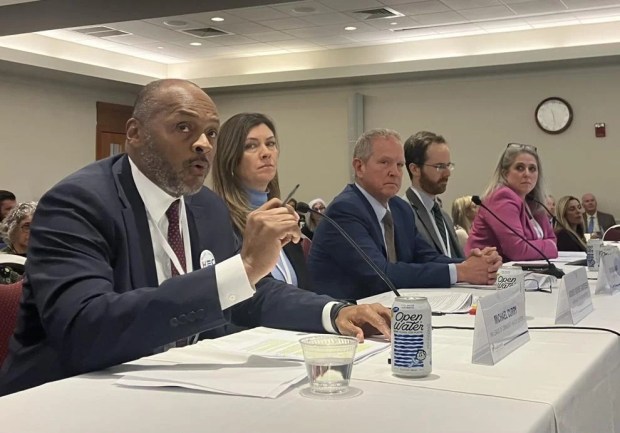 Massachusetts League of Community Health Centers CEO Michael Curry, Massachusetts Health Connector Executive Director Audrey Morse Gasteier, Cape Cod Healthcare CEO Michael Lauf, Undersecretary for MassHealth Mike Levine and Health Care For All Executive Director Amy Rosenthal testify at the Health Policy Commission’s annual cost trends at Suffolk University Law School in November.(Alison Kuznitz/SHNS)