
A couple of private schools in La Jolla are taking steps to try to boost students’ mental health amid a world of ever-growing technology and anxiety.
La Jolla Country Day School and Stella Maris Academy differ in their methods, but they share the goal of encouraging students to build habits that better promote academic success and social interaction.
La Jolla Country Day School
Country Day hosted its third annual Middle School Mental Health Awareness Day on March 20 for students in fifth through eighth grades. The campus serves children in pre-kindergarten through 12th grade.
The day is designed to help students better understand the effects of technology use, nutrition and self-care on their well-being and academic performance.
The event is the product of work from the Middle School Mental Health Awareness Committee, composed of middle school teachers Riley Pratt and Miranda Katz and counselor Kiara Grant.
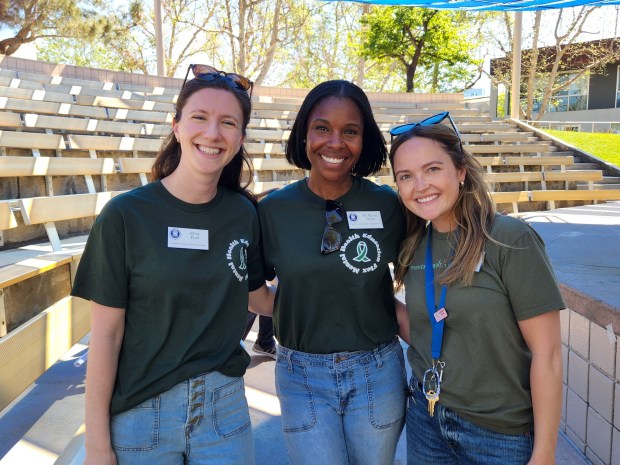 Riley Pratt, Kiara Grant and Miranda Katz helped organize La Jolla Country Day School’s third annual Middle School Mental Health Awareness Day on March 20. (La Jolla Country Day School)
Grant said this year’s theme was self-image.
“When we were trying out how we could make adjustments and implement different initiatives for this Mental Health Awareness Day, we looked at the data … to see what is the need in middle school in particular,” she said.
“We have students who unfortunately have struggled with body image and unhealthy eating … negative self-talk and social media and group chats impacting the mental wellness of themselves and their peers. Based on that information, we created this program.”
Donovan Taylor Hall of national nonprofit organization Active Minds addressed those topics in an hour-long speech during the event. The former middle school educator walked students through his own journey and how they can apply his lessons to their lives.
“He really focused on negative self-talk,” Grant said. “He talked about how he encountered a bully from elementary school into college, and what he shared with the students was that he was the bully. He bullied himself. He was not kind to himself.
“So the message to kids — our students in particular — was how can you show up for yourself in ways others might not show up for you? You have to be kind to yourself first.”
Kristy Johnson, Country Day’s head of middle school, said events like this help meet needs in the community, not just in the classroom.
“La Jolla Country Day is very strong in our academics, and I think that’s something we’ve always prided ourselves on,” Johnson said. “But I think over the last few years, we’ve really focused on the mental health aspect of the students to be able to be successful in the classroom. Days like this really just help elevate the importance of that.”
Among the students in attendance were fifth-grader Delaney Hales and eighth-grader Callan Mischler.
Delaney said she “really liked” Hall’s speech and the parent-prepared organic juices the students were provided. After Mental Health Awareness Day, she said, she plans to eat healthier and add more vegetables to her diet and continue taking academic breaks when she needs to.
“Me and my brother do our homework for a long time, and then you have a five-minute break of maybe playing on a device for five minutes together or we shoot hoops together,” she said. “Then when it’s time to go back inside, we go back inside.”
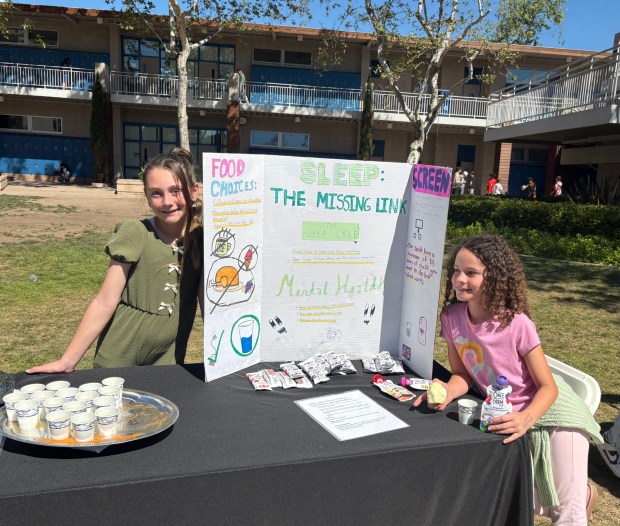 La Jolla Country Day School fifth-graders Delaney Hales and Hazel McDooling made a poster with two other students about sleep and other factors and how they can affect mental health. (La Jolla Country Day School)
Callan, who attended the event for the third time, said he plans to practice affirmations and positive self-talk, as the speaker suggested.
“Something I really try to do is self-advocacy,” he said, “and a lot of the teachers here are really supportive, which is amazing — making sure you’re asking for help when you need it, [and] if you need more time on an assignment, asking for that. … That can take off so much pressure from just my day-to-day life.”
Stella Maris Academy
Stella Maris Academy, meanwhile, is looking to decrease the amount of time students spend in class on screens (cellphones and computers).
The school holds students’ phones during the day, but Stella Maris Co-principal Francie Moss met recently with middle school instructors to slowly reduce time on laptops and other screens — especially in English language and grammar classes.
Stella Maris serves transitional kindergarten through eighth grade. Middle school is grades 6-8.
“We are noticing more and more in our incoming students and even our current students … a higher level of anxiety,” Moss said. “It’s becoming almost common.
“We’re also noticing … an increase of students that come to school tired, sleepy [or with] a lack of social interaction with one another,” she said. “They’re just not as comfortable interacting socially as we used to see. I’ve been in education for 42 years, and we’ve seen a definite difference.”
The new focus on screen time is “taking the bull by the horns,” Moss said.
“We have one-to-one computers, but I don’t want to walk by a classroom and see my students with headphones on on a screen,” she said. “We’re supposed to be teaching them and they’re supposed to be interacting with one another.”
A group of Stella Maris parents is trying to reduce screen time at home as well through a national campaign called Wait Until 8th.
Parents sign an informal pledge agreeing to join with their peers in not giving their children a smartphone until the end of eighth grade. The object is to have at least 10 families from each grade level join the effort.
“It’s banding together to help decrease the pressure,” said parent Diana Anderson. “So if we all do it together, the idea is that it’s easier on our kids.”
Parent Aubrey Eblin said “Childhood is such a critical window for developing their attention and confidence and building these new relationships with kids. When you see kids on computers but they’re not communicating with one another, and then they may have homework and they go home on their computers to finish their homework, that’s a lot.”
Zane Burnett, another proponent of the campaign, said the program doesn’t say no to the technology, but rather “not yet.” There are other options, too, he said, as parents can program phones not to include social media apps.
“I’m in tech — that’s my career,” Burnett said. “So it’s not about being anti-tech. … It’s about being intentional and it’s about introducing tech at the right time.”
According to the campaign’s website, waituntil8th.org, more than 145,000 parents across the country have said yes to waiting to give their kids a smartphone. ♦