

Lexington
Kentucky’s judicial branch warns it may be forced to close its drug, mental health and veterans treatment courts statewide if the General Assembly passes a budget bill it says would underfund the entire court system over the next two years.
Those specialty courts provide supervision and guide those whose charges are tied to substance abuse disorders or mental illness to health care and other treatment services in an effort to address the root cause of criminal behavior, reduce the risk of reoffense and cut down on incarceration costs.
The judicial branch budget outlined in House Bill 504 could underfund court operations by $14.3 million in fiscal year 2027 and $18.7 million in fiscal year 2028, the Administrative Office of the Courts said in a news release Thursday with just one week left of session.
The reduction of 4% in 2027 and 7% in 2028 could mean the judicial branch would face layoffs, furloughs and service reductions.
A current version of the legislation proposes an approximately $687 million annual appropriation to the court system, though the House and Senate disagree on changes made to the budget bill. It stands in free conference where, likely next week, an appointed committee will have the power to amend, add or delete any part to ensure passage.
State Supreme Court Chief Justice Debra Hembree Lambert said in the release the judicial branch already operates with a lean budget. Most of its expenses, about 90%, are devoted to staffing and basic costs to keep courthouses across the state running.
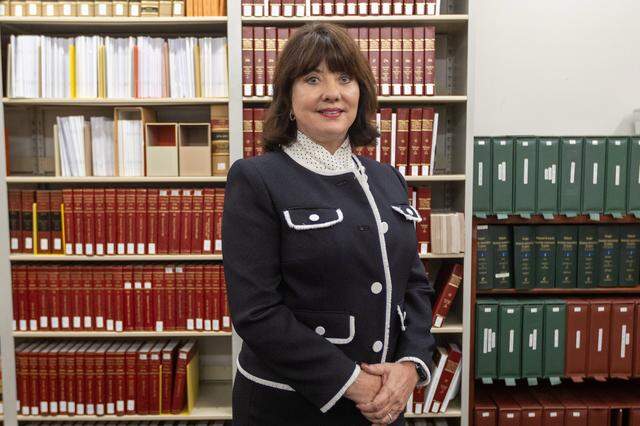 Chief Justice Debra Lambert within the relocated Supreme Court and State Law Library while the Capitol receives renovations. December 2, 2025. Marcus Dorsey mdorsey@herald-leader.com
“When cuts of this magnitude occur, there is simply no way to absorb them through small efficiencies or administrative changes,” she said. “The only viable option we have is to eliminate programs that are not constitutionally required, including Drug, Mental Health and Veterans Treatment Courts.”
Specialty courts have been operating across the state for 30 years and have served as a model for judicial branches across the country, according to the courts news release.
District Court Judge Cole Maier, who serves Clark and Madison counties, has been a member of the specialty courts team since 2013 and presides over the Clark County Drug Court, the state’s first certified program.
 Renovations are underway at the Madison County Courthouse in Richmond, Ky., on Thursday, Sept. 28, 2023. Ryan C. Hermens rhermens@herald-leader.com
According to the Administrative Office of the Courts, drug courts operate in all 120 counties and have 2,500 active participants. Mental health courts operate in 17 counties and have 270 active participants. Veterans treatment courts operate in eight couties and have 92 active participants.
“These programs are not at risk because they do not work; they’re at risk because of funding constraints,” Maier said. “We know that we’ve made constitutional mandates — and we will show up and do that — but we will be missing something and I think our communities will feel it. Certainly the participants who are with us will feel it.”
Maier said specialty court programs are not easy, but they are “a meaningful tool for improving both public safety and strengthening communities.”
Behavioral health liaisons work with those in the justice system to complete intensive treatment programs and frequent drug testing. Case management is provided at no cost to participants who volunteer to be in the program in the same way judges volunteer to preside over cases.
“When they work, what you see initially is people moving into a phase of stabilization, improving housing opportunities, rebuilding or enhancing familial relationships, finding employment that gives them pride and connection to the community,” Maier said. “And all of those things have a ripple effect that go beyond that individual.”
Between 2019 and 2025, specialty court programs aided 5,110 Kentuckians in getting jobs, more than 1,620 of whom were promoted. Another 555 people achieved educational goals while 1,620 improved their housing stability. The Administrative Office of the Courts also reports in that time period, participants secured 2,025 driver’s licenses and programs have supported the birth of over 400 drug-free babies.
“It’s this focus on treatment that allows us to make behavioral modifications, to observe behavioral modifications, to hold people accountable, so that over a period of time … you really settle into changes in behavior that can be sustained long term, that allow participants to live different lives in their communities,” Maier said.
Over a five-year span, the office reports participants have paid more than $5.4 million in child support, restitution and other court-related financial obligations.
In addition, specialty courts are considered a lower-cost alternative to incarceration. In Kentucky, the average annual cost to incarcerate one person is about $16,060 whereas the average annual cost for a specialty court participant is roughly $6,500.
Maier said specialty court is not a profit-driving activity, but it can be tremendously cost saving in the long run by keeping people from reoffending, giving them stability and by working to adjust community attitudes toward people engaging in recovery.
“I’m just a trial court judge that works with what we’ve got,” Maier said. “I’ve never seen Court of Justice quit on something they thought was equitable and served the citizens of Kentucky.”
.JPG)
Lexington Herald-Leader
Piper Hansen is a local business and regional economic development reporter at the Lexington Herald-Leader. She previously covered similar topics and housing in her hometown of Louisville, Kentucky. Before that, Hansen wrote about state government and politics in Arizona.