
Rising absenteeism and worsening youth mental health have pushed more teenagers towards schools such as the Linn Dara Schools in Ballyfermot, where education and clinical care now run side-by-side.
The schools, which are attached to one of the State’s four inpatient CAMHS units, support children and teenagers in some of the most difficult periods of their lives – often at a time when school attendance has become impossible for them.
The two separate schools on the purpose-built site support young people up to age 18 who are either admitted to the Linn Dara Child and Adolescent Mental Health Services (CAMHS) approved centre, or are outpatients within Linn Dara CAMHS Community Services. Open 10 years this year, the specialist hospital school site supports children and young people who are experiencing severe and enduring mental health difficulties and who are temporarily absent from mainstream school due to their medical needs.
Recent research from the Economic and Social Research Institute (ESRI) shows that pupils who miss 20 days or more a year face not only lower grades but significantly higher risks of stress, depressive symptoms and poorer wellbeing, well into their 20s.
Against this backdrop, every day of attendance for the students at Linn Dara becomes both a clinical milestone and an educational one.
Prof Brendan Doody, a psychiatrist, is clinical director of the Linn Dara CAMHS service.
“I would take the view that usually a crisis occurs in a young person’s life when their mental health difficulties lead to the point that their attendance at school breaks down. School is more than just an educational structure – it provides a social structure at a critical developmental stage.
“You’ve got various systems supporting a young person experiencing mental health issues – you’ve the family system holding the child, you’ve the treatment system, and then you’ve a wider social system of which the child’s school is a major part. When school attendance ceases, for whatever reason, a crisis will often ensue.”
Doody is concerned about the wider knock-on effect of the increased rate of school absenteeism post-pandemic, with a recent ESRI report highlighting that both the average number of days lost per student and the proportion of students with chronic absenteeism have grown, with numbers particularly worrying across disadvantaged schools and communities.
Matthew Swain is principal of the 14-strong Linn Dara schools’ faculty, made up of school leaders, teachers, special needs assistants and a school secretary. At present the inpatient school caters for 13 students, reflecting the current bed capacity for the approved centre, which is reduced from 24 while one of the wards remains closed.
As soon as we feel a student is feeling established here – and we have a good idea of their needs and what works for them – we’re looking to where they are going to next. We know that we won’t be their school for life
— Matthew Swain, principal, Linn Dara Schools
The community (or out-patient) school caters for approximately 40 students at any given time. Some of these will have transitioned from the inpatient school, but are not yet ready to return to their local school; the majority are young people attending their local Community CAMHS team and are not engaged in education with any other school or education support programme.
The Linn Dara Schools serve mainly Dublin and Midlands catchment areas including Dublin South City and West and Dublin South-West, Kildare, West Wicklow, Laois, Offaly, Longford and Westmeath, but as it operates as part of a national network, it has hosted students from further afield, depending on capacity and demand.
“The community school caters for a lot of kids who would have been on home tuition, but they have all been able to come in and they’ve found their own tribe there,” explains Swain, himself a father of children attending both primary and secondary schools. He feels home tuition is often explored too early by those advising families.
“Young people become that ally to each other and support each other and hopefully become a pull factor to keep each other coming in every day as well. That in turn helps them expend some energy during the day, getting a better sleep that night, kicking the circadian rhythm back in. It’s about repetitions and building structure, and that is all contributing towards recovery.”
Due to the largely transitory nature of the student cohort (particularly in the in-patient school, where the average stay is 40 days) a significant part of Swain’s and the school team’s role is paving as smooth a path as possible when a student is ready to transition out of Linn Dara.
[ Opinion: Why is mental health so much worse among Irish youths than adults?Opens in new window ]
“We have a very thick address book, and we have key people in different schools to link with. As soon as we feel a student is feeling established here – and we have a good idea of their needs and what works for them – we’re looking to where they are going to next. We know that we won’t be their school for life.”
The school increasingly draws on outside voices who can help the students re-establish routine and a sense of self. One of these was Singaporean artist anGie seah, whose recent workshops offered students an alternative avenue for expression and connection.
When she delivered a series of creativity workshops to a group of secondary level students in Dublin, there was nothing outwardly to suggest the deeply personal experience that they shared.
What the students didn’t know, and seah did not feel the need to disclose, was that she had a mental health breakdown in 2016 triggered by work-related burnout. Her diagnosis of depersonalisation/derealisation disorder (DPDR) – a condition characterised by persistent, recurrent feelings of detachment from one’s own mind, body, or surroundings – and her subsequent recovery, has greatly informed her artistic output and her decision to work with young people experiencing their own mental health challenges.
When you just dabble with ink or with colours, you can produce something that doesn’t need to make sense to anyone else
— anGie seah, artist working with Lynn Dara Schools
“Basically, I came out of my mind. I entered a kind of trance state. It was triggered by burnout. I was doing too much – too many projects. I was too hard on myself. I felt the whole world, my whole being becoming very cynical and negative, and it kind of ate me,” seah explains.
Eventually it was her compulsion to create art again that allowed her to process what she had been through and regain her sense of self.
seah is a multidisciplinary artist that particularly enjoys the freedom and flow of improvisation. The daughter of a butcher, she initially studied sculpture “because I was used to getting my hands dirty, and I felt it allowed me reflect the experience of my upbringing. It also made me feel strong, somehow.”
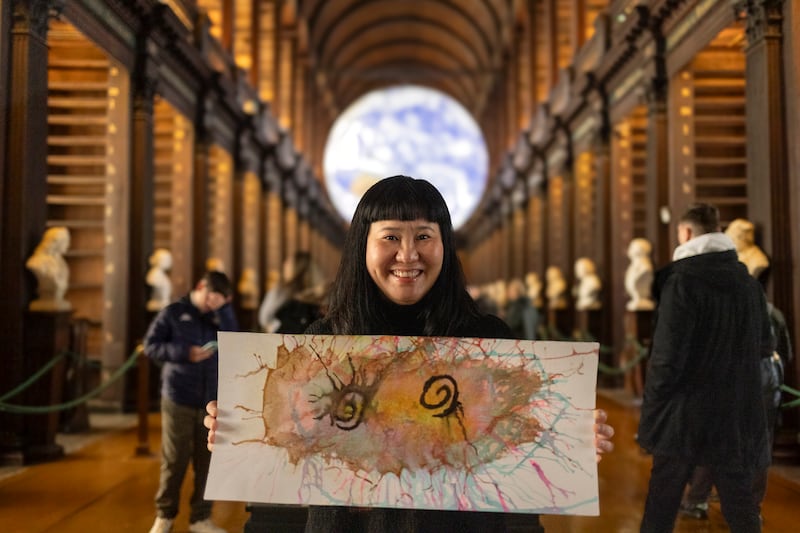 When she landed in Ireland last August, anGie seah wanted to ensure her fellowship year was as much about community engagement as brain health research and learning. Photograph: Chris Maddaloni/The Irish Times
In the early stages of her recovery she started with video work and making music in her apartment before regaining the confidence to return to public installations. She knew she was back on her feet when she accepted an artistic residency at the Cité Internationale des Arts, in Paris.
While there she undertook something of an artistic pilgrimage, walking in the footprints of some of her heroes, including Samuel Beckett, and producing a book of art, photography, and reflections called Staring at the Sun. Today, her base is a stone’s throw from the Samuel Beckett Theatre at Trinity College, after she was selected for an Atlantic Fellowship with the Global Brain Health Institute (GBHI), located on the college campus.
Both GBHI and the fellowships are funded by Atlantic Philanthropies, the foundation established by the late Irish-American entrepreneur Chuck Feeney that, over 37 years, invested more than $8 billion worldwide, with significant contributions to the education sector in Ireland as well as the Northern Irish peace process.
When she landed in Ireland last August, seah wanted to ensure her fellowship year was as much about community engagement as brain health research and learning.
While seah’s experiential workshops were in no way linked to the young people’s treatment plans, there is a growing body of evidence that demonstrates the important role art can play in all our health and wellbeing.
While seah is welcoming of the recognition of art’s contribution to health, she is wary of overly intellectualising the artistic process and experience.
“It’s a routine for me to draw, especially when I have a long day of using my head too much. When I finish, I feel like I have vomited a lot of stuff out of my head and I just feel better, you know.
“There’s too much rationale in thinking in the world – as human beings, we need to find that counterbalance. When you just dabble with ink or with colours, you can produce something that doesn’t need to make sense to anyone else. I saw that with the young people (at Linn Dara Schools) and the art they made. It contains their fingerprints and the many layers of who they are. It is about the process and entering a state of flow. Art allows you to get there.”
An exhibition of artworks and poetry created by the Linn Dara Schools’ students, called Meon (a word in Irish meaning mindset, attitude, character, or temperament) featured as part of GBHI’s Creative Brain Week, Unit18, Trinity in the Community, Macken Street, Dublin.