
Normally, the announcement of the Oak Park-River Forest Community Foundation’s newest round of community grant recipients would be fairly routine.
Every year, the Oak Park-based foundation gives out grants to organizations based in west suburban Cook County and Chicago’s West Side. This year, 16 organizations received a total of $270,000 to support mental and behavioral health services for youth and young adults, as well as to help youth enter mental health care fields and grow as professionals. Several recipients have received this grant before.
But 2025 was no ordinary year, and 2026 is poised to present challenges as well. Nonprofits found their federal funding threatened as President Donald Trump’s administration moved to reduce and eliminate funding for programs it claims fund Diversity, Equity and Inclusion initiatives, which it claims are discriminatory. Also, ramped-up immigration enforcement put additional stresses on the people the organizations serve.
The foundation was already rethinking its approach to grants, pivoting toward multi-year grants and holding conversations to get a sense of what works, what doesn’t, and what support the grantees need. The three nonprofit leaders who spoke to Pioneer Press praised the new approach, saying that it allows them to do more long term planning. Both sides said they intend to keep the communications open, and continue trying to improve the process.
Using the grants
Thrive Counseling Center in Oak Park provides individual group therapy, as well as psychiatric treatment, and it has a clinic for treating trauma. Executive director Jenny Rook said, as a state-licensed Community Mental Health Center, it is required to offer help to as many people as possible, so they accept Medicaid and offer sliding scale services for patients facing financial hardship. She said about half of their clients come from either Oak Park or River Forest; the rest come from elsewhere in Cook County.
Rook said they are using foundation funding to help support their therapists and pay interns. That includes students in its administrative internship program, which allows people, usually undergraduate students “who haven’t decided if they want to pursue a career in mental health” to get a sense of what working in a mental health center is like without doing the mental health care themselves.
Katie Bartholomew is the executive director at the Family Service and Mental Health Center of Cicero, which provides therapy to individuals, couples and families in Cicero and other nearby suburbs.
“We usually work with people dealing with a lot of depression and anxiety related to instances of trauma and life challenges,” she explained.
The center has been using the Foundation grants to pay its interns and offer professional development. Bartholomew praised the foundation as “tremendous partners.”
“They really understand the challenge of the nonprofit organizations and fund us in the way that’s helpful for us,” she said.
BUILD Chicago, which stands for Broader Urban Involvement and Leadership Development, is based in the city’s Austin neighborhood and offers career development programs, academic supports, sports and arts programs and mental health support services. CEO Bradly Johnson said the Foundation grant is funding continuing education for BUILD staff, including help with tuition, books, fees, and “anything that’s a barrier to them for degree completion.”
This, he explained, touches on something that West Side healthcare providers have repeatedly said over the years: There isn’t much effort to encourage Black and Hispanic youth to get into healthcare fields and support them in their careers.
“There’s not too much out there,” Johnson said. “There’s a lot of talk about having culturally relevant people who match the neighborhoods, match the background of the people that we serve, but not a lot of resources to support that pipeline.”
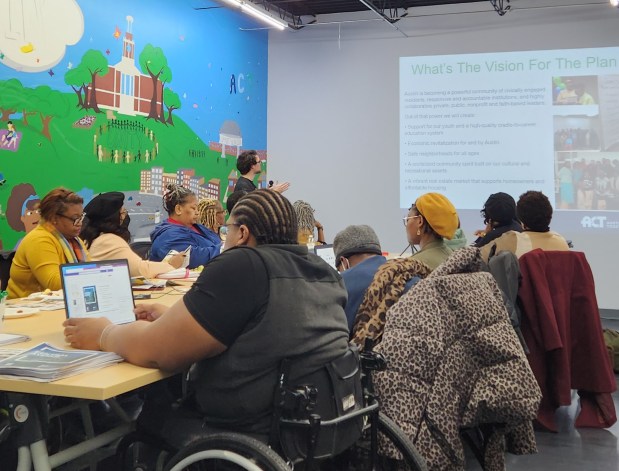 Community groups take part in an Austin Forward Together planning session, which includes efforts by grant recipients BUILD Chicago to improve mental health and public safety resources in the area, especially for teens. (Austin Coming Together)
Trump administration challenges
The second Trump administration policies affect nonprofits in two major ways. Its “anti-DEI” push led to attempts to pull funding, and attached new conditions to long-running grants. Both Bartholomew and Rook said their organizations saw the federal funds withdrawn and restored by court order. Since then, they’ve been trying to shift to other sources.
“To be honest, we would not be applying for federal grants right now,” Rook said. “It’s coming with a lot of strings attached.”
She added that Thrive believes that many of those requirements “would be harmful for our clients.”
“It’s so sad – we’d look at a grant that would be a great fit, and we can’t apply under this administration,” Rook said.
Johnson said there are grants he is sure BUILD won’t get. But the bigger concern is how other policies, such as the “One Big Beautiful Bill” act’s reduction in Medicaid edibility, will affect the people his organization serves.
“That’s going to drive up the need for the services that we offer — there’s going to be a lot of folks whose services are going to be cut or lost,” Johnson said. “That’s going to increase the workload for our team.”
There is also heightened immigration enforcement, which hit Cicero and Berwyn particularly hard and hasn’t spared Oak Park or River Forest. While Austin is still a majority-Black neighborhood, its Hispanic population has been steadily growing over the past 15 years, and the community has seen ICE raids.
Johnson said BUILD serves as a significant portion of the West and Northwest sides of Chicago, which includes majority-Hispanic Humboldt Park, Belmont-Cragin and Hermosa neighborhoods. He said BUILD has been part of the West Side rapid response networks.
“We also deliver food to our members who are frightened, terrified of going out to get groceries,” Johnson said.
All three nonprofit leaders said the heightened enforcement created a climate of fear for all immigrants. As the Chicago Tribune reported, the majority of the detainees have not been convicted of any criminal offenses, and immigrants with legal status and even U.S. citizens got caught up in the sweep. There are also mixed-status households where, for example, a mother and the kids might be U.S. citizens, and the father might be undocumented.
“We just see people really struggling with increased anxiety, depression and fear,” Bartholomew said.
She said many clients are worried about loved ones getting swept up in the raids. Children they work with worry about their parents.
Bartholomew said her organization had noticed the shift since the so-called Operation Midway Blitz. Before then, “we were seeing a lot of demand for in-person services.” But, since then, requests for virtual appointments have surged.”
“I think people are just really terrified and scared to see their homes, to seek help outside the house,” Bartholomew said.
She said they already had pivoted to teletherapy during the pandemic, and the infrastructure was still in place.
“It’s not ideal, and we’d like to see people in person, but it’s better than not to see them at all,” Bartholomew said.
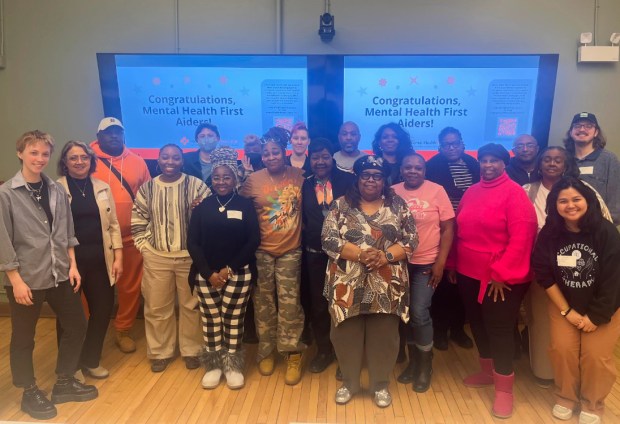 Austin Coming Together coalition and Rincon Family Services teamed up to offer Mental Health First Aid training course for staff and partners, including Oak Park-River Forest Community Foundation grant recipients BUILD Chicago. (Austin Coming Together)
OPRF’s Foundation approach
Carrie Summy, president and CEO of the Oak Park-River Forest Community Foundation, said they have already been rethinking their approach to grants, working with community members and nonprofits “to develop a new approach to our Community Grants program that supports our nonprofit sector in a way that best suits the needs of today.”
The foundation staff and board members visited every grantee and talked to their staff about what was working, what wasn’t, and what their goals were for the near future. They found that some grantees hesitated to commit money and resources if they weren’t sure they would get the funding again next year. Summy said they realized talking to grantees who already received funding about what was working, what wasn’t, and where they could use help, was more productive than asking them to reapply as if they were starting from scratch.
As a result, the foundation has been giving multi-year grants and simplified the application process. And, broadly speaking, they want the application process to be based on mutual communications and treating the grantees as equal parties.
“The grantee leaders in our area are phenomenal people,” Summy said. “They and their staff deserve respect for their work, and they deserve our time and our genuine care and listening that comes from individualized attention and conversations.”
Rook said that, for nonprofit organizations like hers, application for grants consumes time, money and resources they would rather put into their services
“What we really appreciate about the Foundation’s support right now, is they’re making it really simple for (organizations) to apply for their funding,” she said.
Johnson offered similar praise.
“I think the OPRF Foundation, they genuinely want to see the region thrive, and I appreciate that spirit, their continuing support, and hope that it continues,” he said. “But I also understand that they have limited, finite resources.”
Johnson described the funding as the long-term investment in their clients, and their communities’, future.
“People often use the saying ‘hurt people hurt people.’ But I also say that there’s a flip side — healed people heal people,” he reflected. “So, I’m grateful for the foundation supporting healing the community.”
Igor Studenkov is a freelance reporter for Pioneer Press.