
image:
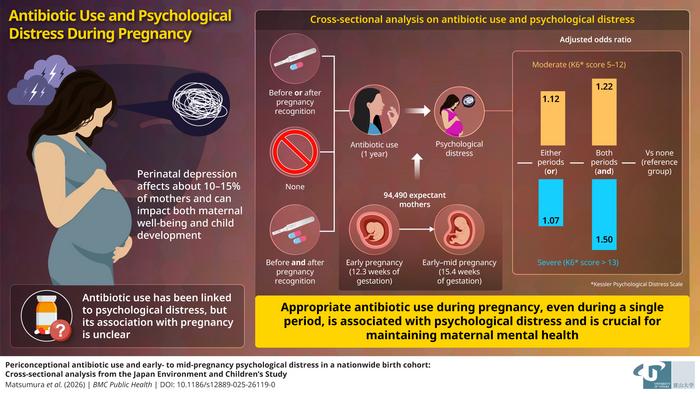
Analysis of 94,490 pregnant women enrolled in the Japan Environment and Children’s Study shows that antibiotic use before and during pregnancy was associated with a higher likelihood of psychological distress during early- to mid-pregnancy.
Credit: Prof. Kenta Matsumura from the University of Toyama, Japan
Perinatal depression, which occurs during pregnancy or in the period after childbirth, is one of the most common mental health conditions experienced by women. The condition affects the well-being of the mother during both pregnancy and after childbirth, as well as the development of the child.
Multiple factors influence maternal mental health and recently, emerging evidence suggests an association between antibiotic use and maternal mental health. The study published in Volume 26 of the journal BMC Public Health on January 10, 2026, was conducted by Collaborative Researcher Kenta Matsumura, formerly a Junior Associate Professor at the Department of Public Health, University of Toyama, Japan, and currently a Professor at Aomori University of Health and Welfare, Japan, along with Dr. Hidekuni Inadera at the Toyama Unit Center of the Japan Environment and Children’s Study (JECS), University of Toyama.
“While there are situations in which antibiotics are essential, the emergence of antibiotic-resistant bacteria due to the inappropriate use of antibiotics has become a significant concern. We wanted to understand how antibiotic use is associated with psychological distress among pregnant women,” shares Prof. Matsumura, as the inspiration behind the study.
To examine the relation between antibiotic use and psychological distress, the researchers analyzed data from 94,490 pregnant women enrolled in JECS, an ongoing nationwide birth cohort study designed to investigate how environmental factors are associated with children’s health and development. Most women enrolled in the study were at around 12 weeks of pregnancy, and follow-up assessments were conducted when they were about 15 weeks pregnant.
Information on the participant’s antibiotic use was collected for the year before early pregnancy. This period covered two stages: from before conception until pregnancy recognition, and from pregnancy recognition until enrollment in the study. Participants were then categorized into three groups: those who did not use antibiotics, those who used antibiotics during either one of the two periods, and those who used antibiotics during both periods.
The researchers evaluated participants’ psychological distress using the Japanese version of the Kessler Psychological Distress Scale (K6), a six-item self-reported questionnaire in which participants answer six questions about their mental state.
The researchers then used the group that did not take antibiotics as the reference group to estimate the association between antibiotic use and psychological distress in the other two groups. They calculated adjusted odds ratio, a statistical measure used to estimate the strength of an association between two variables, in this case, antibiotic use and psychological distress.
“We found that antibiotic use before and during pregnancy was associated with psychological distress in early- to mid-pregnancy, and that this association showed a stepwise pattern in a nationwide dataset of approximately 94,000 participants,” says Prof. Matsumura.
After accounting for potential factors that could influence both antibiotic use and psychological distress, such as maternal age, pre-pregnancy body mass index, education level, income, smoking status, alcohol use, marital status, and psychiatric history, the analysis showed that compared with no antibiotic use, the adjusted odds ratios for moderate psychological distress (K6 score of 5 to 12) were 1.12 for use during either period and 1.22 for use during both periods. For severe psychological distress (K6 score greater than 13), the adjusted odds ratios were 1.07 and 1.50, respectively.
The higher odds ratios observed with greater antibiotic exposure suggest that the likelihood of psychological distress during early- to mid-pregnancy was higher among participants who reported antibiotic use during more periods.
One possible explanation for these findings involves the gut microbiota, which can be altered by antibiotics. Changes in gut microbiota have been observed in various conditions, including obesity, diabetes, and inflammation, and such changes have also been examined in relation to psychiatric conditions.
The researchers emphasize that these findings do not suggest avoiding antibiotics when they are medically necessary. Instead, the findings may contribute to ongoing discussions about appropriate antibiotic use and efforts to reduce unnecessary prescriptions.
“This study may encourage women who are planning pregnancy or in early pregnancy to become more aware of the appropriate use of antibiotics. Antibiotics are essential when medically necessary; however, increasing awareness about avoiding unnecessary prescriptions—such as for common colds—may also be relevant from a maternal mental health perspective,” concludes Prof. Matsumura.
***
Reference
DOI: 10.1186/s12889-025-26119-0
About University of Toyama, Japan
University of Toyama is a leading national university located in Toyama Prefecture, Japan, with campuses in Toyama City and Takaoka City. Formed in 2005 through the integration of three former national institutions, the university brings together a broad spectrum of disciplines across its 9 undergraduate schools, 8 graduate schools, and a range of specialized institutes. With more than 9,000 students, including a growing international cohort, the university is dedicated to high-quality education, cutting-edge research, and meaningful social contribution. Guided by the mission to cultivate individuals with creativity, ethical awareness, and a strong sense of purpose, the University of Toyama fosters learning that integrates the humanities, social sciences, natural sciences, and life sciences. The university emphasizes a global standard of education while remaining deeply engaged with the local community. The university also serves as a Regional Center for the Japan Environment and Children’s Study (JECS), contributing to large-scale national research on children’s health and development.
Website: https://www.u-toyama.ac.jp/en/
About Professor Kenta Matsumura from the University of Toyama, Japan
Dr. Kenta Matsumura received his M.A. and Ph.D. degrees in Human Sciences from Hokkaido University in 2004 and 2007, respectively. He joined the University of Toyama in 2018 as a Junior Assistant Professor. He is currently a Professor at Aomori University of Health and Welfare. Dr. Matsumura specializes in epidemiology, public health, mental health, nutritional psychiatry, and biological psychology and has published over 140 papers on these topics.
Funding information
The JECS was funded by the Ministry of the Environment, Japan.
Journal
BMC Public Health
Method of Research
Observational study
Subject of Research
People
Article Title
Periconceptional antibiotic use and early- to mid-pregnancy psychological distress in a nationwide birth cohort: cross-sectional analysis from the Japan Environment and Children’s Study
Article Publication Date
10-Jan-2026
COI Statement
The authors declare no competing interests.