
Trigger warning: This story contains mentions of suicide. If you or someone you know is experiencing a mental health crisis, suicidal thoughts or emotional distress, call, text or chat 988.
Takeaways
Missouri legislation is seeking to add a 65-cent monthly charge on phone bills in order to create a source of stable funding for 988 services.
Having a state source of funding would allow for growth, particularly in rural areas, of Missouri’s behavioral health crisis centers and other mental health services.
A bleak road to passage, a potential income tax elimination and continued workforce development issues remain as challenges for the bills.
It was nearly 3 a.m.
Lauren Ross awoke to spiking anxiety, the result of stress from the holidays, work and the general state of affairs in the world finally catching up to her.
Ross went through her usual coping mechanisms that she had learned in therapy to try calming down. None worked.
So, she texted the 988 Suicide and Crisis Lifeline.
The trained crisis counselor on the other end first asked if she had thoughts of hurting herself or others and made sure she was in a safe place. After confirming Ross wasn’t in immediate danger, the counselor talked with her for the next half hour about why she felt anxious and asked if there was anything she enjoyed doing to help her get through that moment.
For Ross, that outlet is mental health coloring books. She flipped through the pages before landing on one she had been skipping before. It had the words “You Matter” on it.
After coloring in those words, she felt calm enough to take a hot shower and eventually fall back to sleep.
Without that conversation, Ross likely would have gone to the hospital for care instead. Having the 988 lifeline available meant Ross knew she wasn’t alone at that moment.
“I knew that there was someone on the other end of the phone that cared and was willing to help me through what I was going through,” Ross said. “To help me get to the right people that could help me, or just help me get through that moment and then continue on.”
Since the official designation of 988 as the lifeline number in 2020 and its launch in November 2022, the number of 988 calls across the country has risen from about 3 million to more than 7 million calls in 2025.
However, funding for the service was uncertain after a leaked budget draft from the U.S. Department of Health and Human Services proposed cuts to the lifeline. While the official budget proposal maintained funding at $520 million for fiscal year 2026, the proposed cuts raised questions about the long-term stability of funding for the service and what role individual states should play.
In search of stable funding
People had long been able to call a 10-digit number to access a national suicide line. But the National Hotline Designation Act in 2020 simplified it to 988 in an effort to reach more people and make it easier to access.
Suicide is the 11th leading cause of death in the nation, with 1,143 Missourians dying by suicide in 2023.
Missouri had been making significant investments in its behavioral health crisis networks in recent years even before the federal law was passed with the expansion of its mobile crisis response units and behavioral health crisis centers. Now, they work in tandem with 988 call centers.
Another facet of the 2020 law was that it also authorized states to pass a telecommunications fee to fund the 988 lifeline in a similar manner to 911. Only 11 states and the Virgin Islands have done so.
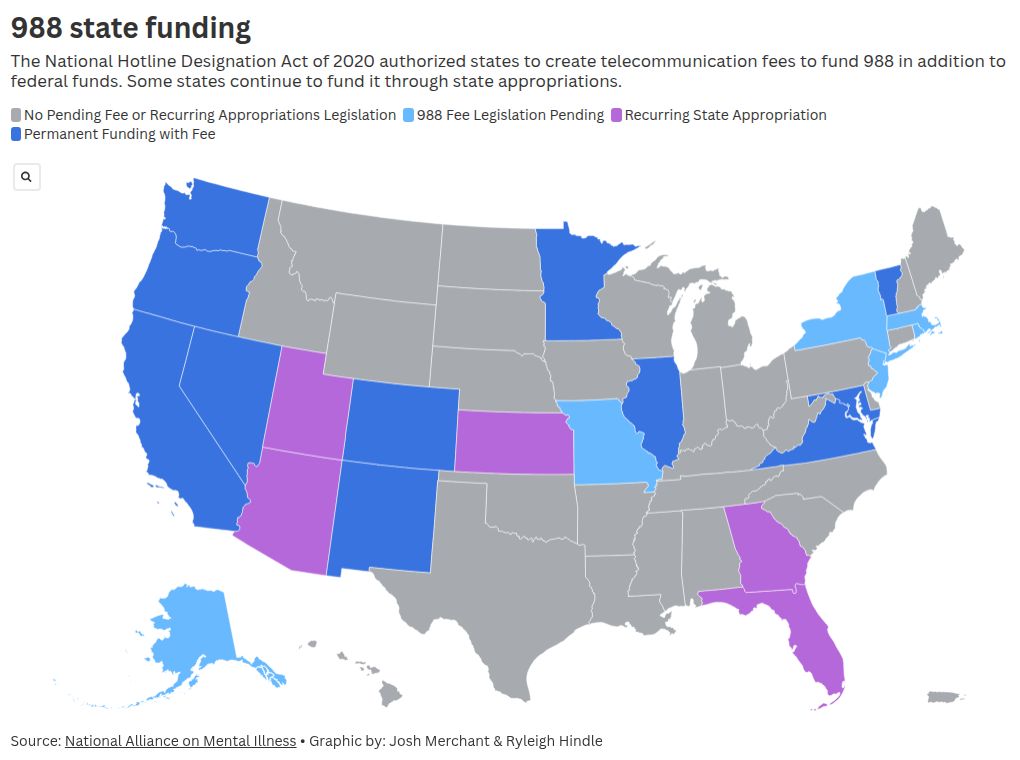
While Missouri did not immediately opt for a telecom fee, it instead funds 988 with money from general revenue. For the 2027 fiscal year, the Missouri House of Representatives proposed more than $18.5 million for 988 and more than $22.3 million for associated crisis services from general revenue primarily.
However, the funding still needs to be reappropriated every year, meaning the threat that it isn’t renewed persists while the state continues to grapple with a budget crunch.
Jonathan Purtle, an associate professor of public health policy and management at New York University, specializes in mental health research and has been examining how state financing for 988 affects mental health outcomes.
Purtle’s research so far has found that states with telecom fees budget on average twice the amount of money for suicide prevention and crisis services than states without such fees. More importantly, a telecom fee represents a stable source of funding.
“It’s a bunch of money which really helps them address needs,” Purtle said. “It’s less sensitive to political turmoil. It is less sensitive to economic downturns when funding gets tight, and it’s also a flexible funding source. They have a good bit of wiggle room in terms of how they can spend that money to best enhance 988 capacity and crisis system capacity.”
Several bills to create a 65 cent telecom charge on the monthly cellphone bills of Missouri residents were introduced in both the Missouri House and Senate this legislative session.
The charge would fund 988, which is and would remain free. And the legislation would allow for appropriations, gifts, grants and donations to also be placed in a “988 Crisis Continuum Fund.”
Ross, who is the public policy and advocacy chair for the American Foundation for Suicide Prevention, has been advocating for the bills. Having a state fund ensures that the components that make up the service have the support they need, she said.
“Each state still needs to have a fund for it so that each state can have the call centers, the resources that are needed to support 988, even if the line itself is funded federally,” Ross said.
Brent McGinty is the CEO of the Missouri Behavioral Health Council, which works with the Missouri Department of Mental Health and behavioral health organizations to provide services, advocate and educate people on behavioral health.
He echoed those sentiments, saying that having a source of state funding would allow for expansion into areas without crisis centers or in areas where the centers are underfunded.
“The biggest thing that that would allow us to do is not only protect and continue what we’re doing now, but it would provide us a little bit of growth,” McGinty said. “In those few geographic areas in rural Missouri, it would be really nice if we could get some additional crisis center funding to go to those rural areas.”
However, none of the bills have been heard since January.
Challenges moving forward
Ross hasn’t given up hope that the bills might still progress, but she plans to continue educating people on what 988 is and what it does in the meantime.
“There are people struggling that we don’t even know that a simple (988) pin sitting on a counter somewhere could be the difference in them being here tomorrow or not,” Ross said.
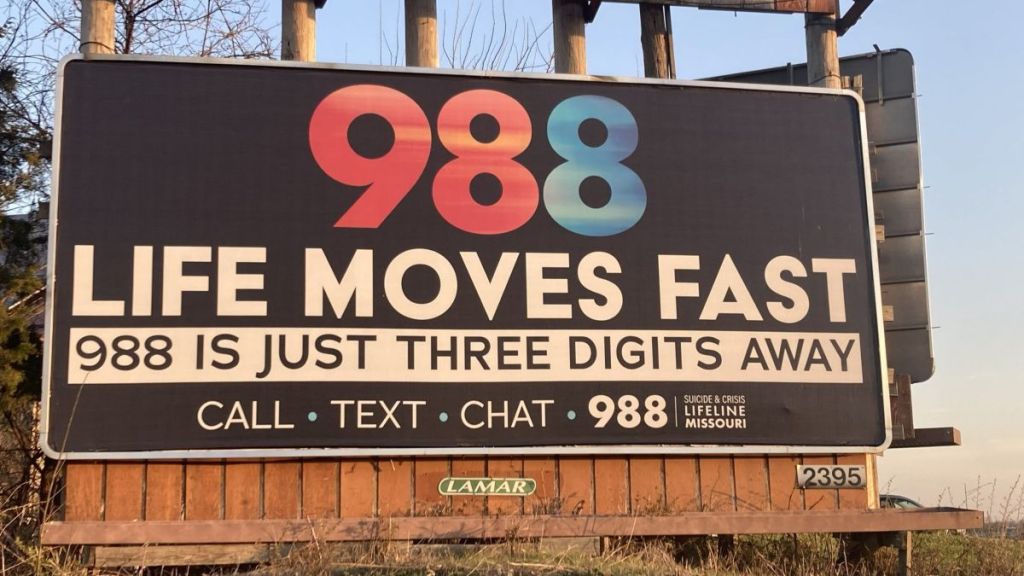 A billboard advertising 988 alongside Highway 63 near the Ashland, Missouri, exit. (Ryleigh Hindle/The Beacon)
The bills or similar legislation will likely be filed again next year, but the conversation could change drastically if a proposal that would gradually eliminate the state’s income tax and grant the General Assembly the power to create new sales taxes on goods and services is placed on the ballot and passed in November.
“We could look at a bunch of different things to make it more palatable, whether that may be adopting the fund this year and then working with our legislative partners next year,” McGinty said. “If the income tax legislation passes the vote of the people, at that point, the game changes, because we’ve got to do something.”
Creating a state fund sustained by telecom fees doesn’t mean it’s the end of the story either. Even in states that have authorized telecom fees, barriers remain when it comes to training and retaining the workforce necessary to staff 988 services.
“You can’t just throw money at something to fix it,” Purtle said. “There’s still all these complexities … like being able to hire and pay quality staff a pretty decent wage. It’s really hard work. It’s tough hours. It can be emotionally exhausting work. It’s high-stakes work.”
That’s where officials are hoping the Rural Health Transformation Fund can help span some of the gaps.
Missouri is set to receive $216 million during the 2026 fiscal year, with some of the funds going toward workforce development initiatives.
“As proud as I am of what we’ve done in this state, we know there’s more to do,” McGinty said.
“But we really do hope that with Rural Health Transformation, we can help find some pipeline things and do some things to grow our own workforce. And if we can get that workforce right, then we can really get going on things.”
With the Rural Health Transformation funds still being implemented, for now, Ross plans to continue advocating for the long-term survival of 988 services so that it can help others like her.
“Just knowing that there is a resource out there that can help people who are going through a crisis, that can can get them through that moment and get them the help that they need…,” Ross said. “We all deserve to be here. We all deserve everything that comes our way. It would mean so much to know that the help is still there.”
Related
Type of Story: News
Based on facts, either observed and verified firsthand by the reporter, or reported and verified from knowledgeable sources.