
For Susan Kane, a former participant of ACC Senior Services’ PEARLS program, mental health is especially important to her as an older adult.
“As an elder, my mental health is more important to me than it ever was before. I want to be as positive and as productive as I possibly can be. If my thinking is not good, the rest of me is not good,” Kane said about her experience as reported by ABC 10 in 2024.
PEARLS, which stands for the Program to Encourage Active, Rewarding Lives, was first implemented by Sacramento nonprofit ACC Senior Services in July 2023, though its first participants weren’t enrolled until November 2023. The program is free and consists of one-on-one life coaching that helps older adults improve their quality of life.
For PEARLS in California funded through the Older Adults Grant from the Mental Health Services Oversight and Accountability Commission (MHSOAC), the program’s funding is set to end in June.
PEARLS was originally developed and facilitated by the University of Washington in the early 2000s. The university conducted a study from 2000 to 2003 to test the program’s effectiveness in treating depression.
It found that participants with clinically significant depressive symptoms were more likely to experience a 50% or more decrease of those symptoms on average after participating in PEARLS.
Soojin Yoo, program manager of ACC’s PEARLS, has been working with the nonprofit since 2012. She said that in spring 2023, ACC Senior Services was able to implement the program through the grant funding from MHSOAC to offer more mental health services to older adults.
“We haven’t had any direct intervention to address the mental health needs of the seniors [at the time],” Yoo said. “So when we learned about this opportunity and what PEARLS can do, we were very happy to join the partnership.”
She said that the program in Sacramento started as a collaboration with four other agencies, which include Agency on Aging Area 4, Resources for Independent Living, Society for the Blind and El Hogar Community Services. It is funded by the California MHSOAC, and AAA4 led the original application for the partnership.
Yoo said that ACC is a part of the Aging and Disability Resource Connection, a California “No Wrong Door” (NWD) network of organizations that work to provide easier access to services across various delivery systems for older adults, individuals with disabilities and family care providers.
“The funding opportunity … [was] a very valuable added tool for us to support the seniors for their healthy aging, especially addressing the symptoms of depression and social isolation among the seniors we get to see quite often,” Yoo said.
The program includes six to eight one-on-one coaching sessions, which can be done at home, remotely, or in a community setting, over five to six months.
During these sessions, a trained care coordinator helps manage the challenges of daily life by setting achievable goals for older adults to improve their social interactions, motivation and sense of purpose. This is followed up with monthly check-up calls up to four months after.
According to Yoo, any adult aged 60 and over with depressive symptoms or social isolation qualifies. Applicants do not have to have a mental health diagnosis to qualify.
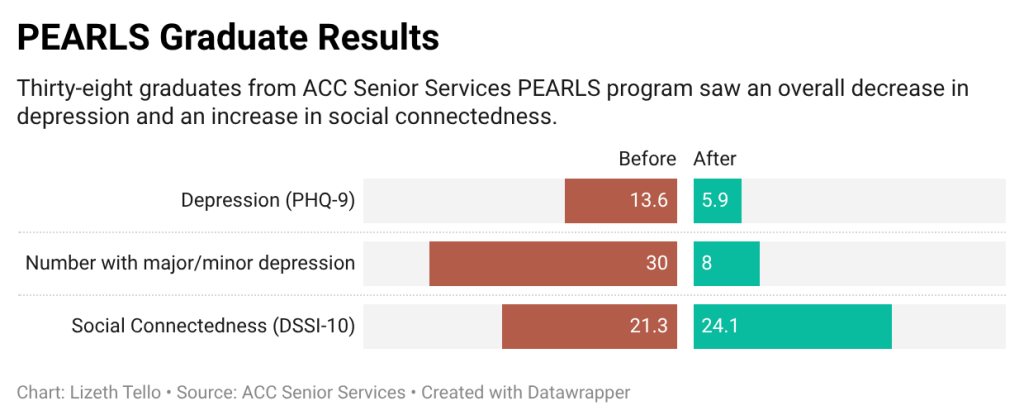
Yoo said that recruiting is done through a referral system, resulting in 176 referrals between November 2023 and October 2025. In that same time period, out of 77 PEARLS participants, 38 graduated with improved mental health.
Yoo said that some changes she noticed from participants included reconnecting with friends, incorporating more physical activity in their daily routines and overall higher engagement in social activities around senior centers and libraries.
“We really did a lot of outreach with senior living communities … to spread the word about the program,” Yoo said.
For former PEARLS participant Connie Craft, she said the program gave her someone to talk to. In an ACC testimonial video, she said she signed up for the program after being approached by a PEARLS recruiter.
“It made me feel a lot better and to get out,” Craft said in the testimonial video. “It was nice to have someone to come and walk and just spend a few hours with.”
Her coach was PEARLS care coordinator Macy Quan, who helped Craft set goals to let go of things she no longer needed both physically and emotionally. Quan also commented about how there’s a lot of stigma surrounding mental health in society.
Mental health within the AAPI community
In a 2019 study from the American Association for Community Psychiatry on the prevalence of stigmatizing beliefs associated with depression among Asian Americans, it was found that 37.1% of participants viewed depression as a sign of personal weakness, 18.9% said they would be disappointed in a family member with depression and 8.8% believed having a relative with depression would bring shame to the whole family.
According to ACC Senior Services Director of Marketing and Fund Development Scott Okamoto, in July 2025, about 50% of adults receiving elder care from ACC Senior Services identified as Asian descent. In Sacramento County, a little over 21% of the population identifies as AAPI.
Oanh L. Meyer is a social psychologist and a faculty member at the UC Davis Department of Neurology who has been studying AAPI mental health for about 25 years. She said that within the community, social isolation and depression is prevalent, citing a lack of transportation as a major factor.
“A lot of older AAPI [adults] don’t drive, and so they’re socially isolated that way,” Meyer said.
She also said that a lack of in-language services exacerbates the issue, since a majority of community members are immigrants whose first language might not be English. For this reason, she said it is hard to know the actual rates of depression within the AAPI community.
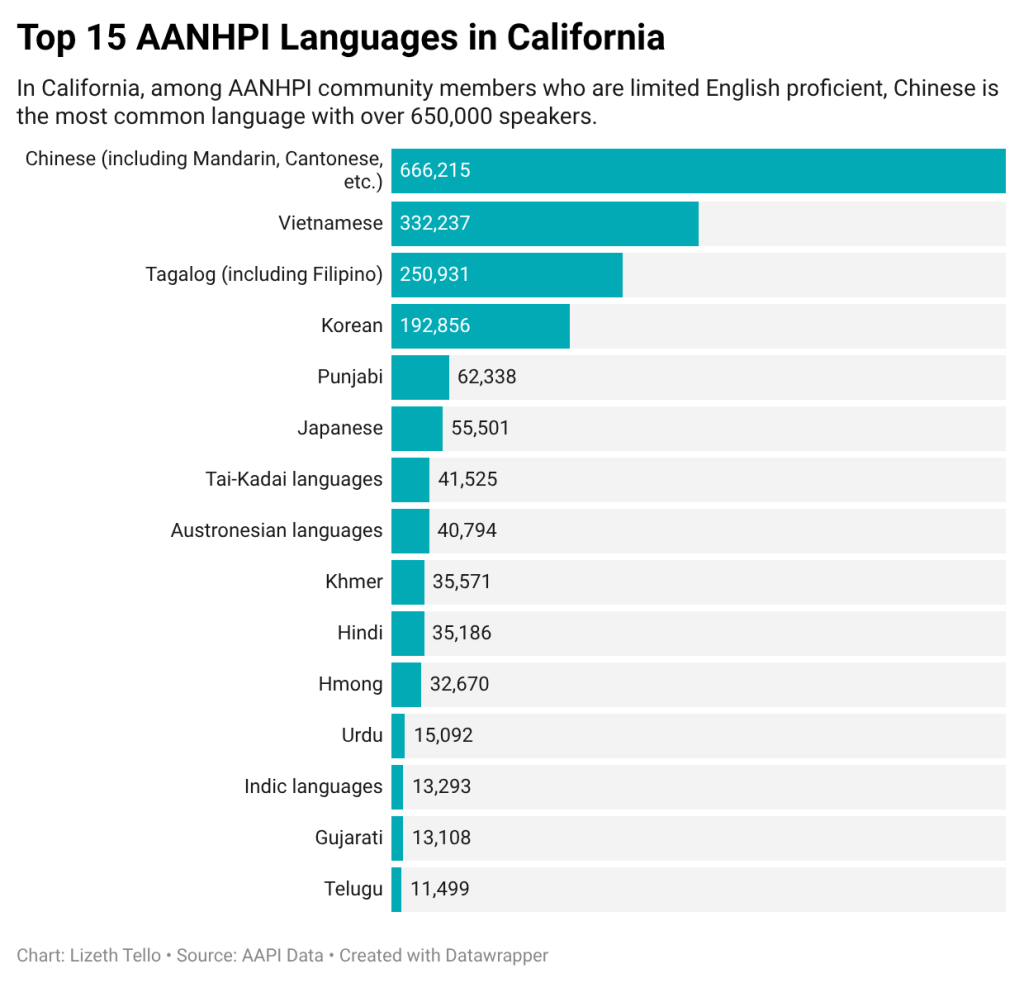
“A lot of the cognitive tests that we give to older Asian Americans may not be in language,” Meyer said. “So we just don’t know, necessarily — for people who don’t speak English — what the true prevalence is.”
ACC’s PEARLS works to make mental health care more accessible by having care coordinators meet clients where they are most comfortable. The program offers services in various languages, including Cantonese, Mandarin, Tagalog, Hmong and Korean.
Yoo said that ACC is looking into ways to secure more funding to allow the program to remain open after its end of June funding cut-off date.
This story is part of the Solving Sacramento journalism collaborative. Our partners include California Groundbreakers, CapRadio, Capitol Weekly, Hmong Daily News, Russian America Media, Sacramento Business Journal, Sacramento News & Review and Sacramento Observer. Support stories like these here, and sign up for our monthly newsletter.