
Is your headache really a brain tumor? Is your friend’s delayed text a sign of rejection?
Negative thoughts like these can be symptoms of “interpretation bias,” a tendency to jump to the worst conclusions about ambiguous situations. Over time, they contribute to anxiety and depression and can shape mood, behavior, and overall health.
A new smartphone app developed at Belmont’s McLean Hospital can target those thoughts, improving users’ mental habits over four weeks, according to the results of a clinical trial published Thursday.
“The point of the app is to make people aware and learn how to open up to other types of interpretations to make them less anxious and worried all the time,” said Dr. Courtney Beard, senior author of the study and director of the Cognition and Affect Research Education (CARE) Laboratory at McLean Hospital, which is part of Mass General Brigham. “What we wanted to do was intervene directly on that habit of thinking.”
The app, called HabitWorks, includes weekly mood check-ins, short mental exercises, and a habit diary for tracking symptoms. It presents users with brief, personalized scenarios like this one:
“Someone mentions your fly is unzipped.”
Users then select one of three reactions to the comment: “humiliating,” “common,” or “thankful.”
The more positive the interpretation, the more points users score.
HabitWorks is not yet publicly available and has a waitlist. Beard hopes it will be available before the end of the year.
She added HabitWorks is not an app for people turn to when they’re in distress, but rather something to set aside a scheduled time for.
“Some apps are designed to help you in the moment and change how you’re feeling,” she said. “This one is designed to reshape underlying thinking habits—core cognitive processes we’ve studied for years.”
She added that users are better able to reflect when they’re not overwhelmed. Instead, the app works like a quick practice session, guiding users through 50 short, game-like scenarios in five minutes.
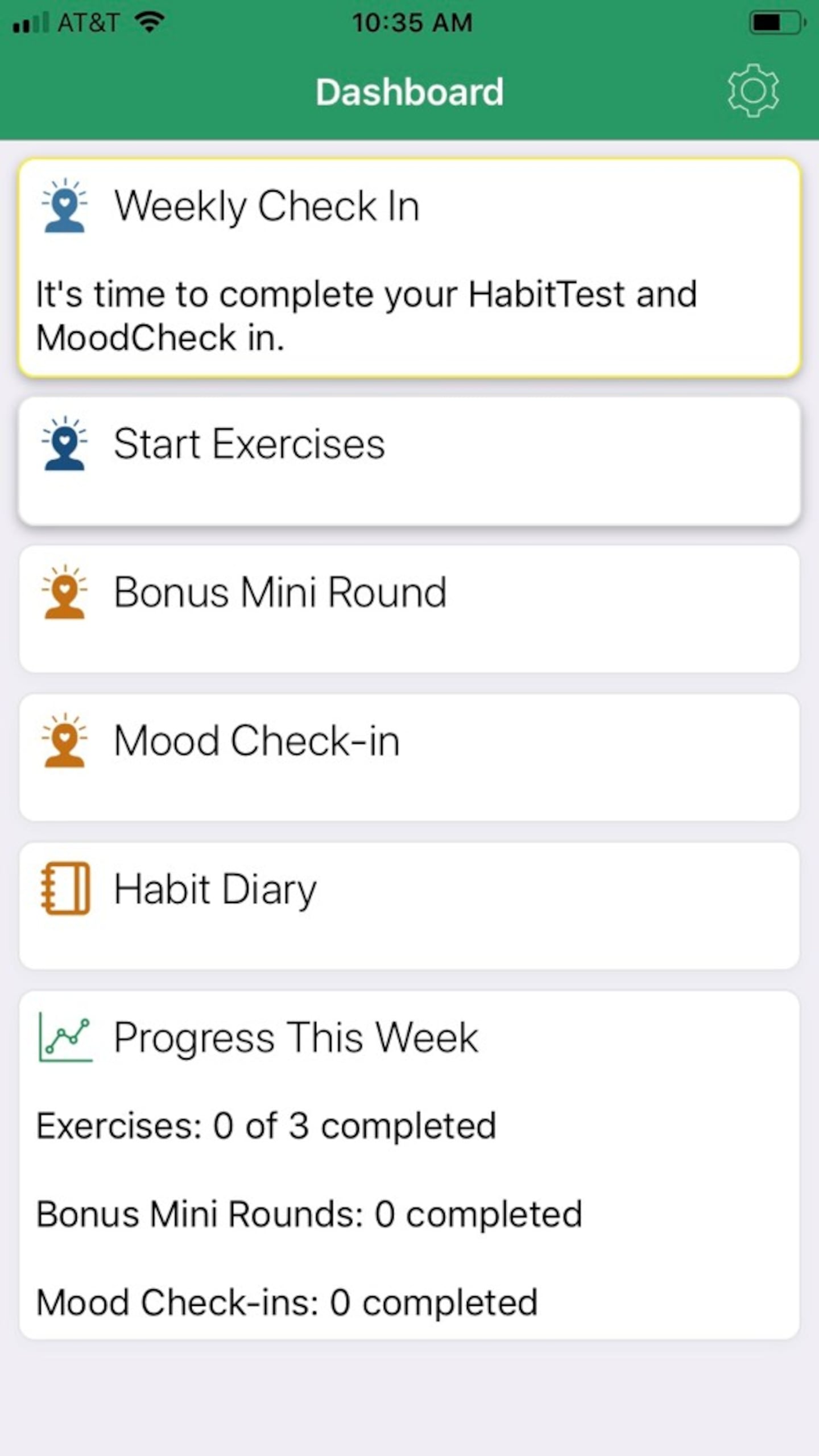 A screenshot from the HabitWorks app. HabitWorks
The approach appears to be working.
The study enrolled 340 adults across 44 states last year, randomly assigning participants to either use HabitWorks for four weeks or to a control group that completed self-assessment surveys tracking symptoms of anxiety and depression. Afterward, both groups were given self-report questionnaires to measure the effectiveness. By the end of the trial, those using the app showed “greater improvements in overall symptom severity and daily functioning,” according to the study.
While many mental health apps see steep drop-off rates after initial download, 77 percent of HabitWorks users were still actively using the app at week four, and 84 percent completed the final assessment.
Beard developed the app alongside another clinical psychologist who designed it based on how people use their phones.
“Unlike other apps that teach mindfulness, this is a different skill. This targets situations like your boss saying ‘meet me in my office in 10 minutes.’ We are teaching people through five-minute bursts to think more flexibly through therapeutic skills,” said Alexandra Silverman, the study’s lead author and a psychologist at McLean.
Researchers said the app was developed as access to mental health care remains strained, with long wait times for appointments and many providers not accepting insurance. The goal was not to replicate therapy or replace physicians, but to complement it, making treatment more accessible through technology, Beard said.
“There will never be enough providers for those who need treatment,” she said. “There are so many barriers to treatment pathways.”
The researchers said there’s no artificial intelligence involved in the app. An advisory board that included people with lived experience of anxiety and depression helped shape the app to be both evidence-based and user-friendly.
“Treatments only work if people actually use them,” said Lauren S. Hallion, a psychology professor at the University of Regina in Canada who was not involved in the study.
“The finding that participants used the app consistently, even when they weren’t being paid, suggests that the study team met that important goal.”
Because the study included people with a range of symptom severity, she added, the app may be especially useful for those who are generally doing well but want an extra mental health “boost.”
Hallion also pointed out that while app-based mental health tools aren’t new, ongoing research is helping improve what works. Studies like this one are key to refining approaches and making them more usable in real life.
“There is a lot of interest and investment in our field in finding the best ways to get mental health support to the people who need it,” she said. “This isn’t the first smartphone study, or even the first smartphone study to look at modifying interpretation bias. However, our technologies are getting better all the time, and we’re always learning more about what kind of interventions are helpful to people and why.”
Funding for the work came from a $700,000 multi-year grant from the National Institute of Mental Health.
Researchers caution that the app is still in the early stages of evaluation. They’re still looking for a sustainable funding source and said it’ll likely have a pay-to-use model.
“There are still things I want to know about it, who’s it going to work best for, in what situations, and why, but it’s ready to be released; we just need to identify sources of funding and keep it maintained,” said Beard.
Sarah Rahal can be reached at sarah.rahal@globe.com. Follow her on X @SarahRahal_ or Instagram @sarah.rahal.