
Greetings, MindSite News Readers.
In today’s Daily, the latest update on the Supreme Court’s decision to reject Colorado’s ban on conversion therapy aimed at LGBTQ+ youth. More on the growing gambling crisis among adolescents. Plus, Mosaic Memory Cafes in Detroit.
Despite Supreme Court Ruling, Conversion Therapists Can Still Be Sued
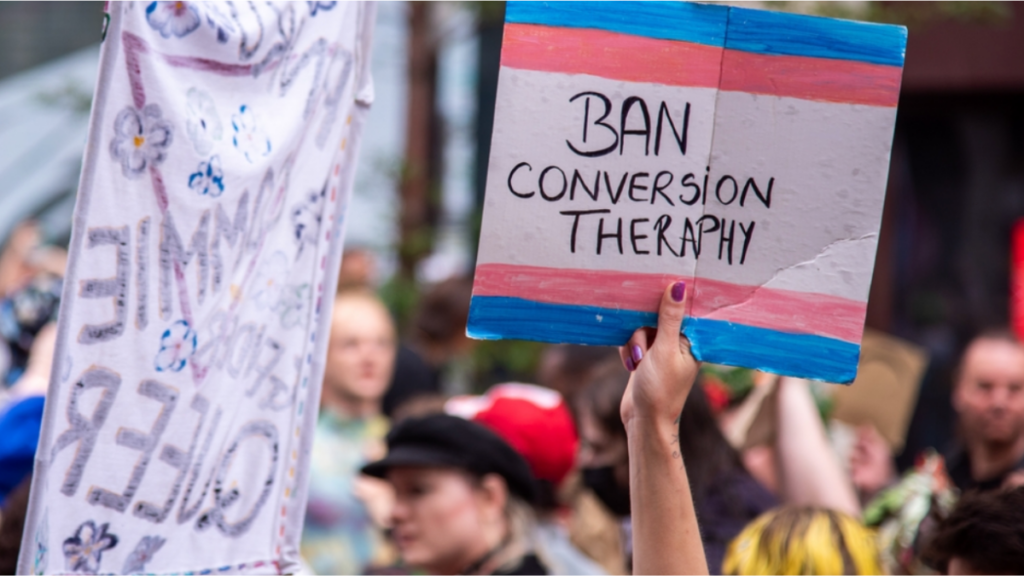 London, England, UK – July 8, 2023: London Trans+ Pride Protest. Credit: Loredana Sangiuliano/Shutterstock
SCOTUS dealt a blow to LGBTQ+ youth protections — but advocates say the fight isn’t over
In an 8-1 ruling in the case Chiles v. Salazar, the Supreme Court struck down Colorado’s ban on conversion therapy for minors, finding that the law regulated speech based on viewpoint. (The 19th had an excellent wrapup that we have republished.)
The case was brought by Christian counselor Kaley Chiles, who argued the ban violated her First Amendment rights to practice talk therapy aligned with her beliefs.
The ruling most directly impacts LGBTQ+ youth whose caregivers might seek out conversion therapy, despite a mountain of scientific evidence that the practice is ineffective and harmful, condemned by every major medical association, and deemed torture by the United Nations.
Conversion therapy attempts to change a person’s sexual orientation or gender identity, sometimes through severe methods that rise to abuse, including electric shock, masturbation reconditioning, starvation, chemically induced nausea, and hypnosis, among others.
Writing for the majority, Justice Neil Gorsuch said that free speech protections apply equally to thought and speech, and that Colorado’s law went beyond regulating public health — it censored speech.
Justice Ketanji Brown Jackson was the lone dissenter, warning that the majority “failed to appreciate the crucial context” of the case, namely that “Chiles is not speaking in the ether; she is providing therapy to minors as a licensed healthcare professional.”
She added that the court’s ruling misinterpreted its previous decisions and could impede the ability of states to regulate the practice of medicine for the good of public health.
Polly Crozier, GLAD Law Director of Family Advocacy suggested there may be a silver lining. Beyond Colorado, 23 states and Washington DC have similar laws, and the ruling against Colorado’s law doesn’t negate existing research, nor does it moot the dozens of other state bans against conversion therapy, Crozier said.
The decision “does not change the fact that conversion therapists who harm patients will still face legal consequences,” she said.
Indeed, survivors of the therapy will still be able to sue conversion therapists.
As Shannon Minter, legal director of the National Center for LGBTQ Rights, said, “I think the most important thing to understand about the decision today is that it only takes one way of regulating conversion therapy off the table…It does not mean that conversion therapy is safe or legal. Conversion therapy is still medical malpractice and consumer fraud…Survivors can still bring malpractice and consumer fraud claims.”
Still, the ruling strikes a blow against LGBTQ+ youth, advocates said.
“This decision directly exposes young people to harm by enabling damaging pseudo-science to proliferate,” Jona Tanguay, president of GLMA: Health Professionals Advancing LGBTQ+ Equality, said in a statement. “This dangerously erodes the scientific foundation of mental healthcare, and paves the way for bad actors to reframe debunked fringe personal beliefs as legitimate care. No young person should be at risk of serious psychological harm from the people licensed to provide help to them. Providers and health systems remain ethically bound to protect patients and uphold evidence-based standards of care.”
Problem Gambling Is Quietly Becoming an Adolescent Crisis
 Antonio Guillem/Shutterstock
Gambling nearly cost Saul Malek, 28, his life, he told students at University High School in Ohio. At just 21 years old, he was $25,000 in debt and contemplating suicide – a near-miss that followed years of problem gambling beginning with a $10 bet he made on a baseball game as a teenager.
Now he travels the country sharing his story in hopes of sparing the staggering number of adolescents who gamble each day from a similar — or worse — fate.
“The three big things are drugs, alcohol, and gambling, that parents might freak out about,” Henry Brown, a University School senior, told NBC News. “And I’d say gambling is probably the most common.”
As online sports betting, prediction markets, and crypto casinos proliferate online, so too has the gambling landscape expanded to host growing numbers of American youth.
A 2026 survey from Common Sense Media, a nonprofit dedicated to helping kids, parents, and educators navigate media and technology, found that one-third of boys age 11 to 17 reported gambling in the past year.
Kurt Freudenberg, now 23, was just 11 when he started trading video game upgrades for digital currency he could bet on online blackjack and roulette. “It felt like a high, an extreme rush,” he said. “I would play soccer and score a goal or get an A on a test — nothing compared to that high on gambling.”
By high school, he’d win — and then lose — as much as $5,000 a day. “Gambling was my best friend,” he said.
A good number of his classmates were pretty hooked by then too. But it wasn’t until college, when he began neglecting class and basic hygiene to bet 15 hours a day, that his parents even realized he had a problem.
“We thought he was gonna say it was drugs,” Kim Freudenberg, his mother, said. “But he said, ‘I’m gambling.’”
Part of the challenge in combatting gambling problems in youth is how integrated gambling has become within pop culture, experts told NBC. Gambling is woven into the fabric of sports culture, amplified by celebrity endorsements, and casually modeled by adults.
“I’ve had lots of conversations with dads who are openly gambling with their kids throughout an entire game,” said Jeffrey Reynolds, president and CEO of Family and Children’s Association, a mental health and addiction counseling center in New York.
The most popular apps, FanDuel and DraftKings, remain adamant about their zero tolerance policies for underage usage, and claim to actively monitor accounts for suspicious activity, reporting violators to state regulators.
However, youth say placing bets remains a cinch. Teens just borrow older people’s accounts or even register with their parents’ social security numbers — sometimes with parental permission.
Further complicating the landscape are apps like Fliff, billed as an online sweepstakes, and Kalshi, an online prediction market, neither of which are regulated as gambling companies.
The addiction follows a predictable but devastating arc, NBC notes, largely because young people, especially boys, believe what they know about sports will protect them from losing. So they ride the thrill of early wins, rationalize losses, turn to secrecy when debts begin to grow, and finally enter a full-blown crisis.
“When you talk about the lack of impulse control among adolescent boys,” Reynolds said, “and you combine it with this notion that, ‘Hey, I know a little bit about sports, and I can outsmart the sportsbooks’ — you have a disaster.”
The mental health stakes are severe and underreported. A 2019 state survey of Minnesota middle and high school students found that those experiencing problem gambling were far more likely to have attempted suicide, while a 2025 study found the risk of suicide to increase when gambling addicts are in their 20s.
And yet a 2024 study reports that over a lifetime, about one in eight people with gambling problems will attempt suicide. Treatment centers that once served middle-aged casino regulars are now seeing teenagers.
“In the past few years, it’s just gotten really young,” said Elizabeth Thielen of Nicasa Behavioral Health Services in Illinois. “I had one parent who called whose child went through almost their entire college fund.”
In other news…
Dozens of dedicated youth mental health beds open in Michigan: Michigan’s mental health care system has previously been criticized for its lack of sufficient services to provide psychiatric care to its thousands of residents in need, with state lawmakers concluding last year that the behavioral health landscape is “horribly underserved,” following conversations with mental health experts, advocates, impacted families, and law enforcement. But this quarter brings good news, Bridge Michigan reports.
Though there’s still a large gap to fill, several new projects will add more than 200 long- and short-term mental health beds across the state. The 66 inpatient beds at Pediatric Center of Behavioral Health within Pine Rest Christian Mental Health Services in Grand Rapids will become the state’s first pediatric psychiatric urgent care center. Built with $50 million in state support, the facility opened admissions last month, supporting children and adolescents in specialized assessment and treatment for eating and neurological disorders, among other conditions.
“Behavioral health challenges among children and teens have increased dramatically in recent years, and families across Michigan are struggling to find timely access to care,” said Mark Eastburg, president and CEO of Pine Rest, in a statement. He said the pediatric center in Grand Rapids is a “significant step forward in addressing that need.”
Later this fall, a $383 million state-funded project is expected to conclude in Northville Township, replacing Hawthorn Center and Walter Reuther Psychiatric Hospital — while also adding 54 new psychiatric beds to serve adults and youth.
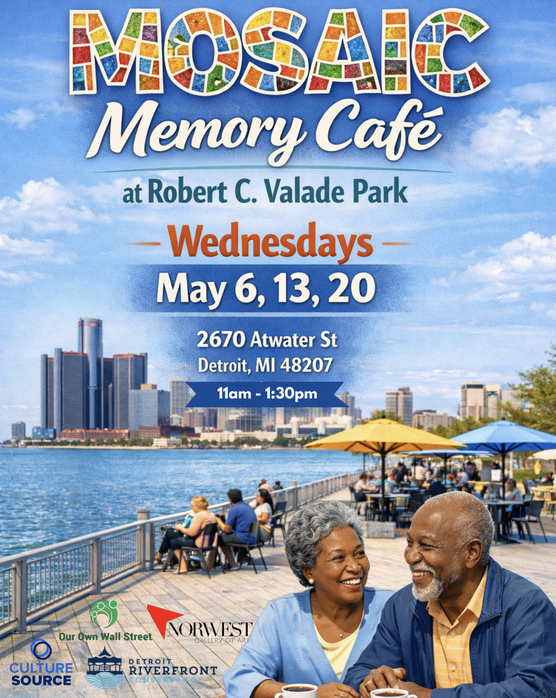
Mosaic Memory Cafes in Detroit: If you’re in the Detroit area and looking for a pleasant, relaxed outing for you and your loved one living with memory loss or dementia, plan to attend one or all of the upcoming Wednesday art gatherings at Detroit’s Robert C. Valade Park, right on the river. Designed for people with memory loss or dementia and their caregivers, the sessions are led by trained facilitators. Each gathering will feature light movement and exercise for seniors, a guided art-making experience, and a closing reception for participants and their families.
Scheduled dates are May 6, 13, and 20 from 11:00 am – 1:30 pm. All sessions are free to attend. Registration is encouraged. For those not in Detroit, you can learn more about this budding movement here.