
Sled hockey is exactly what it sounds like: players holding stubby sticks tipped with ice-gripping spikes careen around the rink – sometimes even in the direction they intend. Nobody is good the first time they play. Not even hotshots and smokejumpers – some of the country’s fittest, most elite wildland firefighters.
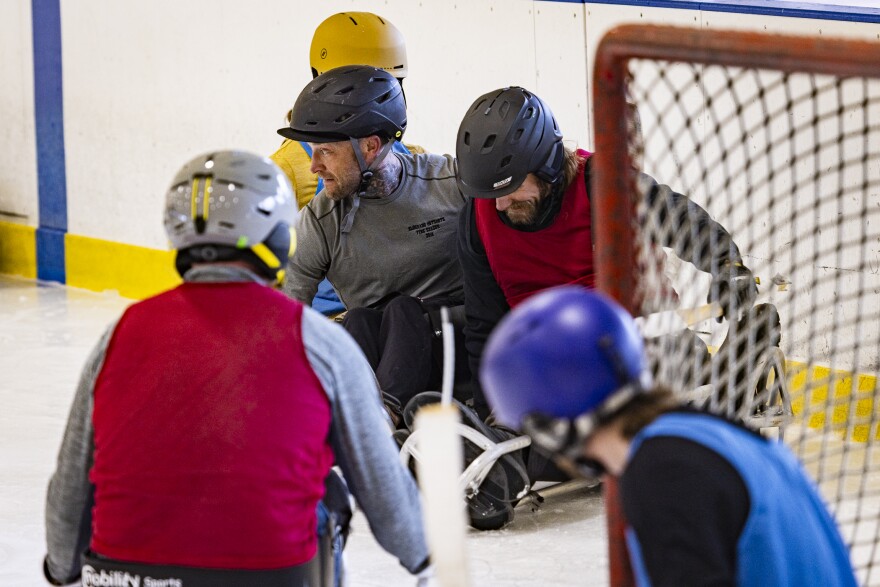
Asked after the scoreless first period if his wildfire work prepared him for the sport at all, Hotshot Superintendent Ben Strahan said, “No.”
“My lungs maybe, but not the other parts of my body,” he added with a laugh.
Murphy Woodhouse
/
Boise State Public Radio
Hotshot Superintendent Ben Strahan (center, gray shirt) and others battle for the puck
Strahan has worked in wildland fire for a quarter century – mostly on interagency hotshot crews (IHCs). He’s now the superintendent of a California-based IHC. After jokingly accusing the other team of cheating, he laid out his team’s strategy for the next period, during which he predicted the “tides are going to turn in our favor.”
“We’re going to try and put the puck in the back of the net, you know what I mean?” he explained.
With a spirited cheer, his team – the Bearcats – spread back out on the ice for the second period. But it was their opponents – the hastily named Let’s Go Club! – who scored the first goal. In the final period, the Bearcats answered Let’s Go’s second, but couldn’t close the gap before the final buzzer.
“We didn’t get it this time,” Strahan said. “Get ‘em next time.”
“I would say it was the result we were looking for, which was fun, camaraderie, a little bit of playful competition,” said Alaina Wilson with Higher Ground, a Sun Valley-based nonprofit that specializes in recreation therapy.
The bonding and physicality are key elements of the program, and feed into the more serious evening group discussions of trauma, professional identity and other weighty topics.
Murphy Woodhouse
/
Boise State Public Radio
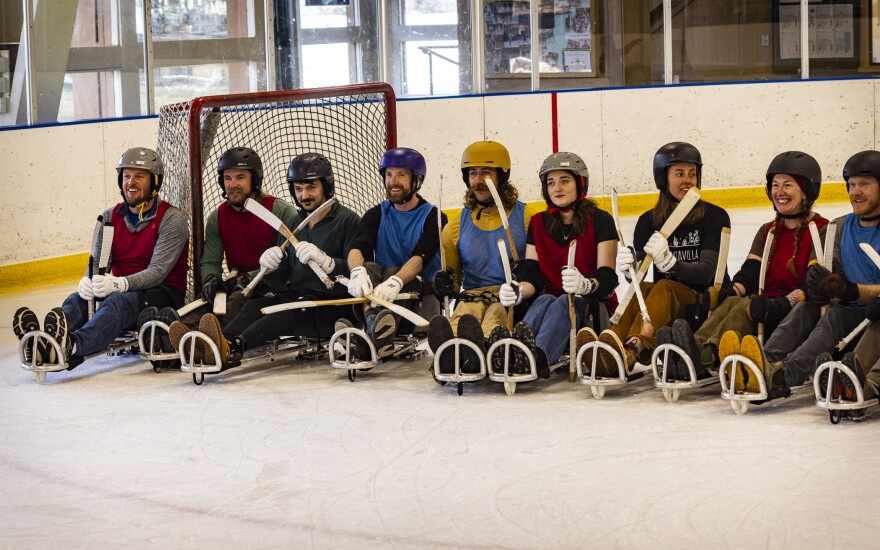
The erstwhile opponents gather for a post-game photo on the ice
“What we do in our leisure time or our recreation time has a massive impact on our quality of life,” she said.
For more than two decades, Higher Ground has worked with veterans, folks with disabilities and, more recently, first responders, providing them with outdoor adventures coupled with mental health support. Aided by another nonprofit – Hotshot Wellness – this is the first time the group has worked exclusively with wildland firefighters. Applications exceeded expectations.
“I would say that we were overwhelmed by the response for this program,” Wilson said.
Al Laurent is with Hotshot Wellness, and has more than a decade of experience in wildland fire, mostly in the 2010s.
Murphy Woodhouse
/
Boise State Public Radio
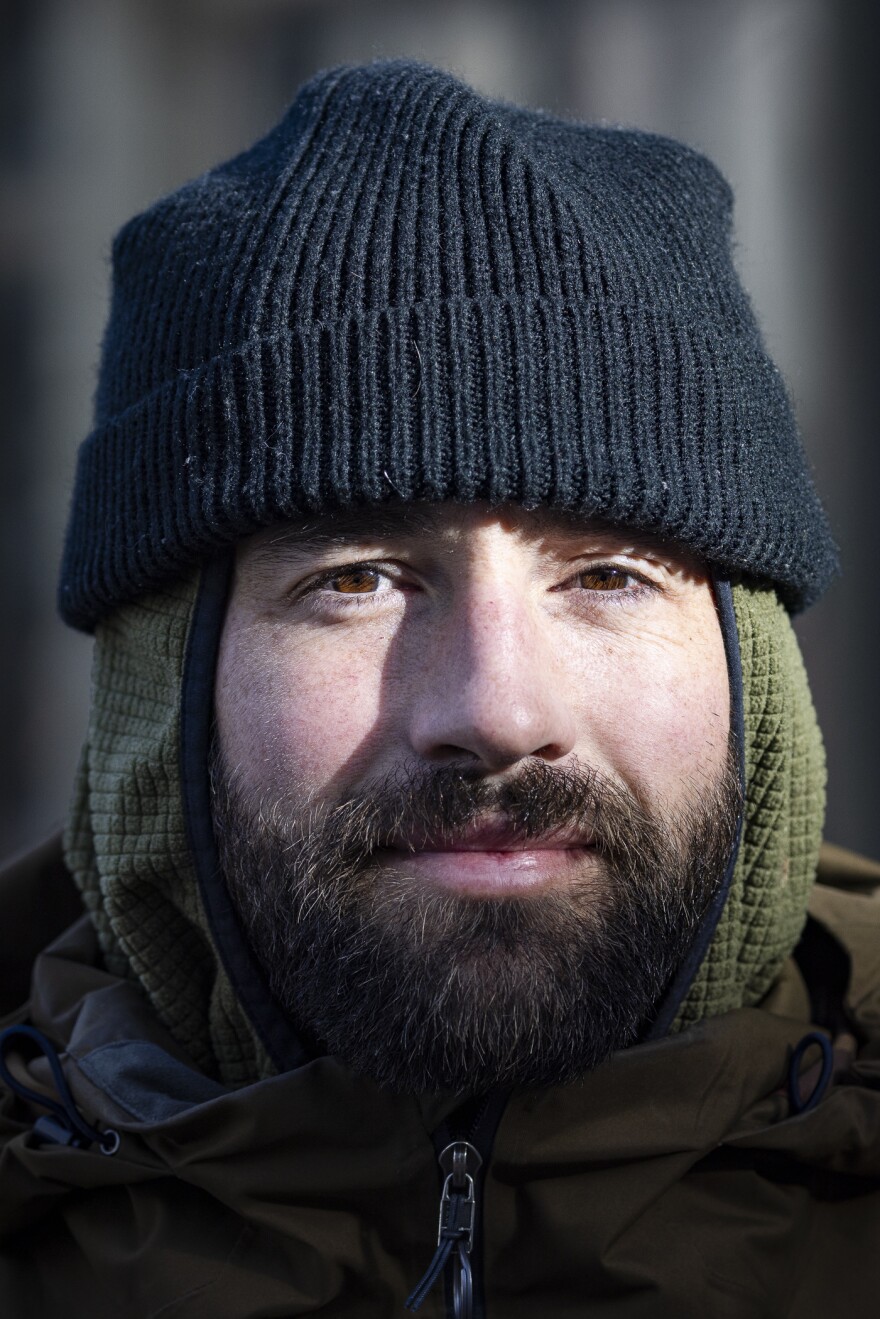
Al Laurent is the director of logistics with Hotshot Wellness
“Honestly, all the way through my 2020 [season], it was just ‘hide your feelings inside and tough it out, get through the season,’” he said of how he saw the fire world’s relationship to mental health then.
But now, he said, “it’s so huge.”
‘It’s O.K. to get help’
In recent years, concerns among the workforce about health risks of all kinds have been getting louder. And mental health is no exception.
Patricia O’Brien, a former hotshot who’s now a clinical advisor at the Department of the Interior, conducted one of the first major studies of mental health in the field nearly a decade ago. She was worried about getting 500 respondents for her survey, but ended up with some 2,600.
“I think that’s a reflection of – even in 2018 – that people are interested,” she said. “And that has only continued to grow.”
While noting that a survey is not a formal clinical diagnosis, O’Brien found evidence of substantially higher rates of mental health disorders – including depression and anxiety – than in the general population. Rates of probable PTSD were roughly four times national rates, and 20% of respondents reported suicidal thoughts, according to a summary of results she shared.
“Though additional research is needed, these preliminary findings suggest wildland firefighters may be at a higher risk of experiencing mental health conditions than the general public,” the summary reads. “And that a notable proportion of those conditions are under-detected and under-treated.”
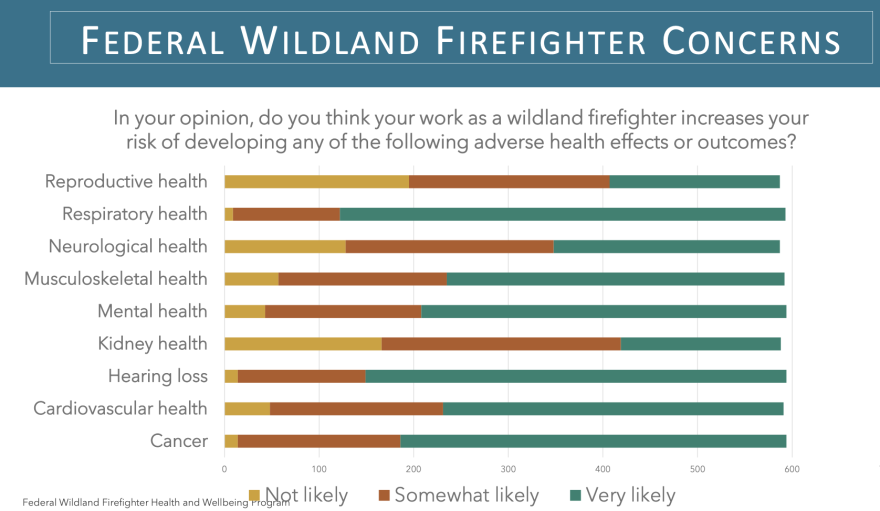
A more recent survey found significant concern among firefighters about these issues. Perhaps unsurprisingly, nearly all of the 600 respondents said the work likely increases their risks of cancer, respiratory ailments and hearing loss. But nearly as many said the same about mental health issues.
Federal Wildland Firefighter Health and Wellbeing Program
A chart summarizing results of a survey of wildland firefighter health concerns
Federal agencies are responding. Last year, the Departments of Agriculture and Interior stood up a free therapy service for all federal wildland firefighters.
“I know people have been waiting for something like this for quite some time, and it is coming to fruition now,” Commander Dana Lee, director of the Wildland Firefighter Behavioral Health and Wellbeing Program, told the Mountain West News Bureau about the service last summer. “I hope that people do utilize the service.”
“It’s O.K. to get help,” she added.
Not sustainable
Virginia Avery is a former hotshot, and a Missoula-based licensed clinical social worker that Higher Ground contracted with for the weeklong Sun Valley event. Given her background, she’s familiar with the many challenges that wildland firefighters and their families face.
“What I found was that there were military expectations on a paramilitary organization without military support,” she said of her experience raising children with a partner still in fire. “There isn’t the housing, there isn’t the childcare, there isn’t the wives groups. All of that has to be grassroots and driven by us.”
Murphy Woodhouse
/
Boise State Public Radio
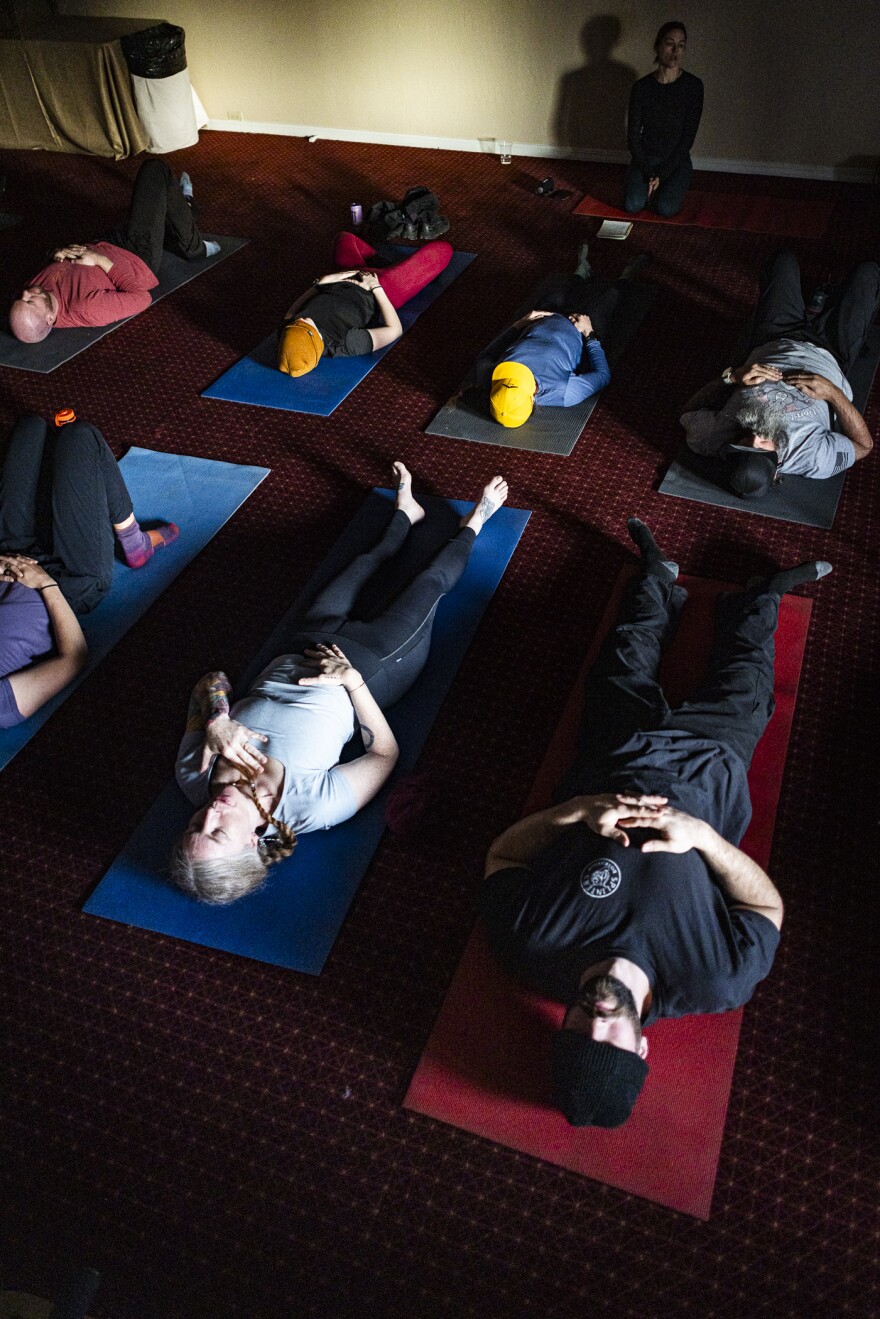
Virginia Avery (bottom center, gray shirt) meditates during a morning session at the Higher Ground retreat
Women firefighters, just 16% of the federal fire service, face unique challenges like sexual harassment and being passed over for professional opportunities, she said. But like others interviewed, she feels there is increasing consciousness about the heavy load borne by all firefighters.
She often gives mental health talks to people in the business, and is “surprised how hungry people are for this and how little resistance there is,” she said. “Because there’s a recognition that this isn’t a sustainable system.”
Good humans, good hotshots
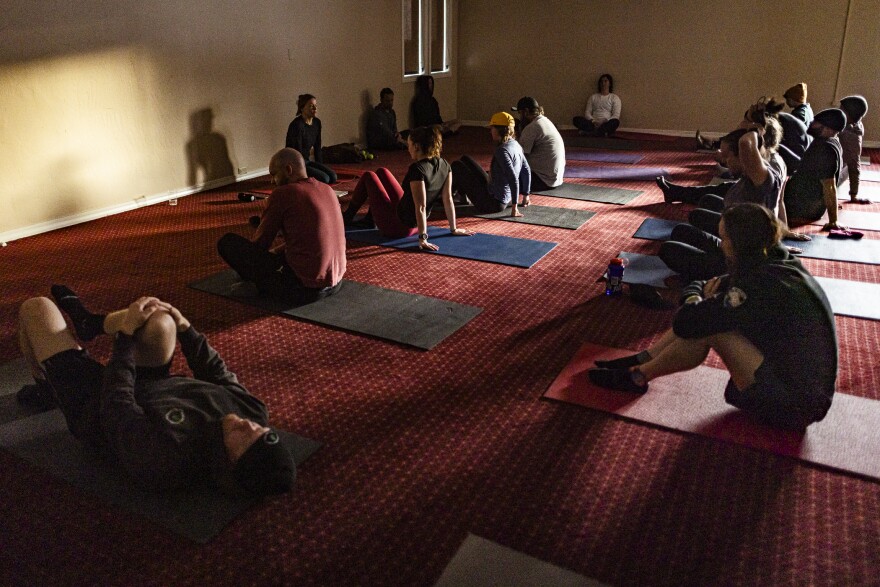
“I’d like you to take a moment to really ground into the mat beneath you,” Higher Ground’s Alaina told a group of firefighters splayed out on yoga mats in a hotel conference room. She had led the group through a series of movement exercises, which ended with a 15-minute guided meditation.
“May I be happy,” she gently intoned. “May I live with ease.”
Murphy Woodhouse
/
Boise State Public Radio
Alaina Wilson with Higher Ground leads the group in a series of movement exercises and guided meditation
Afterward, Ben, the hotshot supe, explained that the fireline is a workplace that pushes people to their limits — and sometimes beyond them.
“We go all over the country as a national resource, fighting fire in the worst possible conditions for six months out of the year – to nine months sometimes,” he said. “It’s hard, grueling work, spending a lot of time outside and in smoky, ashy, dry, hot conditions. A lot of time away from family, a lot of time away from being able to mentally and emotionally process the things that you experience. But it’s also a very profoundly purposeful work.”
He’s no stranger to the toll it takes. He’s dealt with addiction, financial and family problems, and in 2020 attempted suicide. He said those personal crises served as spurs to change patterns, and confront past trauma. Now with a respected leadership role, he said he’s trying to set an example for younger firefighters. And his goal isn’t to forge decent hotshots, work he says that any strong body can do.
“What I’m way more interested in is making good human beings, because good human beings are good hotshots,” he said. “An authentic human being will give you their best.”
Play is serious
Programs like Higher Ground’s, Strahan said, can give firefighters space for reflection, and connection to others facing the same challenges.
Early career firefighters like Stella Vincent, who’s on an Oregon-based handcrew.
“I think we need more things like this in the fire world,” she said. “Because a lot of firefighters are hurting, a lot of people feel isolated and we need to be doing something about it.”
Murphy Woodhouse
/
Boise State Public Radio
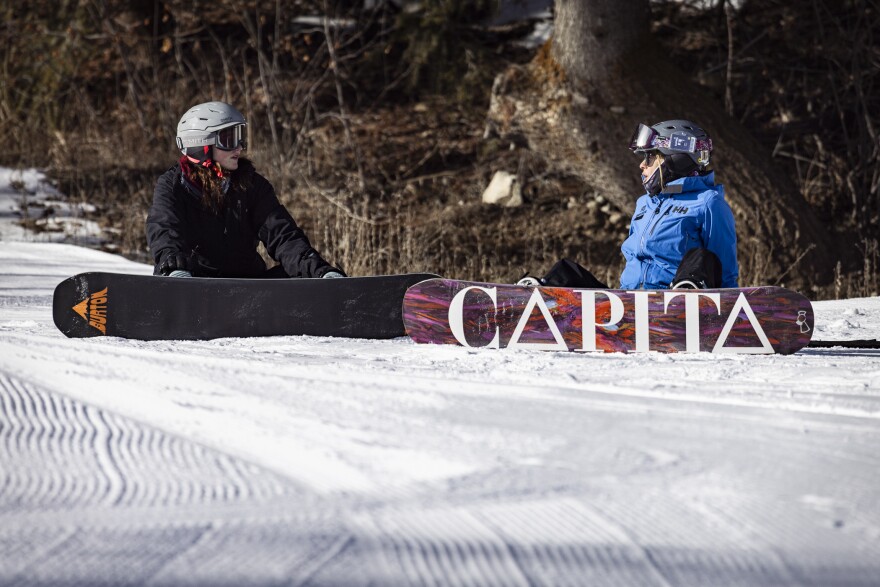
Higher Ground’s Alaina Wilson shares some snowboarding pointers with Stella Vincent.
After breakfast, Stella and the rest of the crew headed to the Sun Valley Resort’s Bald Mountain. Many wildland firefighters are seasoned snow sport athletes, and do the work in part to fund their winter adventures. But Stella is very much a beginner snowboarder.
“I’m so stoked,” she said as the conveyor belt-style lift slowly carted her to the top of the bunny hill. “This is awesome.”
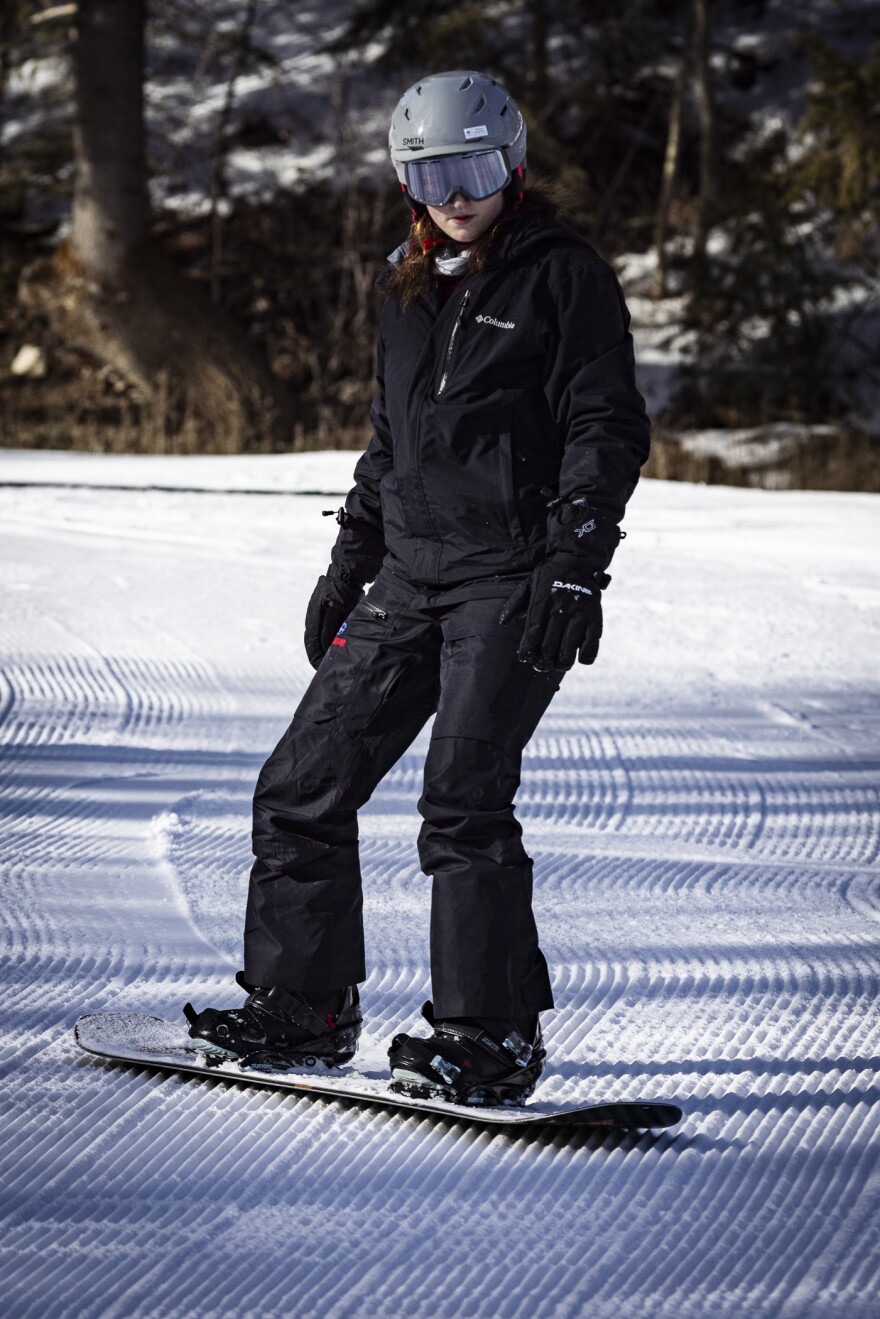
Armed with pointers from Higher Ground’s Alaina, she made her way slowly but surely to the bottom.
Murphy Woodhouse
/
Boise State Public Radio
Stella Vincent finds her groove at the Sun Valley Resort’s bunny hill.
“This whole experience, there’s been such a huge emphasis on play,” she said of the retreat. “Which is really cool because I feel like we all take ourselves very seriously a lot of the time.”
Murphy Woodhouse
/
Boise State Public Radio
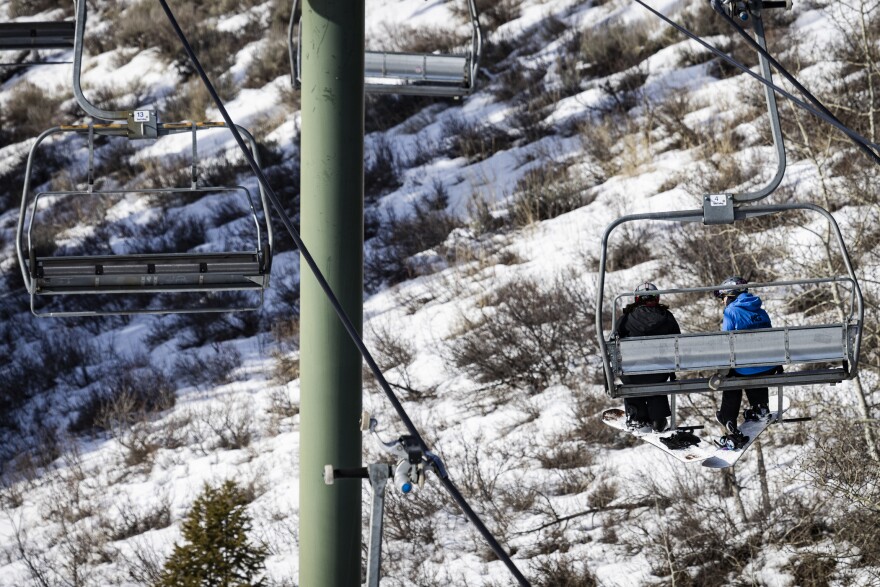
Stella Vincent, left, and Alaina Wilson head up Bald Mountain in Sun Valley
After a few more confidence-building runs, she hopped on a bigger lift and headed up the mountain.
This story was produced by the Mountain West News Bureau, a collaboration between Boise State Public Radio, Wyoming Public Media, Nevada Public Radio, KUNR in Nevada, KUNC in Northern Colorado, KANW in New Mexico, Colorado Public Radio and KJZZ in Arizona as well as NPR, with support from affiliate newsrooms across the region. Funding for the Mountain West News Bureau is provided in part by the Corporation for Public Broadcasting and Eric and Wendy Schmidt.