
About this research
This Pew Research Center report looks at Americans’ views on health information and how they view their own health.
Why did we do this?
Pew Research Center does research to help the public, media and decision-makers understand important topics. This research builds on our longstanding work studying Americans’ views of medicine and health to explore how Americans view sources of health information.
Learn more about Pew Research Center, our research on medicine and health and other research on science and society.
How did we do this?
For this report, we surveyed 5,111 U.S. adults from Oct. 20 to 26, 2025. Everyone who took part in this survey is a member of the Center’s American Trends Panel. The survey represents the views of the full U.S. adult population.
Here are the survey questions used for this report, the detailed responses and the survey methodology.
Key takeaways:
Adults under 30 rate their mental health much more negatively than older adults. Roughly a third (36%) say their mental health is fair or poor, while 16% of adults ages 50 to 64 and 9% of adults 65 and older say the same.
Four-in-ten adults under 30 say they are doing well at having good relationships with other people, and roughly two-in-ten say this about managing their stress. These shares are much smaller compared with older adults who say the same.
Roughly half (47%) of adults under 30 say managing stress in their lives is a major challenge to taking care of their health. This share is 30 percentage points higher than adults ages 65 and older who say the same.
Health experts say the United States is in the midst of a mental health crisis. According to a new Pew Research Center study, young adults fare much worse than older adults when it comes to their ratings of their mental health, social relationships and stress management.
Building on previous Center research on social connections and mental health support, this new analysis looks at how well younger adults say they’re taking care of their health and how they see their health challenges. This study is part of a larger survey on Americans’ health information sources and views on their personal health, conducted Oct. 20-26, 2025, among 5,111 U.S. adults.
For a broader look at Americans’ views of their health, read “Americans value their health – but how well do they think they’re taking care of it?”
And for more about Americans’ views of health information, read “Where do Americans get health information, and what do they trust?”
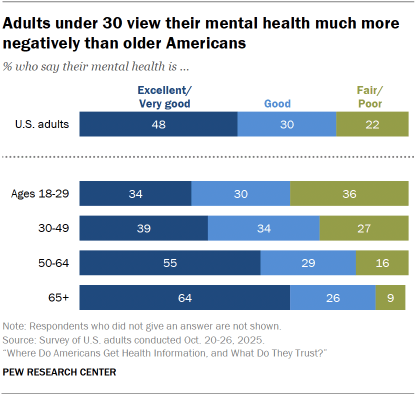
Roughly a third (36%) of adults under 30 rate their mental health as fair or poor. That share is 20 percentage points larger than the share of adults ages 50 to 64 who say the same and 27 points larger than those ages 65 and older who say this. And in the same vein, the share of these young adults who say their mental health is excellent or very good is 30 points lower than the oldest adults.
How well do young adults say they care for their health?
Consistent with their more negative rating of their mental health, adults under 30 are much less likely than older adults to say they’re doing well at managing their stress and having good social relationships.
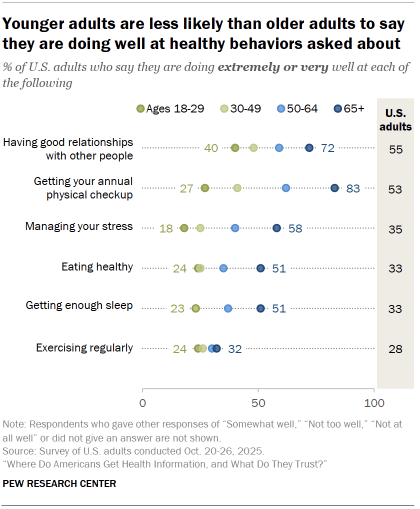
About one-in-five adults under 30 (18%) say they are managing their stress extremely or very well. This share is smaller than all older age groups, but the age gap is especially wide between the youngest and oldest adults. Adults under 30 are 40 percentage points less likely than those ages 65 and older to say they are doing this well (18% vs. 58%).
There is a similarly wide gap between the youngest and oldest adults in saying they are doing well at having good relationships with other people. Among adults under 30, 40% say they’re doing this extremely or very well – more than any of the behaviors asked about. Still, older adults are faring much better, with 72% of adults ages 65 and older saying the same. This age pattern echoes previous Center research showing higher levels of loneliness among younger adults.
There are also age differences in ratings of behaviors that have direct ties to physical health, but that can also impact mental health.
When it comes to eating healthy and getting enough sleep, nearly identical shares – about a quarter – of adults under 30 and those ages 30 to 49 say they are doing extremely or very well at each of these behaviors. But older adults, especially those 65 and older, are about twice as likely to say this.
It’s not just daily health habits: Younger adults are also less likely to say they are getting an annual physical checkup, which can help prevent disease and sometimes include mental health screenings. This behavior has the widest age gap of those we asked about with 83% of adults ages 65 and older say they are doing well at this and 27% of those under 30 saying the same.
Exercising regularly doesn’t follow this pattern – but largely because older adults give themselves worse ratings than they do on other behaviors. While the share of younger adults who say they exercise regularly is in line with other behaviors, the share of older adults who say this is lower than any other behavior asked about.
And while overall there are clear age differences in the shares who say they are doing these behaviors well, large shares of adults in each age group say that each of these behaviors is highly important for them. The one behavior with large age differences in importance is getting an annual physical. Refer to the appendix for more details.
What do younger adults see as major health challenges?
Related to their ratings of how they’re managing stress, adults under 30 are more likely than older Americans to see stress management as a major challenge. Roughly half (47%) of these young adults say managing their stress is a major challenge to taking care of their overall health.Far fewer adults ages 65 and older (17%) say the same.
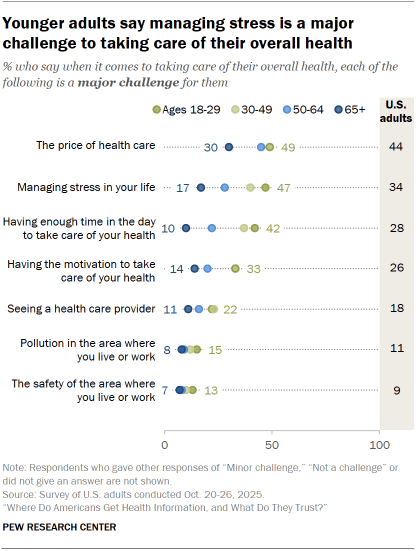
There are also sizable age differences when it comes to having enough time and having motivation to take care of their health. About four-in-ten adults under 30 (42%) see time as a major challenge, and 33% say the same about motivation. These shares are higher than adults older than 50, especially compared with those 65 and older.
The pattern of age differences is subtly different when it comes to saying the price of health care is a major challenge. Very similar shares – roughly half or slightly less – of all age groups under 65 say this is a major challenge. Three-in-ten (30%) of those ages 65 and older – who qualify for Medicare – say this.
How much effort do young adults put into their mental health?
While young adults rate their mental health worse than older adults, the amount of effort Americans under 30 say they put into caring for their mental health isn’t that different from older adults.
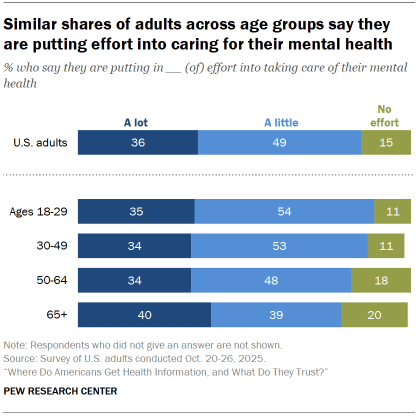
The share of adults under 30 who say they put a lot of effort into their mental health (35%) is nearly identical to the share of adults in older age groups who say the same and only slightly smaller than the share of oldest adults who say the same.
And in each age group, large majorities say they are putting in at least a little effort into their mental health. Adults under 50 are only slightly more likely than those ages 50 and older to say this (88% vs. 80%).