
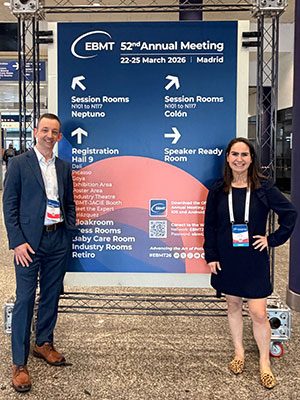
Steven Hardy, PhD (left) and Dana Footer, PsyD (right), present Children’s National Hospital’s protocol for assessing psychological readiness for HSCT and gene therapy in sickle cell disease at the European Society for Blood and Marrow Transplantation (EBMT) Annual Meeting.
Hematopoietic stem cell transplant (HSCT) and gene therapy are changing the treatment landscape for sickle cell disease, offering the potential to reduce pain, prevent organ damage and improve quality of life. Alongside these clinical advances, it is essential to ensure patients and families are prepared for these transformative therapies from a psychological and social standpoint.
At Children’s National Hospital, psychologists have developed a structured approach to evaluating and supporting psychosocial readiness for HSCT and gene therapy. This includes addressing mental health concerns, fostering realistic expectations, considering motivations and activating social support networks. Ongoing monitoring after treatment helps ensure patients’ long-term psychological well-being.
This work was recently presented by Dana Footer, PsyD, and Steven Hardy, PhD, at the annual meeting of the European Society for Blood and Marrow Transplantation (EBMT) as an abstract titled A Protocol for Assessing Psychological Readiness for Hematopoietic Stem Cell Transplant and Gene Therapy in Sickle Cell Disease, highlighting Children’s National Hospital’s international leadership in integrating psychosocial care with cell and gene therapies.
Treating the whole patient
During the conference, the Children’s National psychologists within the Cancer and Blood Disorders Center provided concrete recommendations on how to evaluate readiness and use those results to guide individualized, team-based interventions, ensuring patients and families are fully supported throughout the treatment journey.
co-author of the abstract.
This approach helps promote the patient voice, build confidence, strengthen disease self-management, and improve physical and psychosocial outcomes, ensuring care goes beyond treating the disease to supporting the whole person.
Patient and family feedback and real-world experiences continue to inform refinement of the readiness evaluations and interventions. “By listening to families who have undergone treatment talk about what they found most valuable about the preparation process and which aspects of treatment were surprising to them, we continue learning how best to support future patients,” said Dr. Footer, co-author and attending psychologist in the Divisions of Hematology, Oncology, and BMT.
Leading the field
Access to pediatric HSCT and gene therapy remains limited in the U.S., but Children’s National is a national leader. The embedded psychosocial care providers offer specialized mental health care before, during and after treatment.
By combining clinical innovation with psychosocial expertise, Children’s National is helping ensure these therapies improve not only health outcomes but also patients’ quality of life and ability to pursue their personal goals at every stage of life.