
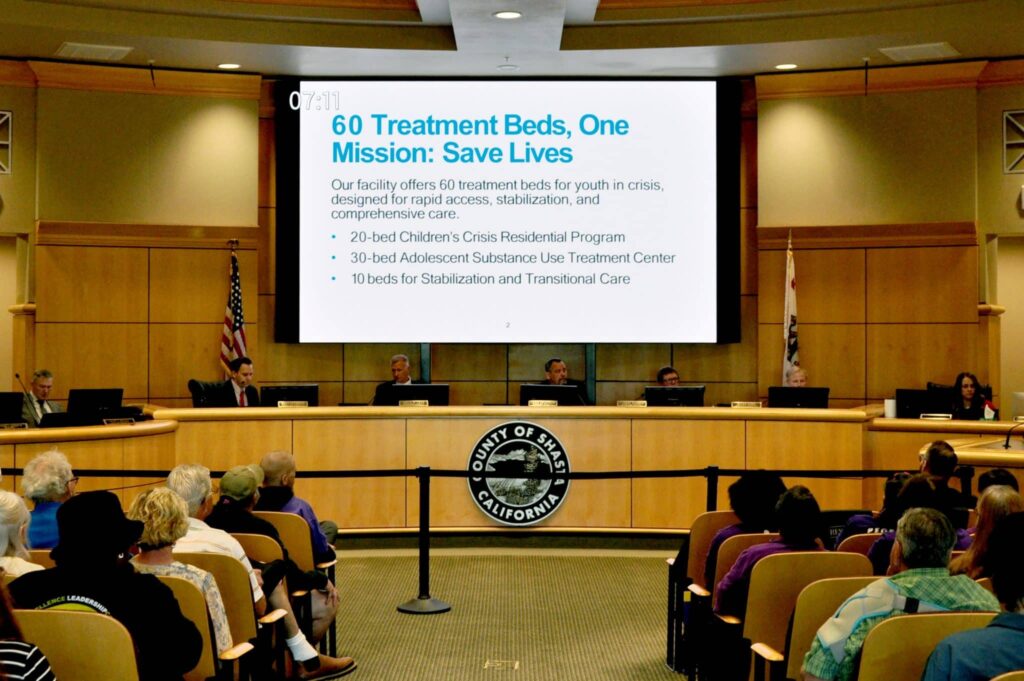
 A slide from a presentation shared by Family Dynamics Resource Center at a recent county board meeting. Photo by Annelise Pierce
After garnering a provisional promise of almost $25 million in state funds and almost $2 million in county opioid settlement funds, the future of a 60-bed youth behavioral health facility slated for development in Anderson is now uncertain.
On Wednesday, Les Baugh, a former county supervisor and the pastor of Anderson Community, announced that his church would withdraw from what’s been known as the Pathways to Leadership Campus. Baugh said it had “become clear that moving forward with this project is not the right path for Anderson Community at this time.” He did not respond to a request for further comment.
His announcement followed concerns voiced by multiple community members at both the Shasta County Board meeting and the Anderson City Council meeting on Tuesday. Anderson Council member Mike Gallagher spoke at both meetings, where he acknowledged the critical need for both youth and adult behavioral health services in Shasta while calling out the coordinators of the youth behavioral campus project for what he said were misrepresentations in state grant application materials.
“I want taxpayer dollars to be spent on facts,” Gallagher said on Tuesday night during his council report, “not on misrepresentations of the truth.”
Supervisor Matt Plummer also withdrew his support for the project this week, citing a lack of trust in organizers given information from grant materials that has emerged in public meetings and online over the last week.
“Any time you bring a large behavioral health facility into a small community there are a lot of concerns,” Plummer told Shasta Scout, “And if you’re not building that process on the basis of trust … that is really problematic. And I think the application revealed that we couldn’t really trust them at this point.”
After the exodus of Anderson Community from the project, the future of the Pathways to Leadership Campus remains unclear. The church was one of two entities which applied for state funding. The Redding-based Family Dynamics Resource Center was also an applicant on the project and is the agency named on funding awards for both state and county dollars. Director Sandra Wilson did not answer questions sent yesterday.
State funds are conditional on a local funding match which was pledged in the form of county opioid settlement funds a few weeks ago. That funding is also still in question. The county money was given only conditionally, contingent on the support of the Anderson City Council as well as local law enforcement and Shasta County Probation.
So far, there has been no agendized discussion of the project by the Anderson Council, something that would be a necessary prerequisite to securing the city’s support. And an Anderson Police Department spokesperson said today that any letter of support from city law enforcement would have to come from the council, not directly from APD.
Sheriff Michael Johnson has not responded to a query this week about whether he will support the project if it moves forward. While Shasta County Probation Director Traci Neal said only that she had heard from Family Dynamics Director Wilson mid-week and would meet with her soon.
Officials with the California Department of Healthcare Service’s Behavioral Health Continuum Infrastructure Support (BHCIP) program, which provisionally awarded funds earlier this year, have not weighed in publicly on next steps given the change in involvement by project partners. And Shasta County’s Health and Human Services Agency Director Christy Coleman did not respond to a request for comment.
Allegations about grant materials
A staff report provided to the county board before the vote on opioid settlement funding last month, said that Family Dynamics had been awarded almost $25 million in state Behavioral Health Continuum Infrastructure program funding to establish a “comprehensive continuum of care for youth experiencing mental health and substance use challenges.”
But Family Dynamics was only one of the entities listed on the grant proposal submitted to the state last year. Shasta Scout is still pending a document request to receive the project application from the state, but has reviewed a document provided by a third party and verified through metadata. That paperwork shows a second agency requesting funds, naming the entity as Anderson Community, INC, a religious nonprofit, and listing as its address the Balls Ferry Road property which houses the church known as Anderson Community.
Former county supervisor Les Baugh, the pastor of that church, told board members last month that the religious organization had donated a piece of land worth at least half a million dollars for the youth campus, but did not further outline Anderson Community’s role in the project for the board or the public. In grant materials the stated value of that 6.5-acre property varies by millions throughout different parts of the document.
That’s one of the inconsistencies Gallagher noted during his comments at both the county board and city council meetings where he alleged factual misrepresentations by project proponents, including an assertion in grant materials that the “project team has met multiple times with city planning, engineering, and fire officials,” something Gallagher said never occurred.
Anderson City Manager Joey Forsaith backed Gallagher’s assertion today, writing by email that “prior to this past Wednesday, April 1st the Family Dynamics team had not met with City departments/staff to discuss their facility and potential land use challenges and concerns.”
In public comments, Gallagher also noted ongoing mentions in grant materials of “Mayor Susie Baugh.” While Susie Baugh is a current Anderson City Council member, and former mayor, her role in the project is complicated by her connection to Anderson Community, INC where she serves as the secretary of the board, according to information included in grant materials. She’s also married to Les Baugh, who’s listed as the organization’s president, and who was budgeted to be paid $150/hour for executive management for the project, up to a maximum of $225,000.
“I take real issue with the mayor, slash secretary of the church, slash wife of the president appearing as a representative of the city council in the application,” Gallagher told the Shasta board and Anderson City Council this week. “She’s referred to as ‘Mayor Susie Baugh’,” which would imply that she’s representing the city, he said, “but she is “one-fifth of the council, and was never authorized by the four-fifths to represent.”
Susie Baugh did not respond to a request for comment.
The application to the state also claimed that project organizers had conducted “neighborhood canvassing and stakeholder engagement … revealing widespread public and professional support.” That was another assertion that Gallagher disputed in his public comments, noting that the project’s outreach efforts were limited enough to have left him, as an Anderson Council member, unaware.
“These were planning meetings,” Gallagher said, referring to a series of meetings documented in application materials, “not community engagement. I’m a city council member and didn’t know this was going on. I wasn’t engaged at all.”
While grant application materials claimed that “families, providers, and civic leaders have endorsed the project’s potential to fill a major service gap in youth and family behavioral health care,” those whose full names were listed as involved in the community engagement process — beyond project organizers, and realtors, architects and builders — included only Supervisor Plummer.
Plummer is referred to in the grant application as having “agreed to help coordinate local stakeholder engagement.” He said he only became aware of that claim about his involvement for the first time in the last week or two, when parts of the grant application materials were posted online by community members.
“I was shocked to read that,” Plummer said. “I had one meeting with them. I don’t remember exactly what I said in that meeting but I know I didn’t say I would lead local stakeholder engagement.
“At a minimum,” Plummer emphasized, “this was an exaggeration of what I offered.”
In the run up to the grant application last year, Plummer did submit a letter of support for the project as did Supervisors Kevin Crye and Chris Kelstrom. All three, along with Supervisor Corkey Harmon, also voted to provisionally award county opioid settlement funds to the project a few weeks ago, against Supervisor Allen Long’s objections. Long’s opposition was based on what he referred to as “unanswered questions” about the project — largely related to a lack of community engagement with law enforcement partners.
Now that Plummer has changed his mind about supporting the project, he said the process has been a learning experience. In the past, he said, he’s been willing to support a variety of entities seeking funding from the state because he’s aware of the critical need for behavioral health services in Shasta County. But that eagerness to support funding for Shasta overlooked crucial evaluation processes in some cases, he now believes.
As a result, Plummer is advocating for the county to standardize and institutionalize a consistent approach to vetting nonprofits prior to discussing public funding allocations, something he brought up at Tuesday’s meeting during his board report, at which time supervisors voted to discuss the idea further at an upcoming meeting.
Amid all the uproar about this particular project, Plummer emphasized, it’s also important to remember that significant behavioral health needs remain unmet in Shasta County and the community has a shared responsibility to work towards meeting those needs.
“If we feel better about being critics than problem solvers, that’s an issue,” Plummer expressed, noting that it’s important to build a community culture where people feel like they can take the kinds of risks required for big community projects.
“But obviously they need to do that with integrity and humility,” Plummer added, “which might have been missing here.”
Do you have a correction to share? Email us: editor@shastascout.org.