
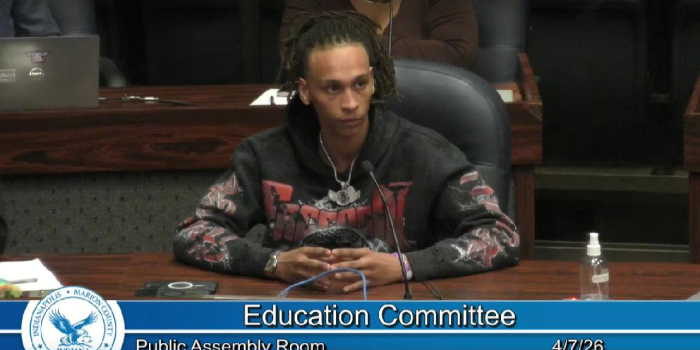
Brandon Spivey, 20, spoke during a special presentation during the Education Committee on youth gun violence in Marion County with potential solutions on April 7, 2026. Photo from USA TODAY Network.
By Maksym Hart
Indianapolis Star, USA TODAY Network via Reuters Connect
INDIANAPOLIS — Indianapolis leaders got a lesson on youth violence in Marion County during the Education Committee of the April City-County Council meeting.
Presenting to the council on the issue, and possible solutions, were Indiana University associate professors Dr. Virgil L. Gregory and Dr. Joseph Tucker Edmonds, who were accompanied by Indianapolis youth leader Brandon Randall, the founder of Tru Colors.
The discussion touched on racial trauma, answering the question of how institutions impact and mediate youth, and the over-criminalization of minority children.
Using research gathered by different health reports, including ones from the American Psychiatric Association, Gregory frames youth gun violence through the lens of mental health, suggesting that conduct disorder and antisocial personality disorder be diagnosed early, so that intervention treatment could be made available.
“These diagnoses are not meant to stigmatize, but instead to specify a unique cause, course, and treatment,” Gregory said. His presentation highlighted criminal risk variables in youth including:
Eight Criminal Risk Variables
Antisocial traits
Risk-taking and pleasure seeking personality
Attitudes, values and beliefs that are supportive of crime
Close relationships with people involved in criminal behavior
Lack of nurturing and supervision from family
Performance problems and lack of satisfaction from school
leisure time due to lack of recreational activities
Substance abuse with drug and alcohol use
Randall spoke about everyone having a part to play in combatting youth violence, including institutions.
“We are letting young people down. We don’t want to admit that, we don’t want to say it on camera, but the reality is we have let them down,” Randall said. “Because we think that it is somebody else’s business or responsibility when it is all of our responsibility.”
Randall brought along one of his students from his mentoring program, Brandon Spivey, who also spoke to councilors. He encouraged leaders to listen more and judge less.
“Put in work to get closer to them to see what the big issue is over the whole situation. Cause you will never understand a young person if you don’t get into their shoes,” he said.
Potential Solutions For Youth Violence
Input from Edmonds was met with open discussion by councilors asking about solutions.
“If a child does not know how to read, what do you do? You teach them,” City-County Councilors Dr. Carlos Perkins said. “But if a child does not know how to behave, we punish them. What I’m hearing tonight is… What are ways in which we can engage with community to help our young to learn behaviors.”
Gregory says preventive psychotherapy, cognitive-behavioral therapy, family interventions, hospital-based interventions after violence has occurred and community initiatives better help combat youth crimes.
So, getting young people mental health help early can lessen extreme violent behaviors, but even if violence has occurred, hospitals like Eskenazi’s “Prescription for Hope” program directly impacts gun violence victims.
On the community front, Randall said leaders must engage, prioritize and invite the young people whom they are often afraid to talk to, and “not the safe kids” to be more intentional.
“The community in general is so disconnected. You can go on any media outlet and look in the comment section and you’re going to see blame parents, blame y’all, and blame the prosecutors, blame everybody,” Randall said. “We want to talk about a village, but no one wants to be a part of the village.”
Jade Jackson is a Public Safety Reporter for the Indianapolis Star. You can email her at [email protected] and follow her on X, formerly Twitter @IAMJADEJACKSON.
This article originally appeared on Indianapolis Star: “Researchers examine youth gun violence through lens of mental health.”