
Rep. Todd Jones, Rep. Kim Schofield and Rep. Mary Margaret Oliver on the Georgia House floor on March 12 discussing HR1007. (Photo courtesy of Georgia House of Representatives)
What it means for local arts organizations, and its potential as a tool for both funding and access.
::
On May 1, 1969, children’s television personality Fred Rogers, the creator and host of Mister Rogers’ Neighborhood, appeared before the U.S. Senate Subcommittee on Communications to testify against the Nixon administration’s proposed reduction of the budget for public broadcasting from $20 million to a grossly inadequate $10 million. Speaking directly to Sen. John Pastore, Rogers made the case that programming like his was important for the development of young minds in the modern media age.
Rogers’ testimony has become the stuff of legend, and video of the speech is routinely shared online as inspirational content, depicting a gentle, humble man speaking truth to power and winning the day through warmth and empathy. The reality is a little more nuanced — Pastore was already a proponent of public television and came into the hearing more supportive on the matter than popular culture usually acknowledges — but Rogers’ words still stand as a crucial argument in favor of public support for the arts.
Almost 60 years later, public funding for arts initiatives remains a popular target for politicians running on a spending cuts platform. As such, it comes as a pleasant and hopeful surprise that Georgia, frequently at the bottom among U.S. states in per capita arts funding, has moved to enshrine the arts as an important component in mental health care with HR1007. The Georgia House of Representatives passed the bipartisan resolution on March 31, making our state the first in the nation to connect art and mental health outcomes in legislative policy.
“I feel like we still have to keep that fight going. I think this just makes it a little bit easier,” says Christopher Moses, the Jennings Hertz artistic director for the Alliance Theatre. His office, awash in children’s books that he’s been scouring for potential stage adaptations, gives the space the same aura of child-like wonderment that defined the Mister Rogers’ sets.
 Christopher Moses. (Courtesy of Alliance Theatre)
“For me, the big win is that it starts to do exactly what Fred Rogers was trying to do, which was reframe the cultural mind-set about the value of the arts,” he explains. “It shows that the arts have value across multiple sectors, and this gives us a way in with the health community.”
Moses is enthusiastic about discussing the already robust knowledge base developing around the measure. “We now have a growing body of research that points to the benefits of participation in the arts. If we are only wholly reliant on money that supports the arts directly, we’re never going to find the funding that we need to keep our field alive.”
He goes on to point out that the Alliance’s recent addition of the Goizueta Stage for Youth and Families was driven by a research study into the developmental impact of field trips for children. “All of us who work in this field know that something transformational happens when a kid goes to the theater. So we wanted to test it and finally have the data to prove to the skeptics that it’s worth your time out of school.”
The results of the study aligned with U.S. Surgeon General Vivek Murthy’s 2021 acknowledgement that mental health issues among young people reached epidemic levels in the wake of the Covid-19 pandemic. “He ticked off all of these factors,” explains Moses. “There was a rise in absenteeism; behavioral infractions; a growing sense of despair among young people; isolation; bitterness.”
The study showed a positive correlation between field trips and overall school attendance, reduced behavioral infractions, better concentration, improved tolerance for multiple viewpoints and hope for the future. Those findings, as Moses explained, served as a compelling argument that arts organizations can be a part of a much-needed solution.
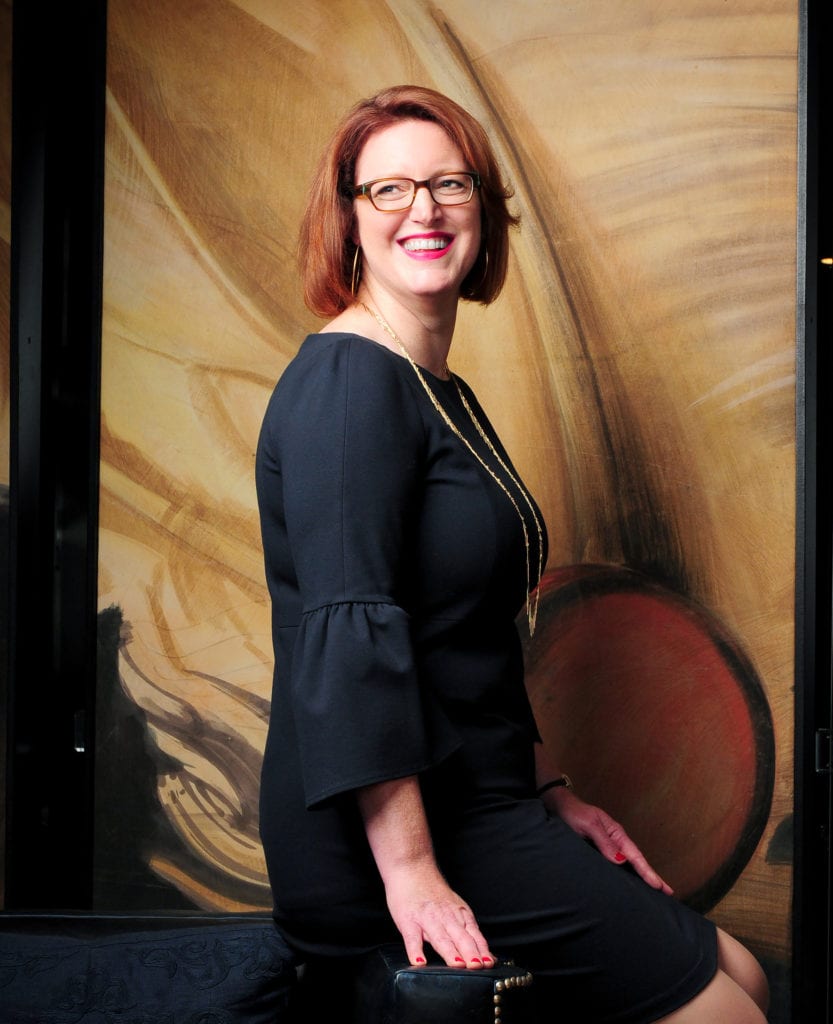 Jennifer Barlament. (Photo by Todd Hull)
Moses’ comments reminded me of the 2008 Nicholas Winding Refn film Bronson, which tells the horrific true story of Michael Gordon “Charles Bronson” Peterson, a notoriously violent and mentally unwell British prisoner who found inner fulfillment as a surrealist painter. It is a visceral, unrelenting look at a deeply troubled mind but also a window into the extraordinary psychological relief found in the arts.
“There have been some theaters who’ve had real success focusing on the prison population,” agrees Moses. The Alliance Theatre’s work in this regard has focused on the Department of Juvenile Justice. “We’ve had partnerships with those correctional facilities and have seen firsthand how arts experiences, in particular storytelling and giving these young people a platform to share their voice and their story, how healing that can be.”
Jennifer Barlament, executive director of the Atlanta Symphony Orchestra, shares Moses’ optimism as well as the potential for the measure to expand the public’s sense of access to the arts.
“There’s this perception about who art is for,” she explains, acknowledging that mediums such as theater and classical music are often seen as the exclusive province of the upper crust. “Reframing it as a tool for health really does expand the set of people who might enjoy and benefit from the arts. There’s all these perceptions that you have to dress a certain way or know a lot of stuff about it. If you reframe it as therapy, then it feels more like any other kind of medicine. It’s the one kind of medicine that nobody is allergic to.”
Barlament goes on to point out that HR1007’s cemented legal status means that going forward, the Georgia government will be required to proceed with the understanding that the arts are important for mental health. It’s an important step in moving beyond the impassioned speeches of people like Fred Rogers and into real, concrete solutions. Like the Alliance Theater, the ASO is keen to contribute to the discussion around mental health.
“For whatever reason, there are a lot of people who are symphony patrons who are medical professionals. We have people who sing in our chorus who are medical professionals,” she says, pointing out that those professionals have seen the importance of the arts in mental health for a long time and that, for them, the Covid-19 pandemic underscored the importance of live music as a communal event. “It’s almost like a collective meditative experience.”
HR1007 was certainly garnering high praise at the administrative level, but I wanted to hear about its potential from someone in the performance realm. For that, I turned to Johns Creek Symphony Orchestra Conductor Henry Cheng.
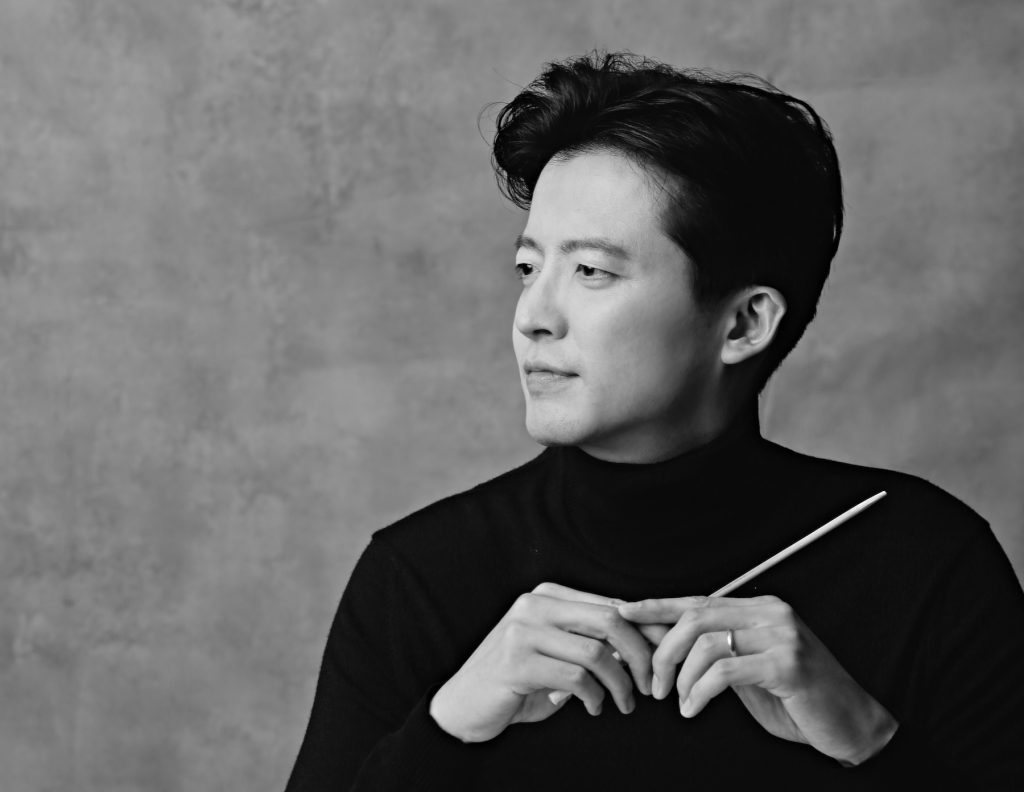 Henry Cheng. (Photo by Jinsoo Lee)
“The idea of healing is not just to give space but to provide access for people,” he explains. “It’s a civic, cultural duty of artistic expression. With Johns Creek Symphony, it’s a question of how we can build that ecosystem at a civic duty level that goes beyond the artistic.”
He shares the hope that HR1007 will circumvent the usual discussions about the importance of funding of the arts and looks forward to realizing the proposition’s wider potential. “If the goal is connection, now addressed on a policy level, the organization’s job becomes ‘How do we make that level of entry as easy as possible while communicating something as high as possible?’ Now the policy exists — what leverage does that give us to move forward?”
The level of excitement around HR1007 is unusual for a mundane ballot measure, but that in itself is a sort of proof of the underlying premise. With three of the state’s leading arts organizations already working toward real mental health initiatives, it’s safe to say the healing has begun.
::

Jordan Owen began writing about music professionally at the age of 16 in Oxford, Mississippi. A 2006 graduate of the Berklee College of Music, he is a professional guitarist, bandleader and composer. He is currently the lead guitarist for the jazz group Other Strangers, the power metal band Axis of Empires and the melodic death/thrash metal band Century Spawn.