
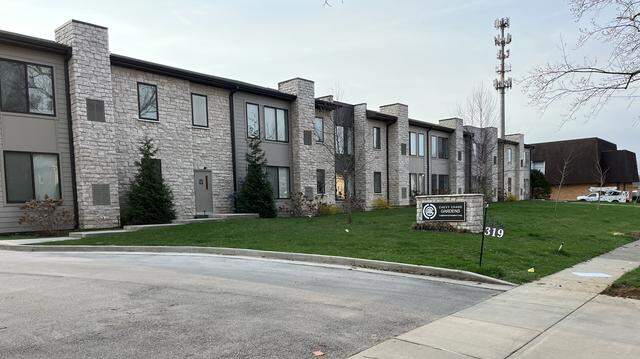
The building at 319 Duke Road was originally built as an assisted living facility, but since then has housed a behavioral health center. Another group specializing in mental health is seeking a conditional use permit for the site.
Linda Blackford
A chorus of boos and jeers erupted Monday night after the Lexington Board of Adjustment voted 4-2 to approve a permit for an inpatient mental health clinic at 319 Duke Road in the Chevy Chase neighborhood.
The vote allows Roaring Brook, a mental health and substance abuse treatment company, to take a step forward on a proposed clinic that would temporarily house patients with mental health disorders for treatment. Chevy Chase neighbors have voiced stark opposition to the project, which was vocalized after Monday’s vote.
“You’re accountable for our children,” “see you in court,” and “we the people” were all shouted immediately following the vote at the conclusion of the nearly six-hour meeting.
Nearly 40 people gave public comment, the majority of whom were Chevy Chase residents outraged about the proposed clinic from Roaring Brook. There was a line out the door of the government center, wrapping around up to the Martin Luther King, Jr. Boulevard bridge for attendees to get a seat at the meeting.
Roaring Brook has insisted that the Duke Road facility will not be a drug treatment clinic, which several Monday speakers and a website alleged it would be.
Roaring Brook applied, along with real estate company ZLD Partners, for a conditional use permit for a “rehabilitation facility.” That permit will allow the company to provide mental health treatment for patients, with a dedicated portion of 52 total patient beds at the facility being reserved for patients with eating disorders. Patients would stay an average of 45 to 60 days, Roaring Brook co-founder Victor Rivera said Monday.
Residents take issue with safety
Matthew Douglas, managing partner of ZLD Partners, said Monday some of the patients who stay at the facility will likely have a substance abuse disorder. But the patients admitted will be people who have a primary diagnosis of a mental health issue.
While people struggling with mental health may additionally have a substance addiction, the mental health diagnosis is the root cause of their struggle and the principal focus of their treatment at the facility.
Even so, plenty of residents said the mental health focus would be too dangerous for the neighborhood.
“What could happen if we have a facility like this in our area? You don’t have to look any further than what happened just less than a year ago with the Rob Reiner family,” Chevy Chase resident Steven Graham said, referencing the murder of the famous Hollywood director by his son.
Nick Reiner, accused of the murders of his mother and father, had previously been open about his struggles with addiction. He also had been in a mental health conservatorship, according to the New York Times.
A recurring argument against the facility is its proximity to Christ the King School, Cassidy Elementary and Morton Middle schools. Opponents fear it would endanger children.
Christ the King’s principal opposes the facility
Ann Bruggeman, principal of Christ the King School, located a half block away from the facility, said most violent attacks against schools are committed not by drug addicts, but by people with mental health issues.
“I’m not worried about all 52 people at this facility,” she said. “I’m worried about the one who has a bad day, the one that leaves even though the doors are locked … no one can prove to me that this is not a safety issue for the schools in the area.”
There were a few speakers who spoke in support of the project, most of whom were either employees or former patients of Roaring Brook’s other facilities.
In a particularly heated moment in the meeting, NAMI advocacy director Kelly Gunning said much of the violence against children in the United States happens in churches and schools, the places neighbors fear could be most impacted by the clinic.
“Most child abuse occurs from people in those settings, many times that we trust with our children — a coach, a teacher,” Gunning said. “Those are people that are hurting our children, too.”
Gunning also raised issue about historical abuses of children in the Catholic church, which caused other attendees to shout and ask the board to remove her from the meeting.
New facility in Lexington would bring ‘so much hope’
Other advocates for the facility focused on how it would have been a great support for them on their journey — especially because they or similar patients are often sent out of state for the type of care Roaring Brook would provide in Lexington, they said.
Kian Johnson has struggled with an eating disorder since he was 12. In 2020, he spent time at a care facility in Florida where he improved. But after moving back home to Lexington, which had no major resources for eating disorders, he began to struggle again.
“When I heard there could finally be a residential program opening in Lexington — Kentucky’s first and only — I felt so much hope,” Johnson said. “I may one day die from this disorder. Saying yes to this will provide access to the treatment that can save my life and the lives of so many of these people who just want to find healing.”
Douglas said much of the motivation behind the project was to provide care that was either extremely limited or not at all existent in Kentucky.
But Jessica Winters, an attorney representing the Chevy Chase neighborhood, argued there are enough facilities like Roaring Brook’s proposal in Lexington.
“Lexington has at least 47 mental health and drug and alcohol treatment facilities … (Roaring Brook) has offered no evidence of unmet need,” she said.
Winters also suggested the facility could increase crime rates in the neighborhood. She displayed a map during the meeting Monday along Alexandria Drive near an existing substance abuse clinic, showing several instances of crime in the direct vicinity.
Roaring Brook has said patients in the facility will be screened and will not be admitted if they are a danger to others or themselves, nor will they be admitted if they are psychologically unstable. Patients will not be permitted to leave the property to walk around the neighborhood.
Patients will not even check in or check out of the facility directly, the company has said. They will be picked up at another Roaring Brook facility on Perimeter Drive and driven to Duke Road.
Bruce Simpson, an attorney representing Roaring Brook who has spoken publicly about his suicide attempt and subsequent treatment, said many of the neighbors’ concerns were driven by fear and intolerance that keep people who need treatment in the shadows.
“The people that need these services, who are suffering in silence right now, aren’t coming (to city hall),” he said. “And they won’t come down here because they if they watch on TV, they will see the passionate opposition that says ‘you’re not worthy to live in our neighborhood.’”
Some argued more appropriate locations would be in commercial, office or industrial zones. But Roaring Brook employee Keith Rapp said a residential area is the proper kind of location for the facility.
“If you put me into a place that is more industrial, I am going to feel like a caged animal,” he said. “If you put me in a place where I get to get outside, see the backyard, see the sun, do some exercise … that’s the place that people like me who suffer need.
“Is it a great area for us? It’s a perfect area for us, because I am not the only person that knows that there are people in the Chevy Chase neighborhood who suffer from mental health disorders, as well as drug and alcohol abuse.”
Lexington Herald-Leader
Adrian Paul Bryant is the Lexington Government Reporter for the Herald-Leader. He joined the paper in November 2025 after four years of covering Lexington’s local government for CivicLex. Adrian is a Jackson County native, lifelong Kentuckian, and proud Lexingtonian.