
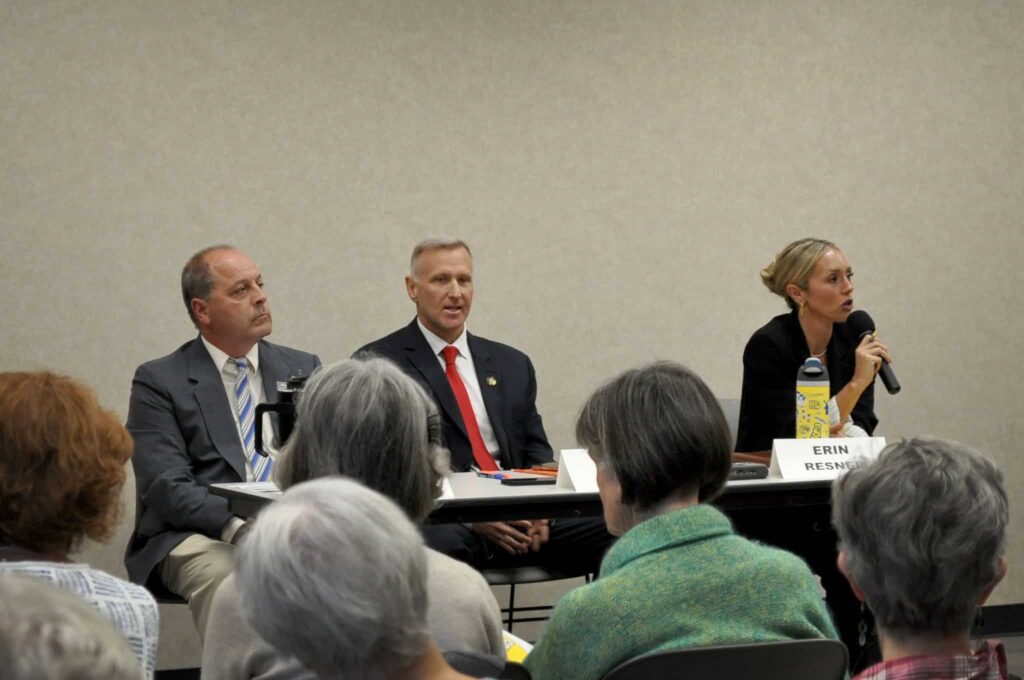
 Seated from left to right, Richard Gallardo, Kevin Crye, and Erin Resner at the League of Women Voters D1 Supervisor Candidate Forum at the Redding Library on April 15. Photo by Nevin Kallepalli
Shasta County voters gathered at the Redding Library community room on April 15, in preparation for a much anticipated election. Supervisor Kevin Crye of District 1 is facing off against Redding City Council woman Erin Resner and commercial driver and election activist Richard Gallardo.
This is not the first time Crye and Resner have run against each other for this very seat. In 2022, Crye beat Resner by a razor-thin margin of just 90 votes. He survived a recall in 2024 by an even thinner margin of 50 votes.
The League of Women Voters hosted the three candidates and presented them with questions submitted by those in attendance. Many of those questions broached political issues that frequently make headlines in Shasta County: a lack of healthcare providers, legal debates over local election law, the county’s mental health infrastructure, approaches to reducing homelessness, and the palpable tension at county board meetings.
Between these varied topics, particular themes emerged for each candidate. Resner expressed repeatedly that she is committed to collaboration, dialogue, and resolution — even with people with whom she may disagree.
“We do not have to agree on everything, we do not have to see eye to eye — honestly, I think that would be a very boring word,” she said. “But when we work together, we listen to each other, it takes down the temperature, and we can solve real problems.”
Resner also took direct aim at Crye for his approach to leadership, noting his combative interactions at public meetings with supervisor colleagues Matt Plummer and Allen Long and reminding the public of Crye’s opposition to a grant proposal for a new behavioral facility in Shasta County.
In turn, Crye cited financial troubles in Resner’s jurisdiction, referring to himself a fiscally-responsible leader and saying his outcomes are more important than the way he may carry himself in meetings.
“The bottom line is, many of you may not like how I say things, but you like the result,” he said.
Gallardo took a consistent approach throughout the question period, blaming nearly every local problem on the California state government, which he characterized as “egregiously tyrannical.” Then, when asked about a lack of healthcare and housing resources, he questioned whether these things were really structural problems in Shasta County at all.
The room was packed with about 150 people, with every seat taken and many more people standing around the perimeter of the space. Moderators urged the audience not to clap or shout in response to the speakers, and the audience remained much more placid than at many county board meetings.
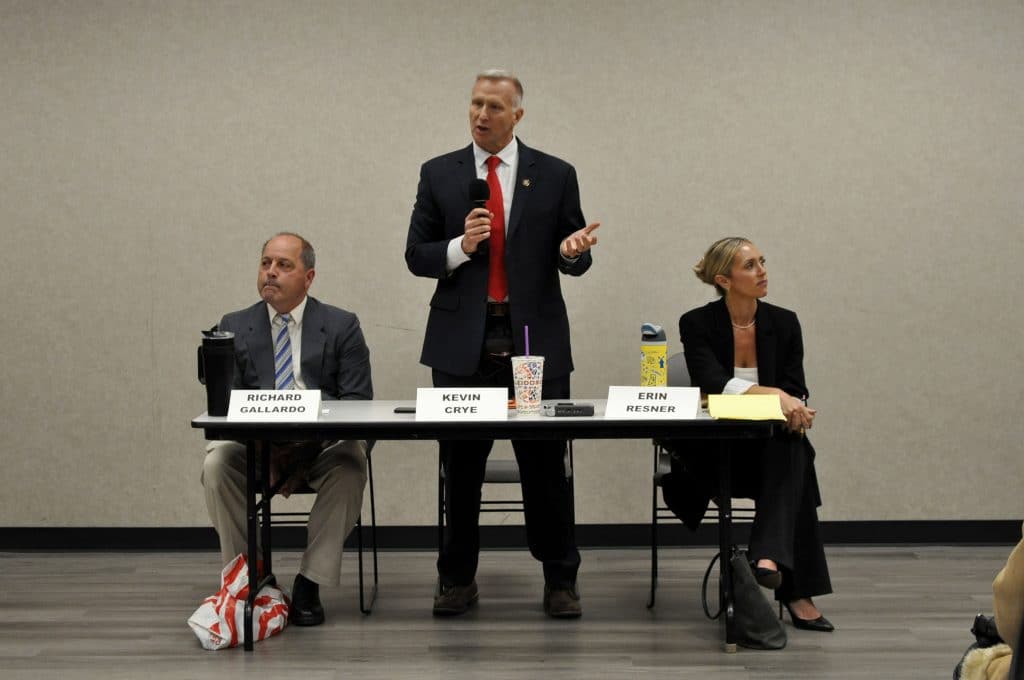 Richard Gallardo, Kevin Crye, and Erin Resner at at the League of Women Voters D1 Supervisor Candidate Forum at the Redding Library on April 15. Photo by Nevin Kallepalli
On some topics, candidates found relative agreement. One of those was their shared optimism about the possibility of establishing a local medical school — though Gallardo warned about the danger of relying on state and federal funds, and floated the idea of the medical school including a homeopathic track.
Candidates were also asked about Measure B, a voter-led initiative that would bring a slew of significant changes to local election law, many of which would likely be illegal to implement under state and federal law. Gallardo verbalized strong support for the measure, prefacing his comments with the disclosure that he was directly involved with the initiative. Crye emphasized his belief that “it will pass resoundingly in Shasta County.” And Resner said she inherently supports voter ID requirements, adding “that anybody would be hard pressed to say that you don’t need some sort of election reform.” None of the candidates addressed the fiscal cost of Shasta being sued by the state if the measure passes, as happened in Huntington Beach.
A series of questions about recruiting more healthcare providers and bolstering mental health resources showed the candidate’s stronger divides. “What can the county do to attract medical professionals; how will you engage stakeholders such as community health centers?” one audience member asked via the moderator.
While Crye deferred to the idea of establishing a medical school as a long-term solution, Resner warned about the impact of Google searches on the county’s reputation saying Shasta County’s “circus” has repeatedly made national news and noting how that might dissuade qualified medical personnel from wanting to relocate here.
Building on Resner’s concerns, Gallardo shared his belief that “local alternative media” has a role in how Shasta’s digital footprint is shaped, adding that Google will intentionally show negative results about Shasta based on the search prompt.
Candidates sparred over a question asking about how to deal with the county’s mental health needs. Gallardo again shifted the blame on state policy, and posited that pharmaceutical drugs themselves are too easily accessed by people with mental health needs.
“It says right on the bottle, may cause suicidal ideations,” Gallardo said, asking “how can you get good, effective counseling to somebody when their minds are sideways with all these psychotropic drugs?”
Crye used a metaphor of standing by a river downstream and seeing babies floating in the water. Rather than saving the babies one by one as they float to the end of the river, he explained that he’s focused upstream on childhood interventions. He also shared his support for specific local programs including Visions of the Cross and the Good News Rescue Mission.
Resner prefaced her answer by saying that issues related to mental health are extremely complicated and can’t be summed up succinctly, emphasizing that collaborating with other rural counties is key to demanding resources from the state for more rural areas. She accused Crye of giving people “his version of reality,” while criticizing him for supporting a proposal for youth behavioral health services which has elicited widespread community concern.
Perhaps the candidate’s most succinct answers came in response to a simple question: in your opinion, what are the biggest challenges facing Shasta County? Crye said “it starts with the economy and our taxes,” prioritizing fiscal responsibility first, followed by public safety and healthcare. Resner answered, “mental health, mental health, mental health,” expressing her belief that mental health inequities touch almost every family in Shasta County, spilling over into public safety concerns. Gallardo said he’s concerned about crime, mental health and public health but noted that it all starts with finances as money drives everything.
“And I’m not gonna repeat what I said earlier about the federal government being broke. They’re broke. They’re broke, folks,” Gallardo repeated. “We have to get the community engaged at all levels to help fix all problems in Shasta County.”
Do you have a correction to share? Email us: editor@shastascout.org.