
***WARNING: The following article contains discussions about death by suicide. Viewer discretion is advised.***
WASHINGTON (TNND) — President Donald Trump on Saturday signed an executive order directing federal regulators to accelerate the review of certain psychedelic drugs so it can be used to treat post-traumatic stress disorder (PTSD) and traumatic brain injuries in military veterans.
“I’m pleased to announce historic reforms to dramatically accelerate access to new medical research and treatments based on psychedelic drugs,” Trump said during a news conference from the Oval Office.”In many cases, these experimental treatments have shown life-changing potential for those suffering from severe mental illness and depression, including our cherished veterans,” he added. “Our veterans are having a tremendous hard time. You know, the suicide rate, we have it down a little bit, but they are having a hard time.”
Trump said the suicide epidemic among veterans is “a national tragedy.” He said 21 times more veterans have died due to death by suicide in comparison to combat duty since 9/11.
“And today, we’re bringing them new hope,” he said. “I think you are going to see a big difference and a big reduction in that number.”
The president went on to cite a 2024 study from Stanford University, noting that 30 special operations veterans with traumatic brain injuries underwent “ibogaine treatment.” He said they experienced an 80% to 90% reduction in symptoms of depression and anxiety within one month.
“Can I have some, please? I’ll take some,” Trump said. “I’ll take whatever it takes.”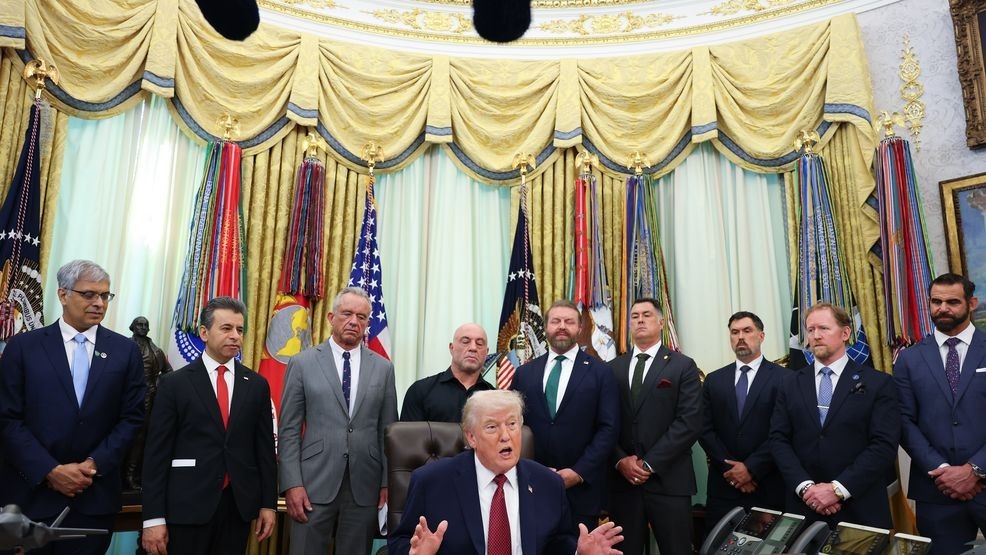
WASHINGTON, DC – APRIL 18: U.S. President Donald Trump speaks in the Oval Office before signing an Executive Order April 18, 2026 in Washington, DC. The executive order directs the Food and Drug Administration to issue new guidance on the use of psychedelic drugs intended for clinical trials for U.S. veterans suffering from Post Traumatic Stress Disorder. (Photo by Tasos Katopodis/Getty Images)
Ibogaine and other psychedelics remain banned under the federal government’s most restrictive category for illegal, high-risk drugs. But the Trump administration is taking steps to ease restrictions and spur research on using the drugs for medical purposes.
The executive order instructs the Food and Drug Administration (FDA) to prioritize and fast-track applications for treatments that have shown early promise for PTSD and traumatic brain injury, as well as conditions such as depression, anxiety, and other mental health disorders.
The FDA’s “breakthrough therapy” designation is reserved for drugs that demonstrate substantial improvement over existing treatments in preliminary studies. Trump’s order aims to shorten the timeline for those therapies to reach patients.
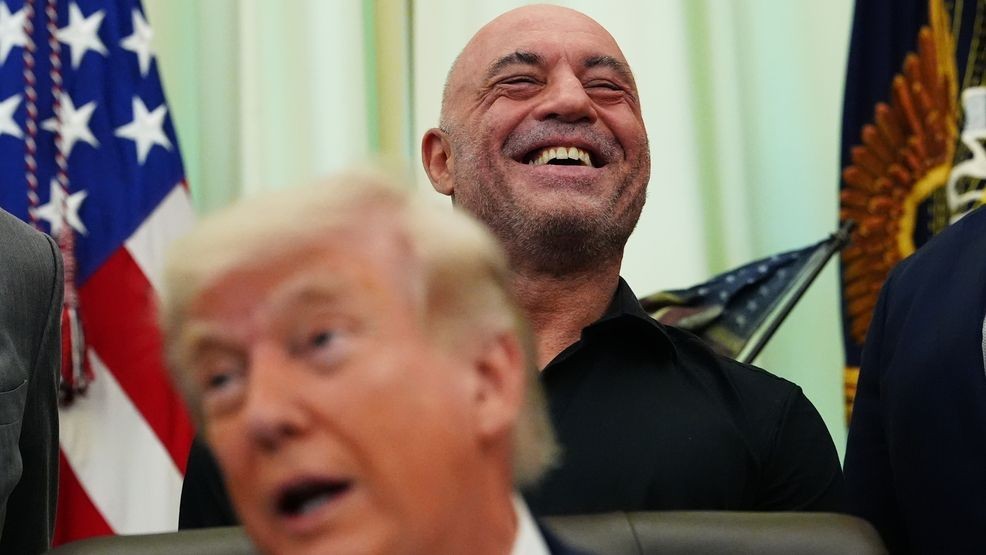
Joe Rogan laughs as President Donald Trump speaks in the Oval Office of the White House, Saturday, April 18, 2026, in Washington. (AP Photo/Julia Demaree Nikhinson)
Joining Trump in the Oval Office were his top health officials, podcaster Joe Rogan, and Marcus Luttrell, the former Navy SEAL whose memoir about a deadly mission in Afghanistan was the basis of the film “Lone Survivor.”
“You’re going to save a lot of lives through it,” Luttrell told Trump during the ceremony. “It absolutely changed my life for the better.”
Critics, however, cautioned that accelerating the approval process could raise concerns about safety and oversight, emphasizing the need for rigorous clinical trials before widespread use.
Trump’s action surprised many longtime advocates and researchers in the psychedelic field, given that ibogaine is known to sometimes trigger potentially fatal heart problems. The National Institutes of Health briefly funded research on the drug in the 1990s, but discontinued the work due to ibogaine’s “cardiovascular toxicity.”
“It’s been incredibly difficult to study ibogaine in the U.S. because of its known cardiotoxicity,” said Frederick Barrett, director of the Johns Hopkins Center for Psychedelic and Consciousness Research. “If the executive order can pave the way for doing objective, scientific research with this compound, it would help us understand whether it is truly a better psychedelic therapy than others.”
No psychedelic has been approved in the U.S., but a number of them are being studied in large trials for various mental health conditions, including psilocybin, MDMA and LSD. All those drugs remain illegal, classified as Schedule I substances.
_________________
EDITOR’S NOTE: The Associated Press contributed to this report.