
Patients enter their local pharmacies every day to pick up their prescription, ask a few questions and leave. But these short interactions often do not touch on the additional challenges patients carry with them: mental health concerns, substance use issues and food insecurity, among them.
An initiative co-founded by Andrew Peterson, Ph.D. ’09, PharmD, professor of pharmacy, known as the Behavioral Health Pharmacy Advocates program, is trying to change that.
Peterson said pharmacists are among the most accessible healthcare professionals in the country, yet they are rarely trained to respond to behavioral health needs that show up in these daily interactions.
“Pharmacists can be front-line behavioral health advocates,” Peterson said. “They’re already positioned there, seeing patients regularly, mostly without an appointment.”
From bystanders to advocates
In the 2021-2022 school year, Peterson and Toyin Fadeyibi, PharmD, a Philadelphia-based public health pharmacist, led a post-graduate training program where they trained one pharmacist to be able to better address behavioral health concerns. By the end of the year, Peterson and Fadeyibi wanted to expand their reach to more pharmacists.
Kelvin Lu ’20, PharmD ’22, practitioner educator at St. Joe’s, was in the residency program with Peterson and Fadeyibi during this time. Lu helped create a statewide analysis to inform the development of the BHPA program and ensure it “addressed the challenges experienced by pharmacists.”
Between October and November 2022, Lu surveyed pharmacists, technicians and student pharmacists and found over 90% of pharmacy personnel understood the importance of behavioral health screenings but lacked the training and resources needed to conduct them.
In 2023, Peterson and Fadeyibi co-founded BHPA to close that gap. The program, which partners with Community Behavioral Health in cooperation with Pennsylvania Pharmacists Association, was first offered in November 2024 and has since trained 86 pharmacy personnel, including 31 pharmacists, 52 pharmacy students and three pharmacy technicians.
The program requires 14 hours of training that combines online modules with an in-person session. Participants learn how to screen for behavioral health conditions, communicate with patients and refer them to local resources like treatment centers and food banks.
“The vision isn’t for pharmacists to replace mental health professionals,” Peterson said. “It’s for them to serve as an accessible bridge to care.”
John Toner, project manager for BHPA, describes it as adding another layer of support in a fragmented healthcare system.
“We’re another safety net, essentially, for patients that might not see health care practitioners, other than their pharmacist, as often,” Toner said.
Grounded in everyday encounters
Patients may only see a doctor once or twice a year, but they often visit pharmacies monthly. This frequency creates opportunities for patients to receive help, if pharmacists know what to look for.
Pharmacists are already trained to monitor patient safety in other ways — learning in school how to recognize when patients are refilling prescriptions too frequently, when dosages may be unusually high or when drug combinations raise red flags — and they routinely communicate with prescribers to resolve these concerns.
Through BHPA, trainees extend this attentiveness to other behavioral health concerns, learning to identify subtle warning signs like changes in appearance or even offhand comments about stress. They also learn how to act without overstepping.
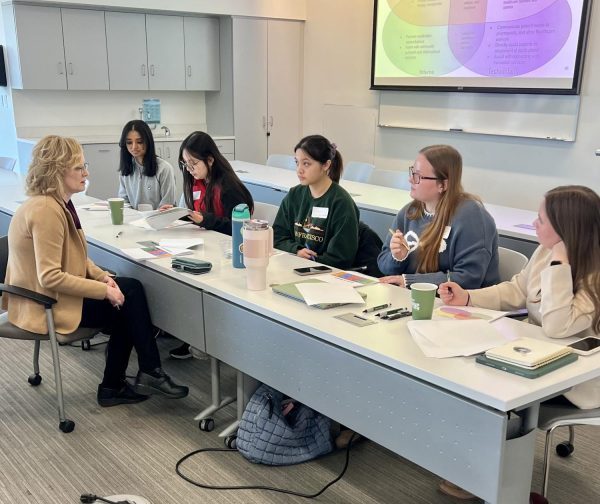 Behavioral Health Pharmacy Advocates program trainees learned how to screen for behavioral health conditions, communicate with patients and refer patients to local treatment centers and food banks.
“You never want to assume that someone needs or even wants help,” said Carly Robinson ’26, PharmD ’28, who completed the program in February. “We must curate an environment in which patients feel safe and comfortable to ask for help when they need it.”
For Reanna Paxton ’25, PharmD ’27, who completed the program in November 2024 and joined BHPA in 2025 as a student intern, the training reshaped how she sees her future role.
“If you’re going to be front facing and you’re going to be working with patients, it’s just so much easier to get these patients the help that they need if you know how to screen them, you know what to look for, you know where you’re going to be able to send them before you even decide what sort of help they need,” Paxton said.
One of the program’s most practical tools is a resource database. By entering a ZIP code, pharmacists can locate nearby services such as shelters, food banks and rehabilitation programs.
“You just see how many things are offered that people probably have no idea about and people could utilize so much more,” Paxton said.
That focus on social determinants of health — factors like housing, transportation and food access — is central to BHPA’s approach.
The training also emphasizes language used to talk about sensitive topics without stigma. That includes shifting from labels to person-first language and learning how to start conversations patients may not initiate themselves.
Early results
To measure impact, the program uses pre- and post-training surveys to assess participants’ confidence and skills. The results have been promising, said Toner.
“We see improvement across the board after every single training,” Toner said, noting that follow-up surveys sent two months after the training show strong retention.
The program has also received recognition at national pharmacy conferences, signaling growing interest in the model.
Still, challenges remain.
Pharmacists face time constraints, heavy workloads and limited reimbursement for services beyond dispensing medication, according to Peterson. There is also lingering stigma — both from patients and within the profession itself.
“In behavioral health specifically, many pharmacists simply haven’t been trained to have conversations about mental health, substance use or social needs, and they don’t feel confident doing so,” Peterson said.
Even when pharmacists are willing, structural pressures can get in the way.
“Community and retail pharmacies are saturated with patients and prescriptions,” Robinson said. “Many pharmacists feel the pressure from managers and corporate offices to hit quotas for scripts and vaccines rather than provide quality patient care.”
A shift in how care is delivered
BHPA expands patients’ access to care by working within an existing system rather than building a new one from scratch. It also challenges assumptions about what pharmacists can do.
“Our role spans so much more than just talking about prescriptions,” Robinson said. “Pharmacists are easily accessible public health professionals that can help patients in all aspects of their healthcare.
That shift is already visible in small moments: a pharmacist asking one more question, offering a resource or simply recognizing something isn’t right.
Paxton works at a pharmacy in Howell, New Jersey, where she said she is able to apply what she has learned through the BHPA program.
“People come in, and the first thing they’ll say is, ‘This medication isn’t working, and it’s freaking me out,’” Paxton said. “And then the pharmacist comes over and you come over and you just all have a discussion about what it could be.”
That is what BHPA’s mission is all about, according to Peterson.
“BHPA is about transforming pharmacy personnel from bystanders into advocates, giving them the knowledge, tools and confidence to identify patients in need and act,” Peterson said.