
Who knew college students were the most
stressed members of their generation?
Pointing to the numerous behavioral health resources available to its members, United Healthcare (UHC) has released results of a YouGov survey in which
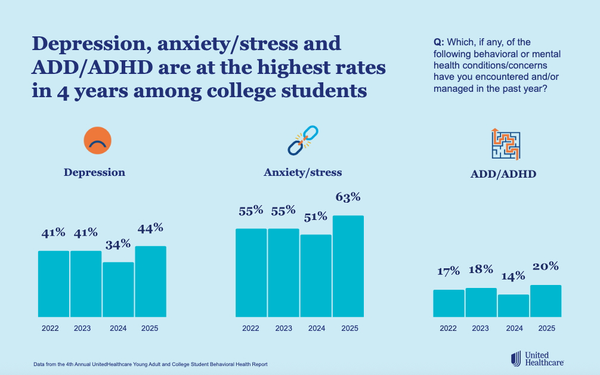
62% of 18- to 28-year-olds reported they or a roommate/friend had experienced a mental or behavioral health concern in the past year. The number was greater for college students (69%) than for other
young adults (54%), with the former group’s rates of anxiety/stress, depression and ADD/ADHD at the highest levels in the four years that UHC/YouGov has done the Young Adult & College
Student Behavioral Health Report.
Showing what UHC called differences in awareness, only 43% of parents of college students reported that their children had mental or behavioral health
concerns. With young adults not in college, the parents’ perception was in line with their children’s.
advertisement
advertisement
UHC suggested that digital tools like AI-based platforms can help provide
mental health support for college students and other young adults.
Specifically, the study found, 31% of respondents or their friends/roommates had used AI for symptom exploration, information
gathering or coping strategies over the past year, with 26% of such users turning to AI “for companionship, reassurance and/or emotional support.”
Furthermore, UHC said, 25% of
respondents who reported not seeking help for their behavioral or mental health concerns cited cost as a barrier, “underscoring how affordability can influence whether individuals seek
care.”
“To help address these challenges and improve access to care,” UHC said it offers such resources as 24/7 mental health support telephone lines; digital coaching, a
Calm Health app, employee and student assistance programs, a peer support program, in-person and virtual care option, and – for youth and their parents – conversation starter
cards.
Some “good news” noted in the report: 74% of young adults are “currently enrolled in an insurance plan,” with 81% of college students enrolled, compared with
just 65% of other young adults. A similar discrepancy was shown when it came to the insured knowing how to access behavioral and mental health services through their plan (69% for college
students, 50% for other young adults).
The report offered these four suggestions for supporting young adults in the behavioral/mental health area: Focus on quality conversations, not just
frequency; encourage access to care; strengthen insurance literacy and care navigation; and guide safe use of AI.
For college students, UHC has an insurance division called UnitedHealthcare
Student Resources.
The Young Adult & College Student Behavioral Health Report, conducted online in October, surveyed a total sample of 2,031, of whom 501 were college students, 523 were
parents of college students, 502 were young adults not enrolled in college, and 505 were parents of young adults not enrolled in college.