
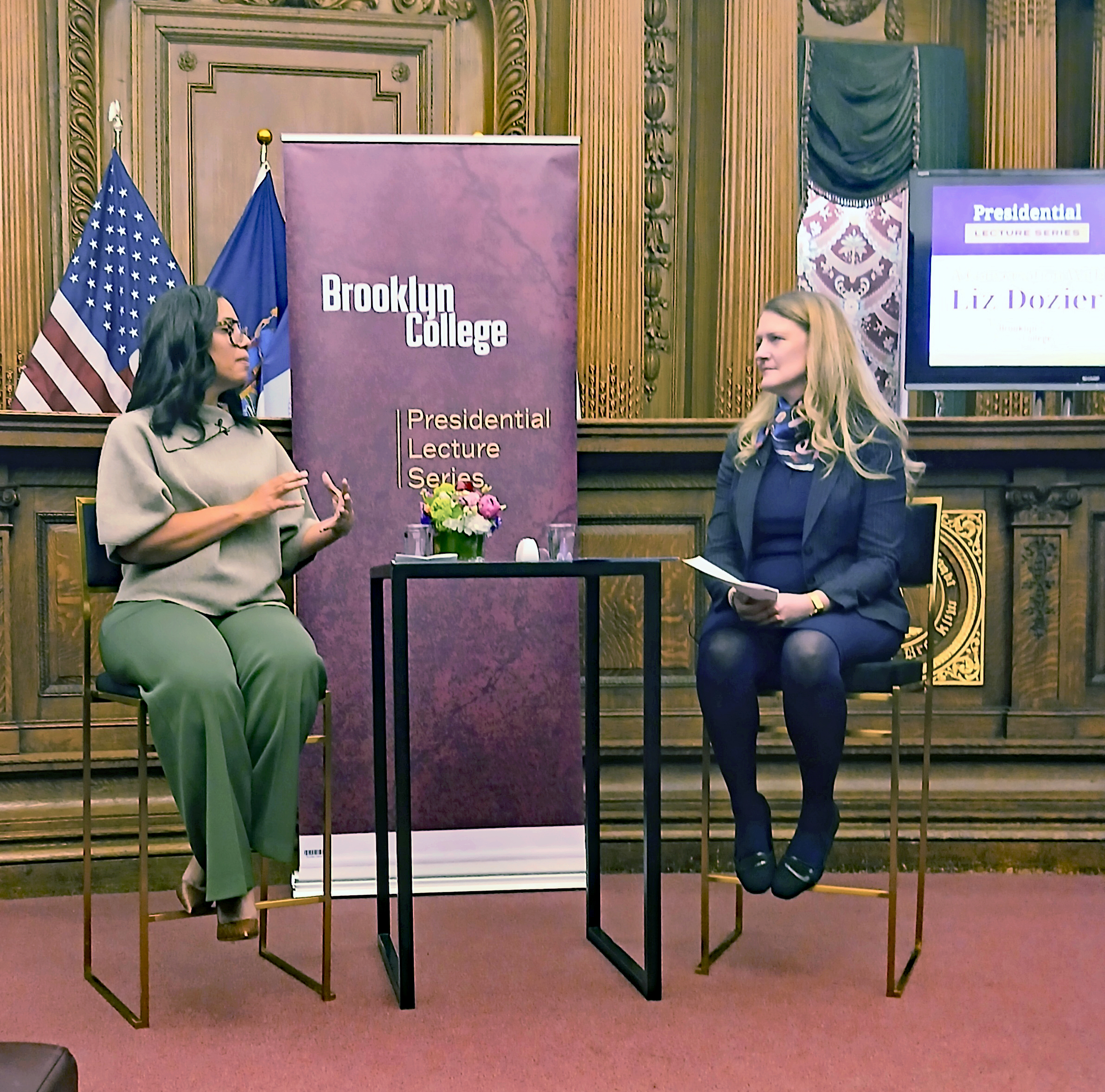
CEO and Founder of Chicago Beyond, Liz Dozier and Brooklyn College President, Michelle J. Anderson
elaborate on the challenges women face with Maternal Mental Health.
Photo by Dawn Plummer
As the month of May kicks in, several campaigns are lauded for declaring the month as “Child’s Month,” “Mother’s Day,” etc. However, one significant and challenging observation that is also marked during this tenure is the problematic concerns of Maternal Mental Health.
Last Thursday evening at Brooklyn’s Borough Hall, Brooklyn Borough President Antonio Reynoso and Brooklyn College President Michelle Anderson collaborated to continue piloting efforts to raise awareness of Perinatal Mental Health and the crisis that surrounds maternal mental health.
The partnership between the Borough President’s office and Brooklyn College led to a meaningful two-day summit discussion on its first day, which featured Chicago’s Beyond Founder and CEO, Liz Dozier, as an invited guest.
In recognition of maternal mental health month, the conversation explored how higher education, philanthropy, and community partnerships can develop effective solutions to address maternal mental health, particularly among Black women. How can organizations and education provide resources for mothers facing the difficult transition?
At Borough Hall, the Borough President welcomed the group of medical professionals to the opening of the summit and pledged his continued support for the challenges women in underserved Brooklyn neighborhoods face during and after pregnancy. Mr. Reynoso said that helping sponsor the program and working with Brooklyn College to get resources to communities to make services more available are policies his office will support.
The Chicago Beyond CEO said it was important to raise awareness, reduce stigma, and promote treatment of perinatal mood and anxiety. Ms. Dozier continued her discussion, noting that the problems that Black women face when it comes to maternal mental health are often “overlooked and unseen.” She noted that Chicago Beyond has implemented programs to help turn the problems around by providing mental health services to the communities. Ms. Dozier said that the conversations are important, “to innovate systematic changes and make way for racial and gender justice.”
Brooklyn College President Michelle Anderson, for her role in the partnership, explained the plans the college has undertaken to help combat the crisis through education. Ms. Anderson reminded the audience of the Perinatal Mental Health (PMH) courses currently being offered at Brooklyn College since Spring 2025.
The credit-bearing one-year program is a 120-hour in-person clinical program and features a flexible, innovative synchronous online format, allowing students to continue their careers while learning.
The Brooklyn College President also used the opportunity to thank both the Borough President Reynoso and New York Senator Chuck Schumer for sponsoring the program at Brooklyn College and for their continued support in raising awareness of the problem of maternal mental health.
 Panelists discuss maternal mental health challenges at the Greg Jackson Center in Brownsville, Brooklyn.Photo by Dawn Plummer
On the final day of the two-day summit at the Greg Jackson Center for Brownsville, in Brownsville, Brooklyn, a group of medical professionals, including OB-GYNS, midwives, birthing parents, doulas, young mothers, and fathers, shared experiences on what maternal mental health means to each one and how it has affected each one as well as their families. Without naming anyone, the panelists also shared some of the concerns and challenges their patients have endured during the critical time.
The campaign aims to also highlight the length of time some mothers struggle through the crisis, “…for at least a year,” while still taking care of the child. This, the medical professionals said, heightens their efforts to reach multiple communities and educate them about available services.
The month of May is observed as Maternal Mental Health Month. One week is specifically observed, May 3 – May 9. This gears to emphasize support for parental disorder and the critical transition that comes with postpartum depression, and how important it is to discuss the feelings that come with the mood.