
Zachary Capp is a self-described gambling addict. He’s been to rehab for his addiction twice in the last 11 years. The first time it was because the Las Vegas native couldn’t stay away from casinos, sports betting and daily fantasy sports websites.
The second time occurred as a result of his compulsion for trading cards. To be more specific, his obsession with winning valuable cards through online “live breaking” platforms, primarily on Whatnot — one of the trading card industry’s largest online sales platforms. And when he landed a multi-million-dollar card most collectors could only dream of, it only made the problem worse.
Breaks are a high risk, high reward form of collecting in which participants buy the rights to certain cards, usually by team or individual player and sometimes at random, within a certain number of unopened packs or boxes. It can give participants a better chance at getting a rare and valuable card, but it can also result in walking away with little to nothing if the packs involved don’t contain that player or team.
“The thing driving me was never the cards,” wrote Capp, a 38-year-old filmmaker. “It was the hype. The games. The way each break was presented as something you could not afford to miss. The rush of the reveal. The particular agony of the near miss. … I was chasing a feeling I had first learned in casinos, now delivered directly to my phone, available at any hour of any day, packaged to look exactly like a normal thing that normal people did for fun.”
Capp estimated losing “hundreds of thousands of dollars” on Whatnot’s platform when calculating how much he spent compared to the value of the cards he received in return.
More than 60 Whatnot users have filed arbitration claims, according to attorney Paul Lesko, who is representing them, accusing the company of conducting an unlawful gambling scheme and violating the RICO Act by allowing sellers to hold randomized box breaks and randomized repack breaks on its platform. Within the filings, Whatnot users claim randomized box breaks violate California’s ban on illegal lotteries. (Whatnot was incorporated in Delaware, but its headquarters is in California.)
Whatnot’s terms of service require users to resolve disputes through a private arbitration process rather than through the public court system.
“Whatnot represents that it operates a ‘marketplace’ where live-shopping helps connect ‘buyers’ and ‘sellers.’ This is a false front,” the filings claim. “Functionally, Whatnot operates an unregulated online casino where it exploits its customer base by encouraging compulsive spending and in the process generates billions in revenue without providing the safeguards required of regulated gambling operations.”
Capp is not part of the arbitration complaints, but the crux of the company’s response to the allegations infuriated him: “Gambling isn’t allowed on Whatnot, and we strictly enforce this policy.”
“We absolutely reject the characterization in this complaint,” Whatnot’s statement said. “Card breaks are a long-standing format in collecting — at card shops, conventions, and in communities that have thrived for generations. And while sellers who ‘break’ only make up 4 percent of sellers on our platform, we’ve taken care to bring that experience online in a way that holds everyone accountable.”
“Whatnot’s statement does not describe what I experienced,” Capp said. “The people filing those claims are not confused or misguided. … They are not alone.”
Whatnot declined to comment on Capp’s claims.
Capp said he doesn’t intend to single out Whatnot. Breakers on other sites, like Fanatics Live — which also does not describe itself as hosting gambling — have similar practices.
“This is a systemic issue across the entire live-break industry,” Capp said. “They (Whatnot) are the biggest player, but the predatory practices and the lack of regulation are industry-wide.”
Breaks have exploded in popularity among trading card enthusiasts over the last decade, powered by the growth of live selling. Whatnot says it accounts for 60 percent of a $22 billion live selling market, and that sports cards are its No. 1 category with more than 6.4 million cards purchased by its users in 2025.
Capp said he hopes the negative impact online breaks had on his life can serve as a cautionary tale, even for those who land a multi-million dollar card while using Whatnot’s platform like he did.
Anyone who’s watched season one of the Netflix series “King of Collectibles: The Goldin Touch” might remember Capp.
He and two other men — Kevin Parker and Jason Hickey — sat across from Ken Goldin, founder and CEO of Goldin Auctions. They were offered $1 million up front to consign a widely coveted one-of-one LeBron James 2020-21 Panini Flawless triple NBA Logoman patch card (bearing the NBA logo patches from three of James’ game-worn jerseys), which they had won through an online box break on Whatnot.
Breaks involve a dealer selling the rights to a configuration of cards from sealed packages (usually large quantities of them) before they’re opened. While participants can often select the exact team or player they want to buy, randomized breaks are also common, where someone bids on a spot blindly, and the spin of a wheel or a randomizer app determines which exact player/team the participant receives.
Capp, Parker and Hickey didn’t know each other before entering the live-streamed break — through Whatnot vendor Backyard Breaks — in which they hit the James card. Capp held the Miami Heat spot, Parker snagged the Los Angeles Lakers slot and Hickey landed the Cleveland Cavaliers spot in the random team break, and since the card included patches from James’ jerseys for all three teams, they shared ownership. In November 2025, Parker filed a lawsuit against Whatnot in U.S. District Court in Utah alleging the company operates an illegal gambling enterprise; the lawsuit does not include Capp or Hickey. Whatnot subsequently filed a motion to compel arbitration, as per its terms of service, which has not yet been ruled on.
Even as a recovering gambling addict, Capp didn’t equate the action of winning the James card in May 2022 with what forced him into rehab in 2015. Not even with the purchase of a blind spot followed by the spin of an electronic “roulette” wheel, with team names rather than numbers. (Whatnot eliminated randomized wheel spins earlier this month amid the gambling allegations.)
“Box breaks can literally be considered the hobby form of gambling,” Goldin said in the premiere episode of the show (this James card served a storyline in episodes one, two and four). “It can cost as much as $20,000 to open up a box, and there’s no guarantee of return.”
Capp discovered Whatnot during COVID lockdown, and viewed his rabid spending as simply being a part of “the hobby.”
“I told myself I was a collector,” Capp said. “An investor. The sports card hobby has real economics. Players break out, rookies become stars, certain cards appreciate dramatically. There was always enough logic available that I could arrange it into something that felt like a rational decision.
“Every single time.”
So when Capp struck gold with the James card, it felt more like a childhood pull from a box of basketball cards than winning the lottery. Goldin, during episode three of the Netflix series, equated hitting the card with winning the “Willy Wonka and the Chocolate Factory” golden ticket.
Goldin convinced the trio to consign the card with his auction house, where it sold for $2.4 million via auction on June 25, 2022. Capp, Parker and Hickey each ended up with around $770,000 after the auction house took its percentage.
“I don’t know what the future has in store, but it’ll be life changing,” Capp said during the episode.
Instead, Capp, producer of the 2019 documentary “The Ringmaster,” who still resides in Las Vegas, says it brought him back to a life that was all too familiar.
He kept buying into breaks on Whatnot, chasing cards of prospects and young players seemingly with upside in their values. Sometimes he’d hit. But the majority of the time, he didn’t. The result mirrored what happened to him when he was addicted to casino games, sports betting and daily fantasy sports.
“The screen is a cacophony of stimuli,” Capp wrote in an email to The Athletic describing his online box break experiences. “There is a host, usually charismatic and always energetic, opening boxes and reacting to every card. There are games layered on top. Randomized wheels spin to assign teams …. Countdowns and reveals are calibrated for maximum tension. Brightly colored alerts ping constantly to celebrate the latest purchaser while a text chat sidebar scrolls by so fast it is impossible to read, filled with emojis and hype.
“Hosts talk about ceilings and floors to frame what a spot might be worth. They say things like the case hit has to still be in there and you’ve got to jump in on this one. Big spenders get celebrated.”
Capp said Whatnot’s programming felt like every element was engineered to keep buyers in the live stream. He watched people on Whatnot spend thousands of dollars on breaks in a single sitting, buying spots that yield nothing and walking away with no cards, just the experience of having tried. He’d watch people buying into break after break, chasing an ultra-rare card that would justify everything they had already lost.
And he was just as susceptible as anyone else.
“I told myself it was shopping, even as I felt the old patterns returning,” Capp said. “The losses become motivation instead of warnings. The inability to stop at any point that made rational sense. I kept calling it a hobby because calling it what it was would have required me to stop. And I did not want to stop.
“I had been here before”
After being forced into his first rehab stint by family and friends, he eventually recognized the pattern himself this time, and entered rehab on his own in spring 2024.
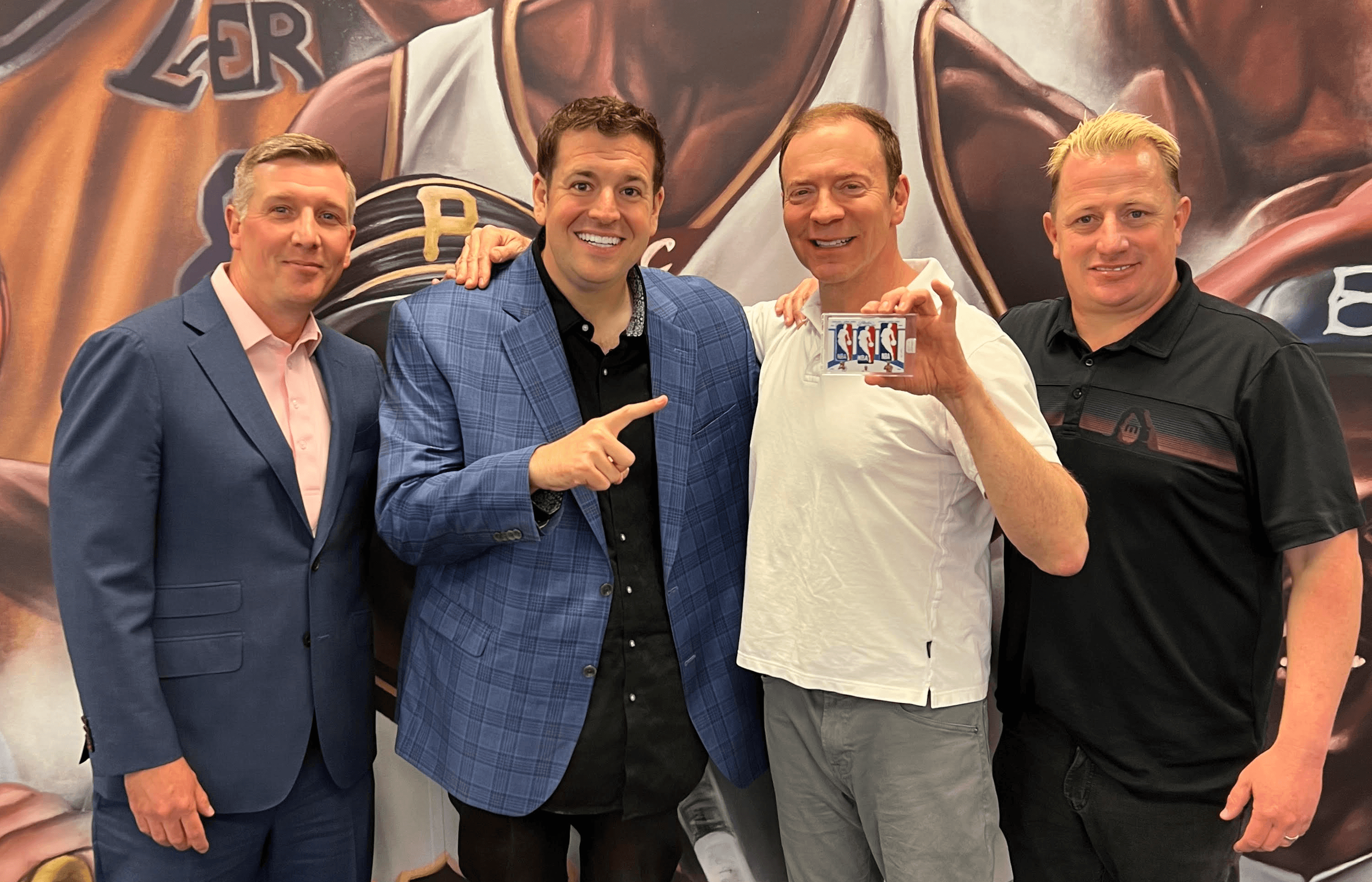
From left to right: Jason Hickey, Zachary Capp, Ken Goldin, and Kevin Parker pose with the LeBron triple Logoman card. (Photo courtesy of Zachary Capp)
Marc Lefkowitz, director of gambling recovery for Carlsbad Beach Recovery, treated Capp during his second rehab stint. He’s familiar with the connection between collectibles and gambling, having owned trading card shops from 1987-2001.
“Many new sports gamblers that come to me for treatment end up having a connection with sports cards, and never mention it unless asked, and don’t view it as an issue until they begin treatment,” Lefkowitz said. “I’m getting calls from parents where their 15-, 16-year old kids are stealing their money to go on Whatnot or to go on Fanatics and the parents don’t know what to do. … It’s a whole new phenomenon of gambling.”
Capp said during his treatment that Lefkowitz pointed him to GamBan, an app designed for people in recovery which blocks access to gambling sites and platforms across devices. Capp reached out to GamBan in the hopes the app would include online trading card live stream platforms like Whatnot, Fanatics Live and others as sites the app could add to its banned list for users.
GamBan agreed, adding such sites as Whatnot and Fanatics Live to its list of more than 490,000 banned gambling sites.
When asked for comment about the classification by GamBan, Fanatics Collectibles sent a statement to The Athletic: ”Fanatics Live is a live commerce marketplace where the experience of purchasing and break trading cards is rooted in community building, passion for the hobby, and providing pricing and location accessibility. We are proud to offer collectors a fun way to purchase trading cards and engage with the hobby they love.”
GamBan’s Matt Zarb-Cousin said online breaks on the hobby’s most popular streaming platforms use “pretty blatant gambling mechanics” that aren’t regulated by any gaming enforcement agency. He said GamBan works closely with Collectors MD, a support group that helps card collectors “navigate compulsive spending, modern break culture, and hobby burnout,” to determine which sites to add to the banned list.
“There’s the nature of gambling addiction,” Zarb-Cousin said. “If you self-exclude and say ‘I’m going to quit that form of gambling,’ it can very easily fall into displacement activities which have gambling elements. Collectibles is an example because you’re basically spending money on an opportunity to obtain something that you don’t know what the outcome is. It’s an element of chance there, and that thing that you obtained could be worth a lot of money.
“So (collectibles are) very, very similar to gambling. We looked at that and we thought that’s something that we wouldn’t encourage people who are already addicted to sort of conventional forms of gambling to get involved with”
Capp said it’s been more than two years since he’s been on Whatnot or similar sites. While his experiences occurred primarily on that site, he views the live-break industry as a systemic issue, taking advantage of a lack of regulation.
“The energy was real,” Capp said. “There was always the possibility that the next box could change everything.
“It was sold as a hobby. But underneath all of it was a simple engine: you put money in, an outcome you cannot control comes out.”