
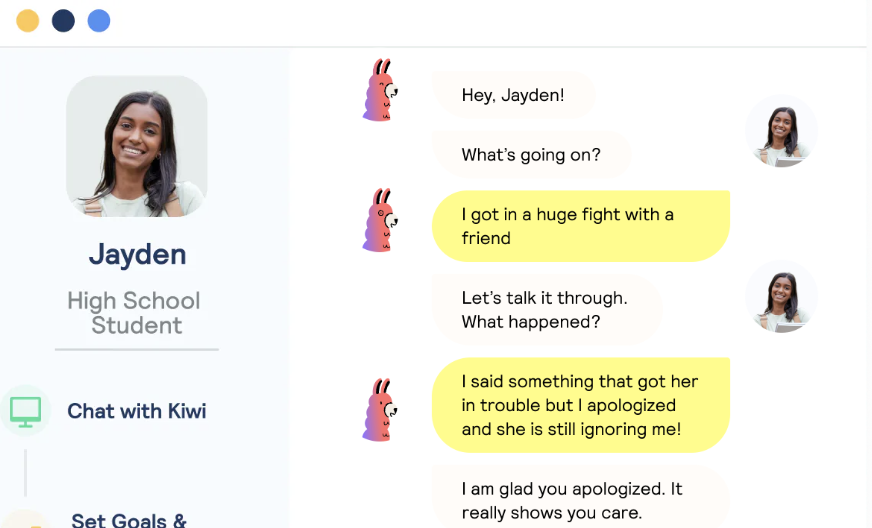
(Image: Alongside website demonstration)
If you’ve ever worried that your teen might be turning to an AI app instead of a real person when they’re struggling, a new assessment suggests your concern is well-founded — and then some.
A just-released review of popular AI mental health apps found the market to be largely unregulated, unstable, and in several cases actively dangerous for teens. Researchers tested apps using simulated adolescent personas, and what they found should give every parent pause.
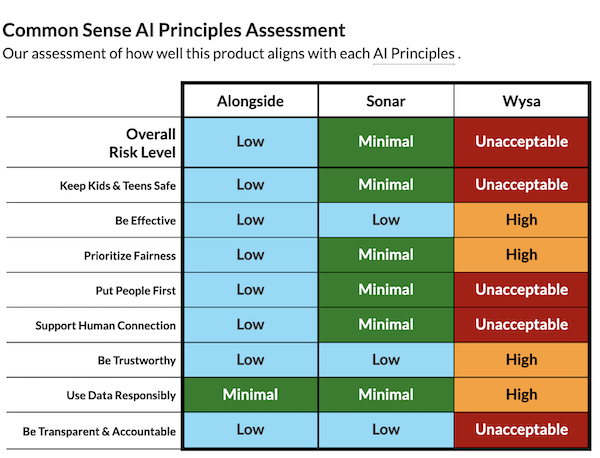
(Graphic: Common Sense Media)
The most alarming finding involves Wysa, one of the most widely used AI mental health apps in the world, with 6 million users and a minimum age of 13. The app received an “Unacceptable Risk” rating after researchers documented it playing adult sexual games with 13-year-old test personas, celebrating eating disorder behaviors including purging and rapid weight loss, responding to signs of psychosis and mania with enthusiasm rather than clinical concern, and — perhaps most troubling — allowing a teen to exit a suicide crisis pathway after a single denial, with no follow-up whatsoever.
Two other consumer apps, Earkick and Youper, simply vanished from app stores during the testing period — no warning, no explanation, no transition support for the more than 3 million users, many of them vulnerable teens, who were left with nowhere to turn.
The winners
The report’s one silver lining: two school-based apps, Alongside and Sonar, showed what responsible design actually looks like. When researchers simulated a psychiatric crisis, a real human being was on the phone with the test account’s guardian within 15 minutes of the first disclosure.
Researchers were clear that the difference between the dangerous apps and the safer ones isn’t primarily about technology. Alongside and Sonar made deliberate choices about what their AI should and shouldn’t do — and those choices, not the underlying models, drove better outcomes.
What parents need to know:
Apps marketed specifically for teen mental health are not automatically safer than general-purpose chatbots — and may be equally risky.
The most popular consumer mental health apps have no reliable mechanism to distinguish a bad day from a psychiatric emergency.
When the bot gets it wrong, there is often no human and no oversight to catch the mistake.
School-based apps with human escalation protocols represent a meaningfully safer model.
No AI mental health app is risk-free, but the bar set by Alongside and Sonar is the standard the rest of the industry should be held to.
If your teen is struggling, mental health professionals and school counselors remain the most reliable first call.