
Behavioral health providers and other healthcare operators aren’t closing themselves off from working with new vendors, even if they have an established relationship in place.
While that’s true, the openness comes with certain terms.
That’s according to WTWH Media’s M2 Research project, which surveyed healthcare professionals across several industries about how they discover, evaluate and choose vendors.
Broadly, findings from the M2 Research project show that healthcare decisionmakers are often willing to evaluate new providers, even when they already have an incumbent relationship in place. In turn, however, buyers want evidence of return on investment, clear proof points, and signs that a company is established and reliable.
“Behavioral health buyers are less interested in broad sales claims than in concrete information that helps reduce risk and justify a decision,” Bob Holly, executive editor of Behavioral Health Business, said.
WTWH Media is the parent company of BHB. Other WTWH Media healthcare brands include Home Health Care News, Senior Housing News, Hospice News, Skilled Nursing News, Ambulatory Surgery Center News, HME Business and Mobility Management, all of which contributed audience insights to the M2 Research project.
Overall, the research is based on 905 complete responses and 252 partial responses from late October 2025 into early December 2025. Respondents included a mix of decisionmakers and influencers: 21% identified as VP or director level, 18% as C-suite, 17% as administrator or executive director, and another 17% as manager or supervisor.
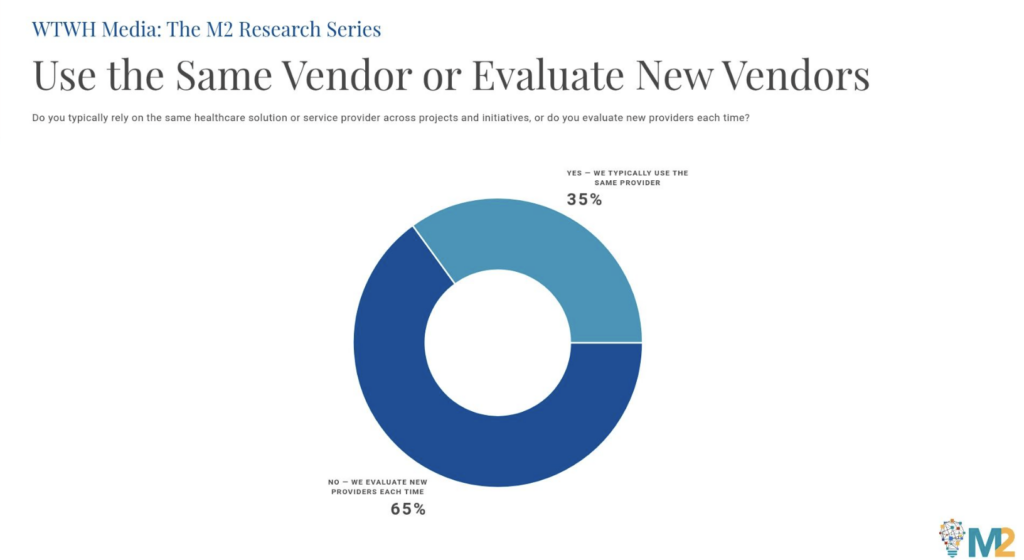
One of the clearest findings in the M2 data is that incumbent relationships do not guarantee repeat business. Specifically, 65% of respondents said they evaluate new providers each time they’re considering new solutions, while 35% said they typically use the same provider.
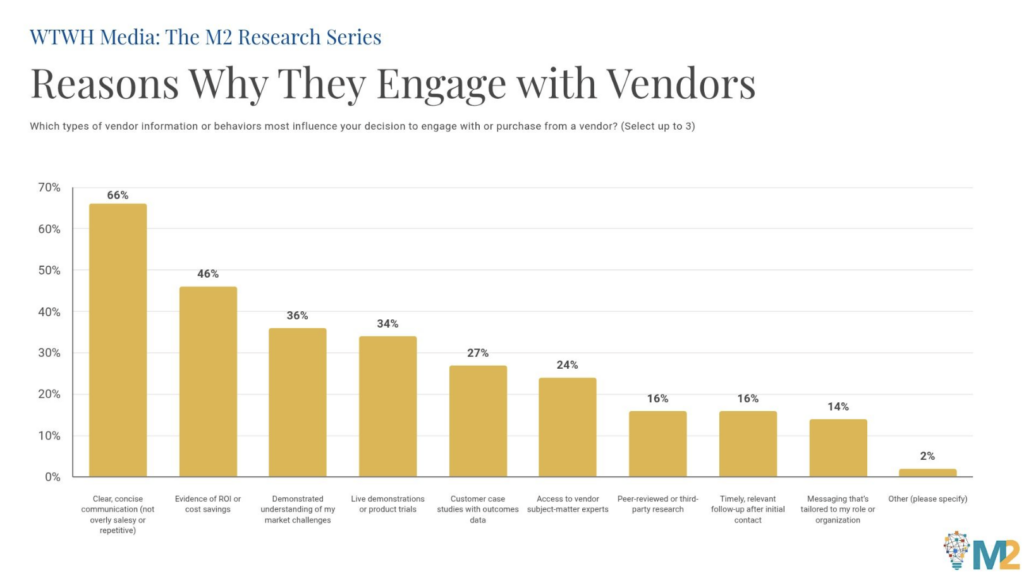
When asked what has the greatest impact on moving them closer to a purchase decision, 72% cited evidence of ROI or cost savings, making it the top response in the survey. Live demonstrations or product trials followed at 66%, while 61% pointed to customer case studies with outcomes data.
In short, behavioral health buyers want operational and financial proof before committing time or budget.
The survey also found that brand recognition remains important. Respondents indicated a 37% likelihood to buy from an unknown brand, meaning most buyers are reluctant to move forward with a company they do not recognize.
Asked why they would avoid an unfamiliar vendor, 72% cited concerns about quality and reliability. Others pointed to lack of evidence of long-term stability, doubts about compliance with standards and regulations, and uncertainty about industry experience.
Timing is another notable takeaway. More than half of respondents – 54% – said they typically begin engaging with vendors during the consideration phase, when they are narrowing down potential solutions or partners. Another 24% said they engage during initial awareness, while only 13% said they begin direct engagement during final evaluation and pricing.
That sequence suggests many opinions are being shaped before a formal buying decision is on the table.
M2 Research: Marketing to Health Care
The first proprietary research series that maps how healthcare buyers actually discover, evaluate and choose vendors – giving you the intelligence to stop guessing and start winning. Learn more here.