
Routine blood work comes back clean. The doctor says your numbers look normal, your stress response is doing its job – just like everyone else’s. That picture has a flaw.
The wear that chronic stress puts on the body does not accumulate the same way in everyone.

How much builds depends on whether you are a man or a woman, and changes again as you age. The tools doctors use to track that damage largely ignore both.
The hidden cost of allostatic load
Scientists have a name for that accumulated wear. They call it allostatic load – the price the body pays for adapting to chronic stress again and again. Each adjustment is tiny. The bill is not.
The wear is measurable. Blood pressure sitting a notch high, stress hormones lingering, blood sugar creeping up, cell receptors going numb from constant signaling. None of it feels urgent, which is why it builds unnoticed.
A team of family medicine and physiology researchers at Josip Juraj Strossmayer University of Osijek (UNIOS) in Croatia gathered the scattered evidence.
Their argument is blunt. The load does not build the same way in everyone, yet medicine measures it as if it does.
Stress looks different in blood
Pull blood from a stressed man and a stressed woman and the chemistry diverges. Men tend to run higher on markers tied to heart and metabolic disease – blood pressure, cholesterol, and blood sugar readings. Women run higher on inflammatory ones.
In lab tests where volunteers face sudden pressure – a mock interview, a surprise math problem – men release more cortisol, the main stress hormone, than women.
The split hints at why men skew toward metabolic disease and women toward autoimmune conditions.
Here the review presses hardest. Because one marker can mean different things by sex, the authors say risk thresholds should be set separately for both sexes.
Most are not. A reading that looks safe for one patient may understate another’s strain.
Two brains under chronic stress
Stress does not stay in the blood. When the alarm keeps firing, the hormones it releases begin reshaping tissue, including the brain, according to one foundational paper. Regions handling memory and emotion get remodeled.
Brain scans show the sexes handling identical chronic stress differently. In imaging studies, men’s activity climbs in the prefrontal cortex, the seat of planning, while women’s rises in deeper limbic areas tied to emotion. Same stressor, two circuits.
Those wiring differences carry weight. The way a body processes stress may help explain why women face higher rates of anxiety, depression, and trauma disorders, while the male pattern tracks more with heart disease and diabetes.
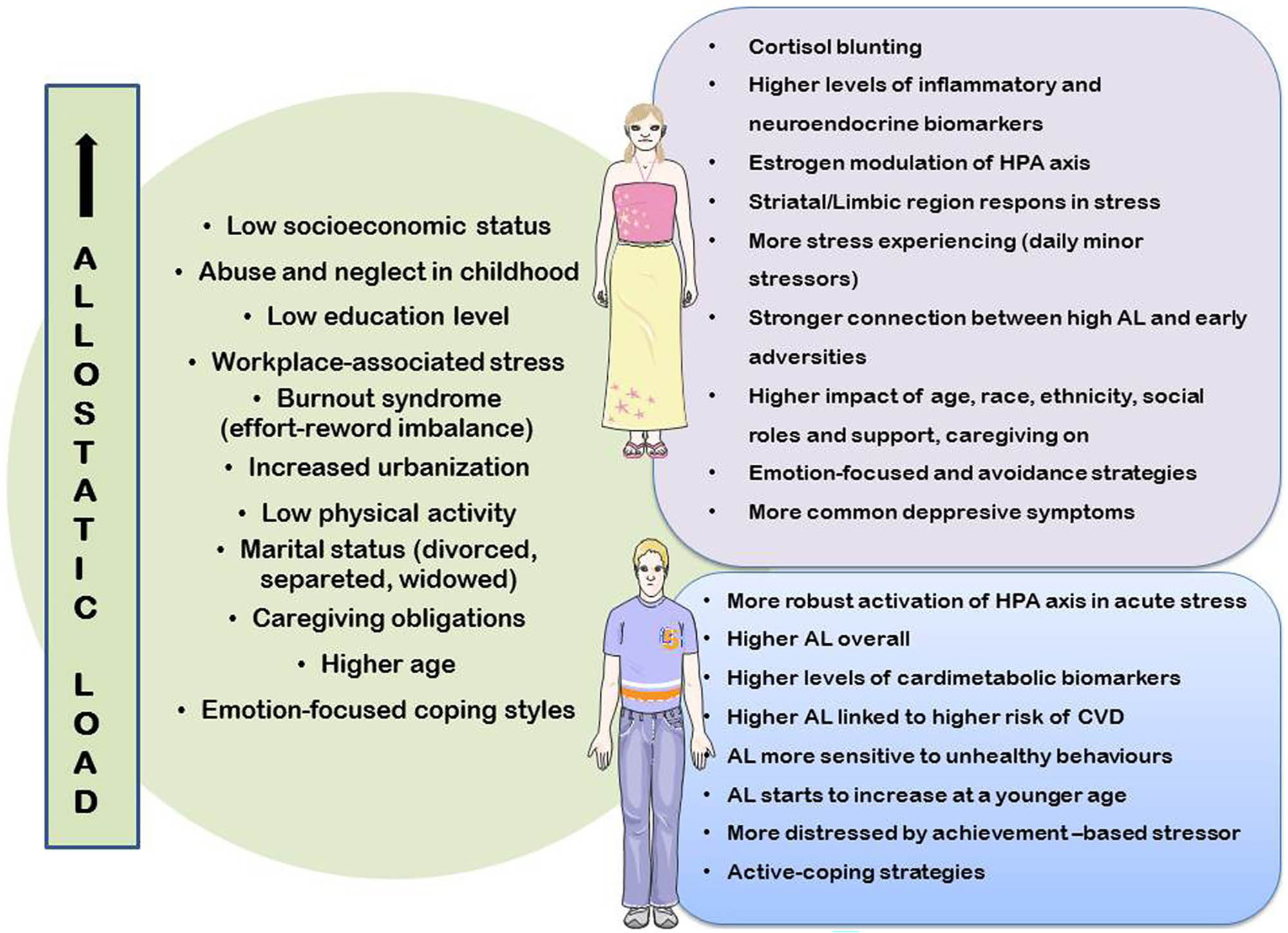 Factors related to allostatic load generally and depending on sex/gender differences. Credit: Frontiers in Medicine. Click image to enlarge.Stress outside the body
Biology is only half the story. Women outlive men but spend more of those years in poor health, a mismatch called the health-survival paradox.
Much of the gap sits in the roles people carry, not the bodies they were born into.
One finding cuts against intuition. Traits tied to masculinity predicted higher load whether the person was male or female. Women in male-dominated jobs often carry more wear than male colleagues, partly from the effort of fitting in.
Daily habits feed the load too. A large systematic review found smoking, heavy drinking, poor diet, and inactivity all push it higher.
Subtler patterns appear too – women who control their schedules, or who are married, tend to carry less.
Getting older changes everything
Age changes math in surprising ways. Older bodies have absorbed more cumulative wear, part of why chronic disease climbs with the years.
Yet many older adults show greater resilience than the young, after decades of learning to manage stress.
The body’s stress chemistry also changes over time. Dopamine signaling can fall 40 to 50 percent between the ages of 18 and 88.
A key blood-pressure hormone may halve by age 70. A marker that flags trouble at 30 can mean something else at 75.
Illnesses also cluster with age. When two or more chronic conditions pile up, doctors call it multimorbidity, and a review of the evidence connects high load to cancer risk.
In one study of nearly 40,000 people, about 80 percent of those reporting very hard childhoods carried multiple conditions as adults.
Rethinking how stress is measured
Plenty of the load is reversible. Regular exercise lowers inflammation and lifts mood, better sleep steadies the stress response, and a healthier diet measurably cuts wear in people over 30. Meditation and stronger social ties help too.
What this synthesis makes clear is that one yardstick for stress damage no longer holds. Male or female. Young or old. The same biomarker carries different weight. Most clinical thresholds still ignore that.
That suggests a different kind of care. If thresholds were tuned to sex and age, doctors could catch the strain earlier and tailor prevention to the patient before them, not to an average that fits no one. The wear may be inevitable. How soon we notice it need not be.
The study is published in Frontiers in Medicine.
—–
Like what you read? Subscribe to our newsletter for engaging articles, exclusive content, and the latest updates.
Check us out on EarthSnap, a free app brought to you by Eric Ralls and Earth.com.
—–