
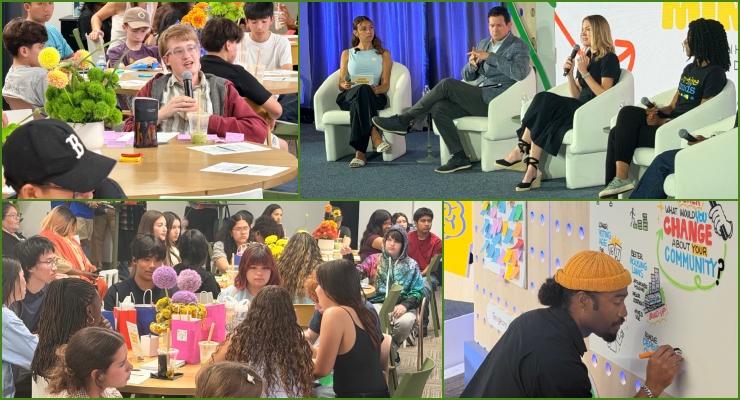
Active Minds and Google.org on Thursday announced a $5 million initiative to expand youth mental health programming to 100,000 students nationwide, launching the effort in Altadena alongside high school students still navigating the aftermath of the Eaton Fire.
Assemblymember John Harabedian, who represents the Pasadena area in Sacramento, said the mental health consequences of the Eaton Fire have been the most persistent issue his constituents have raised.
“Our youth are particularly affected by the day-to-day struggles of recovering from a wildfire,” he said. “And beyond that, they live in a world that is more stressful than the world that we grew up in.”
The partnership will bring Active Minds programming to 154 high schools across the country at no cost to participating schools, with funding designed to remove financial barriers that have historically kept mental health resources out of under-resourced districts. Altadena was selected as the launch site in recognition of the compounding pressures facing local youth, who are recovering from last year’s fire while also contending with adolescence in a technology-saturated world.
The Collaboratory event brought together school administrators, community partners and high school students for a morning workshop followed by a public panel discussion. During the workshop, students identified community needs aloud while a local artist translated their words into a live mural to the right of the stage.
The panel was moderated by Audrey Vanavich, a senior at Pasadena High School and former Tournament of Roses student ambassador.
She pressed Harabedian on California’s investments in broadband access after wildfires, drew out Dr. Megan Jones Bell of Google on how artificial intelligence is being built with adolescent mental health in mind, and asked Brandy Pretlo of Active Minds how the organization intends to make its programs sustainable in schools facing deep budget cuts.
Jones Bell, senior director of the clinical team at Google, said the company’s approach to AI safety for young users includes what she called persona protections, safeguards built into Google’s Gemini assistant that prevent it from acting as a therapist, encouraging users to confide exclusively in the tool, or expressing human-like qualities that could blur the line between technology and reality for younger users.
“We do not want someone with a mental health challenge to only use Google’s products,” Jones Bell said. “We want them to contact someone in their real life, reach out to a professional, turn to peer support.”
That conviction is central to why Google chose Active Minds as a partner, said Pretlo. Research shows that young people are most likely to seek help first from other young people, and the Active Minds model focuses on training peer supporters to hold those conversations with care and skill.
Pretlo added that the $5 million investment makes it possible to bring speakers, interactive exhibits and community activations to schools that could not otherwise afford them.
“Without the funding and support that we’ve received, we wouldn’t be able to bring this to school districts and communities that may not have been able to afford it,” she said.
Also on the panel was Anais, a PUSD junior and member of the district’s student think tank, who spoke candidly about the difficulty of managing advocacy, academics and athletics at the same time.
“Just because you have responsibilities and obligations, it doesn’t mean you need to be on top of it all the time,” she said. “It’s just not possible for a lot of people.”
She described texting her facilitator when she is overwhelmed, leaving practice early when she needs to, and spending time at a donut shop near school called Sidecar, with her friends. She also said she deleted Instagram after recognizing that the app was becoming a source of stress rather than connection.
“There are so many pros and cons with technology,” she said. “I think it’s important that we all analyze what is important to us individually so that we can use technology in a way that benefits us personally and minimize the harms.”
Harabedian told students their voices reach Sacramento, whether through events like Thursday’s panel or through the emails and messages his office receives daily.
“I get hundreds if not thousands of emails, texts and tweets a week and a lot of them are from you,” he said. “We read them all.”
He also spoke about his own mental health, describing a habit of checking in honestly with his family and colleagues rather than projecting resilience he does not feel.
“When we try to convince ourselves that we’re okay when we’re not, it just leads to more problems down the road,” he said.
Anais closed the panel with straightforward advice for peers who want to engage civically but are unsure where to begin: attend a school board meeting, talk to a principal, send an email to your representative.
“Closed mouths don’t get fed,” she said. “There are people who actually care.”
The wellness fair that followed filled the Collaboratory’s common space with resource tables and student conversation.
More information on Active Minds is available at activeminds.org.
 Get our daily Pasadena newspaper in your email box. Free.
Get all the latest Pasadena news, more than 10 fresh stories daily, 7 days a week at 7 a.m.