
13 Hrs Ago
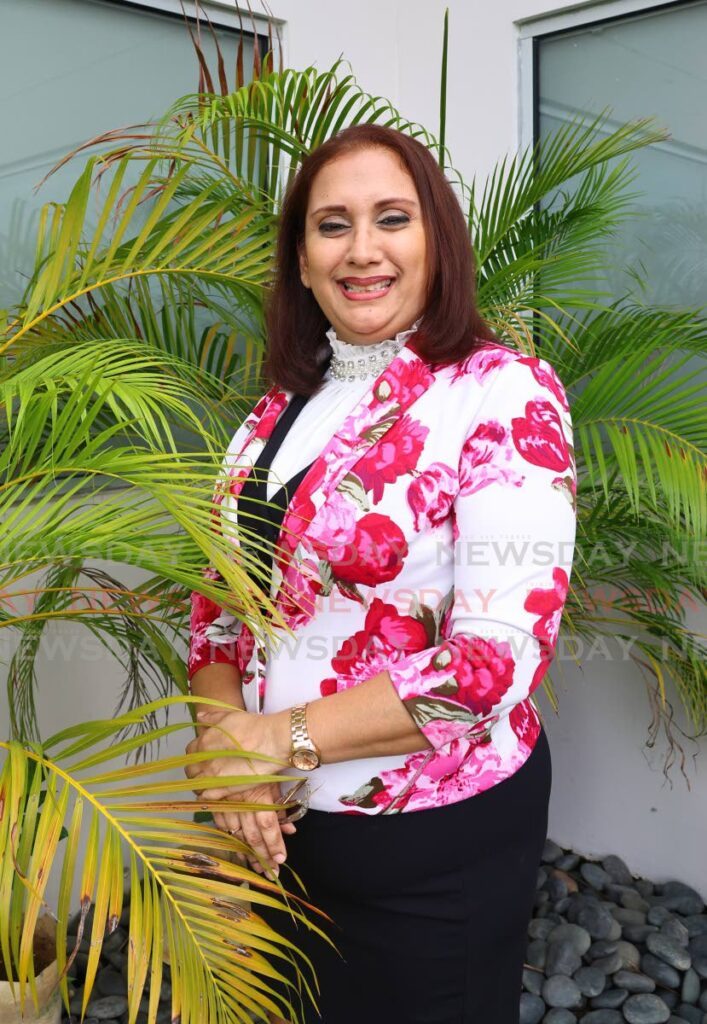 Mental health therapist Amanda Ackbarali offers help to survivors of sexual assault and children harmed by those meant to protect them. – Photo by Faith Ayoung
BAVINA SOOKDEO
EVERY year, from November 25-December 10, the world observes the 16 Days of Activism Against Gender-Based Violence – a call for unified global action to end violence against women and girls in all its forms.
For mental health practitioner Amanda Ackbarali, the campaign speaks to the lived experiences of many of the people she supports.
For 15 years, Ackbarali has sat with survivors of sexual assault, children harmed by those meant to protect them, trafficked people seeking safety, incarcerated youth fighting for dignity and families navigating unspeakable trauma.
At 44, the San Juan-born counsellor describes her work not as a profession but “a deep sense of purpose, like an internal compass.”
Ackbarali’s earliest lessons in care came not from textbooks but from her home.
“It was the way I grew up, watching compassion in motion in my family,” she explained. Ackbarali said people were always drawn to her mother, the most caring person she knows.
“Our front porch was like a little sanctuary. Neighbours and friends would stop by, sit and talk with her.
“From early on, she taught me a simple truth: if you can be kind, then be kind. That became the frame through which I saw the world.”
But her own childhood was not without pain. Ackbarali suffered from severe atopic eczema from age three, and learnt early what it meant to be treated differently at school and even at times with her own extended family.
“When you experience that kind of vulnerability as a young female,” she remembered, “you learn to see the world from the margins. You understand the underdog, the quiet child, the person who feels less than others.
“Those early experiences planted something in me: a deep desire to make people feel safe and understood.”
Ackbarali eventually followed those urges academically, and got a bachelor’s degree in psychology and a master’s in mediation studies from UWI. She became board-certified as a civil and family mediator in 2013.
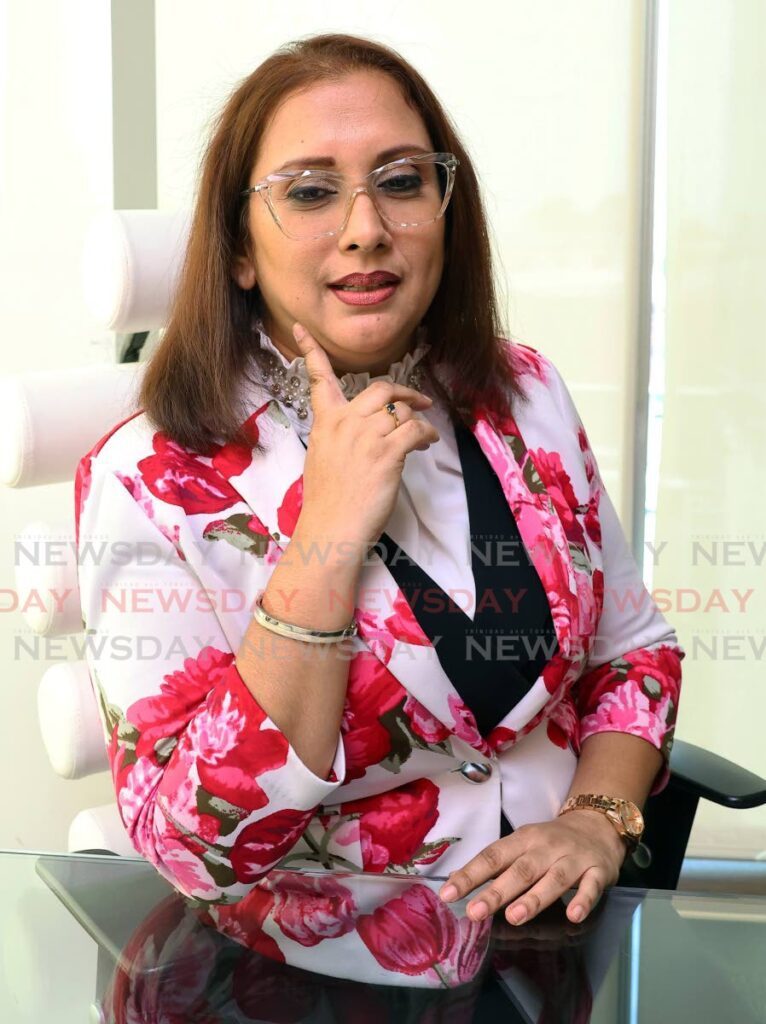 Mental health therapist Amanda Ackbarali offers help on her virtual platform via the Opening Lotus. – Photo by Faith Ayoung
But it was her work with frontline institutions that cemented her commitment. They have included the Rape Crisis Society, the Coalition Against Domestic Violence, the Children’s Authority and the Prison Service. She has trained police officers, hotline counsellors and prison staff – often in spaces where the air was thick with trauma.
At the Children’s Authority from 2015-2018 – its startup phase – she played a pivotal role in setting up and building the Child and Family Services Unit and developed protocols for helping child victims of trafficking, focusing on victims’ rights.
She carried out training for the Counter-Trafficking Unit in hotline and self-care skills and served on a governmental committee responsible for securing safe housing for trafficked people.
Ackbarali said one of the most sobering lessons she learnt in child-protective work was recognising the weight of the responsibility.
“Child protection isn’t just paperwork and procedure: these are decisions that can change the course of a child’s entire life,” she emphasised. “You are often the person standing between danger and safety, between chaos and stability.
“That kind of trust is humbling. It forces you to hold both urgency and care at the same time, even when the circumstances are overwhelming.”
But when asked what the hardest aspect of her work has been, she said, “The most emotionally challenging part has never been the people I serve, but rather the systems around their care and treatment.
“What often creates emotional strain for practitioners is navigating structures that are overburdened and under-resourced, that are moving more slowly than the urgency of the situation demands.”
This, she says, is where practitioners often burn out. She stressed that as a result, caring for caregivers is not optional – it’s essential.
“If you want protocols that actually work in the real world, they must include the wellbeing of the people doing the work, their safety, their emotional health, their access to supervision and support,” she explained. “You cannot protect children effectively if the adults protecting them are running on empty.”
Over time, she has learnt to advocate within the system, while supporting colleagues who are also doing their best under pressure.
She said maintaining compassion comes from recognising that everyone – clients and practitioners alike – is navigating something, and empathy is essential in both directions.
Some of the cases she encountered have left permanent imprints. At the Rape Crisis Centre where she worked from 2010-2015, Ackbarali confronted cases that changed her.
“Sometimes very young children, only three-five years old, were brought in by nuns, community leaders or caregivers because they had been sexually harmed. Some cases were so severe that ongoing medical treatment was needed.
“Those moments remain imprinted on my mind and heart.”
But hearing about events like this, devastating as they were, did not drive Ackbarali away.
“It was then that my conviction for this work became written in stone,” she said.
Seeing that level of vulnerability, and the courage it took for the adults around these children to seek help, deepened her belief that mental health care must be accessible and compassionate.
“It strengthened my desire to work in prevention and with offenders, because supporting survivors also means addressing the systems and behaviours that harm them.”
As a response to everything she had witnessed – the broken silences, the small triumphs, the need for accessible, compassionate care – Ackbarali founded The Opening Lotus in 2018, which operates on a virtual platform. It’s a mental health practice rooted, she said, in culturally grounded care. Ackbarali is the main therapist but she often hires a multidisciplinary team for special projects.
“I wanted a space where therapy wasn’t rushed, where services were accessible, and where practitioners lifted each other, instead of competing.”
She aims to offer therapy, she explained, in a way that feels familiar and aligned with how people naturally relate to one another.
“Our culture is warm, expressive and story-driven. When therapy allows that, people can feel safer.”
Sessions often include small rituals, like ringing a bell when a client experiences a breakthrough, because, she explained, a ritual of this kind “makes the invisible visible.
“It signals: something important just happened here. It helps the brain encode the shift, and it gives the client a concrete way to recognise their own growth.”
The lotus flower, which rises through mud to bloom, is an image of Ackbarali’s philosophy. It guides how she sees every person, she said: not for the “mud” they’ve come through, but for their ability to rise in their own time.
“Healing, like the lotus, is a slow unfolding. It doesn’t ignore the difficulty, it grows through it.”
In honour of the 16 Days of Activism, Ackbarali reflected on the emotional burdens faced by women, particularly in Caribbean societies.
“One of the biggest emotional struggles women face today is the pressure to achieve balance and the constant feeling that they are falling short.”
She added that cultural expectations, especially in developing countries, still put heavy caregiving and household responsibilities solely on women, even when they are juggling careers or studies.
The result, she said, is exhaustion, self-doubt and an internal conflict between personal growth and traditional roles. For many women, she added, the real struggle is granting themselves permission to rest, ask for help, and redefine what balance truly means.
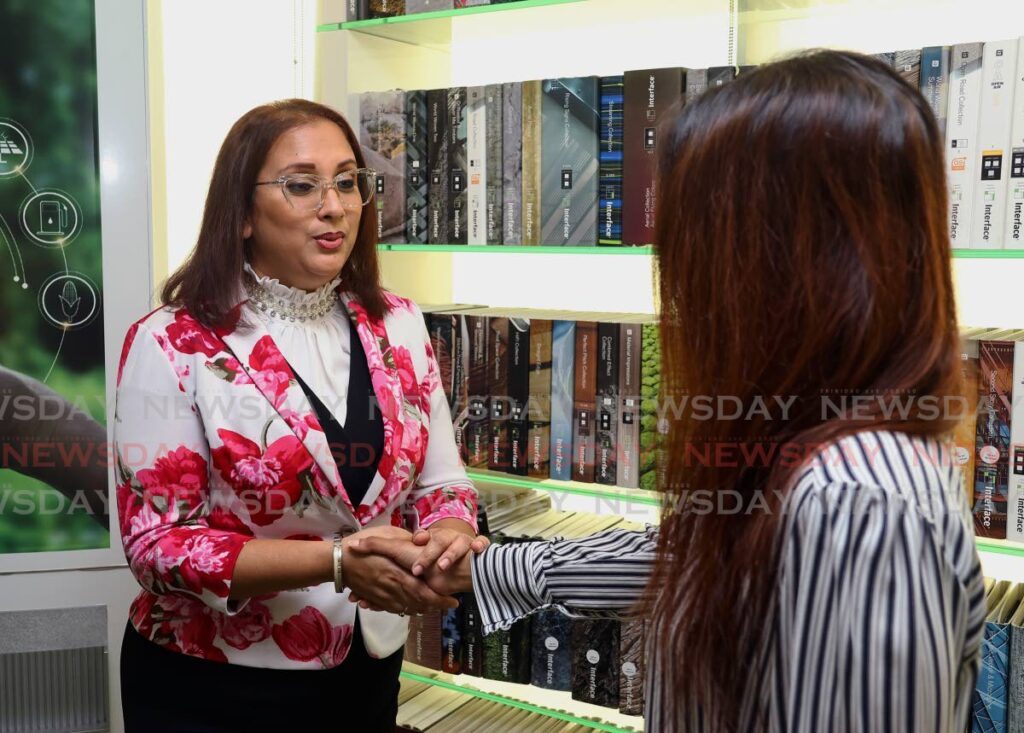 Mental health therapist Amanda Ackbarali, left, greets a client on November 26. – Photo by Faith Ayoung
Having trained police officers, prison staff and even counsellors, what does she see as one major misconception?
“People often expect trauma to look a certain way – sadness, withdrawal, low energy – and they interpret that as weakness.”
But, she stressed, trauma doesn’t have a single way of presenting itself.
“Some people move into hypoarousal and appear low, or shut down. Others shift into hyperarousal and look highly functional, organised or emotionally detached.”
These, she said, are both adaptive responses of the nervous system to overwhelming experiences. “This is the misunderstanding: you can’t read trauma from the outside. You understand it by listening to the person’s story and noticing how they’ve learned to survive.”
Ackbarali firmly believes that healing is always possible. The proof, she said, lies in the people she has met along the way: women rebuilding after violence, children reclaiming safety, incarcerated youth discovering worth, families surviving crisis and choosing to persevere. She remembers one woman vividly – an educator who survived a brutal gang rape and the subsequent falling-apart of her marriage.
“She often spoke about the first-year students she taught, and the light she found in them to keep living.”
Examples like this reinforce Ackbarali’s belief in human resilience.
“What stands out is not the brutality of the stories, but the courage in their choices. They showed up on days when they didn’t want to. They pushed through triggers to learn new ways of thinking, new patterns of behaviour, new possibilities for themselves. Even in their most fragile moments, they carried a quiet yearning: ‘I want to be better. I want to get past this.’”
Overall, Ackbarali said, TT is still in the early stages of building a strong mental health system, with many foundational pieces still being put in place – she noted there are gaps in education, service delivery, assessment and treatment options, and referral pathways.
She stressed the need for better emotional literacy for children, and also highlighted the importance of training community gatekeepers – teachers, police, coaches and faith leaders – who are often first to spot distress. Underserved groups, including men, rural communities and people with disabilities, also require more intentional support, she feels.
But while progress may be slow, she said the work being done now is essential to creating a more inclusive, responsive system for future generations.
Through her years in crisis response, education, child protection and social work, she said, she has witnessed a truth that guides her: “People are capable of rising through things that should have broken them. Each chapter of my career has shown me a different face of human strength.”
Ackbarali said being allowed to walk beside these people changed her forever.
She had words of encouragement for those who are facing obstacles: “People don’t just survive their challenges. With the right support and compassion, they find a way to bloom again.”