
Editor’s note: This story contains mentions of racist messages and suicide.
KANSAS CITY, Mo. (KCTV) – Before he’d even reached his locker, threats were already pouring in to Zeke Mayo’s phone.
The senior guard for the Kansas Jayhawks and Lawrence native walked off the floor following his worst game of the season — a 5-point, 5-turnover performance that featured a season-worst 1-for-7 shooting from the floor — and opened his phone to a nightmare.
“It was just a bunch of racist stuff,” Mayo recalled to KCTV. “People telling me to kill myself. (Saying) if they ever saw me out in public, they would do this or that.”
Mayo saw the messages that arrived in his Twitter feed and Instagram DMs and took to social media, apologizing for his play in a 78-73 loss to Texas Tech on March 1.
“I 100% deserve all the criticism in the world,” Mayo wrote. My performance was beyond pitiful today, and has been for a while now. I work my ass off every day to be great, but I can’t be perfect all the time. I’m sorry to our fans and my teammates, I will continue to be better.”
Kansas Athletic Director Travis Goff responded to Mayo’s post with a message of support, insinuating gamblers, rather than Kansas fans, were behind the messages.
“These aren’t Jayhawks. They’re not ours,” Goff said in a post. “Driven by gambling and hate. They’ve never competed a day in their life. To Zeke and all our guys — the Jayhawk family loves you and will always ride with you through thick and thin.”
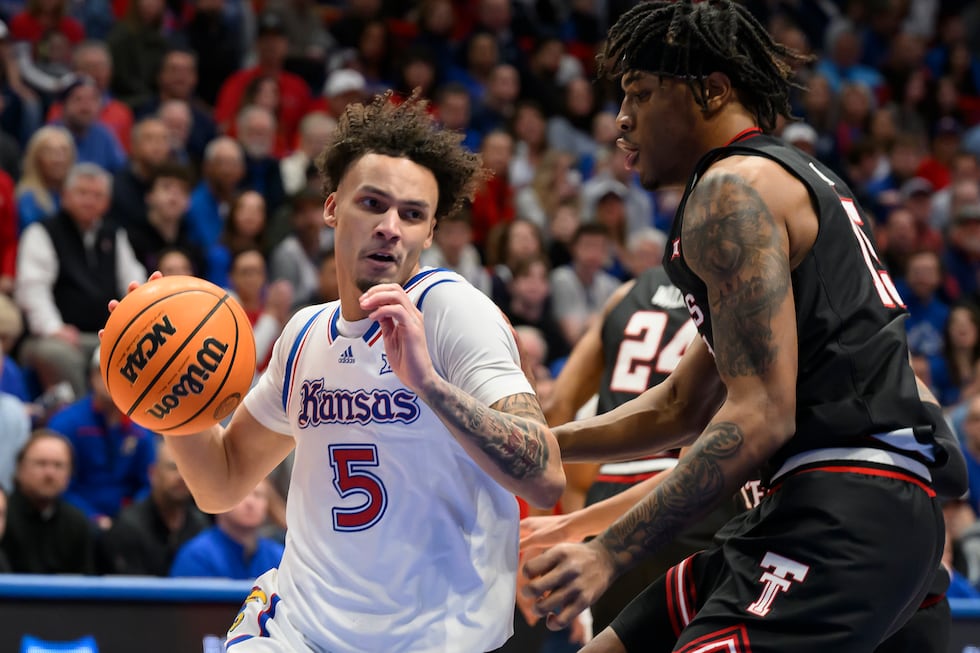 Kansas guard Zeke Mayo (5) drives around Texas Tech forward JT Toppin (15) during the first half of an NCAA college basketball game in Lawrence, Kan., Saturday, March 1, 2025. (AP Photo/Reed Hoffmann)(Reed Hoffmann | AP)
Usually, Mayo said he would meet up with his family after games or go see them at home. This loss, Kansas’ third of the year at Allen Fieldhouse, broke Mayo’s routine.
“I went straight home and like locked myself in a room for a very long time,” Mayo said. “I didn’t want to speak to anybody. I turned my phone off. It was a very difficult day.”
Two days later, Mayo and the Jayhawks went on the road to No. 3 Houston, but his mind wasn’t focused, posting his third straight single-digit scoring game in a year in which he averaged 14.6 points per game.
“I wasn’t too worried about the game itself. I was worried about my mental capacity and where I was at,” Mayo said. “As a young kid just trying to live out his dream, you can’t be perfect all the time… but those messages hurt my feelings a bit.”
Mayo’s experience isn’t uncommon.
“We’re seeing more harassment of student-athletes, coaches, and officials from people who have a betting interest,” said Clint Hangebrauck, the NCAA’s Managing Director of Enterprise Risk Management.”
 Zeke Mayo (center) pictured with former KU star Andrew Wiggins (left) and his childhood friend Devin Neal (right). Mayo’s dream of playing at KU was realized in 2024-25, but came with it nightmares from angry bettors.(Courtesy @Dev_Neal23/Twitter)
A recent NCAA study says more than one in three Division I men’s basketball players experienced betting-related abuse in the last year.
In many states, including Kansas and now Missouri, gamblers can bet on specific player actions with prop bets. Those can include how many points, rebounds or rebounds they grab on the basketball court, and how many yards, catches or touchdowns they score on the football field.
In Lawrence, those prop bets occasionally resulted in some in-person praise for Mayo and his teammates.
“I’ve had a handful of guys come up to me and say, ‘Hey, you won me some money tonight,’” said Mayo. “They were never on my tail (in person) about losing them anything.”
But online, it was largely a different story.
“That really puts a target on the back of student-athletes to receive abuse and harassment from angry bettors,” said Hangebrauck.”
Missouri’s new law does differentiate between Kansas in one way. Prop bets will not be offered for games involving Missouri schools, according to the Missouri Gaming Commission’s regulations. Several other states, like Colorado and Arizona, don’t allow player props on any college games.
Authorities are fighting back against angry bettors. The NCAA says it’s now using artificial intelligence to spot online abuse and alert police. The governing body of college athletics has also partnered with Venmo, with some angry bettors have made a habit of sending requests for money to student-athletes who have fallen short of their expectations.
“It’s my hope that any student athlete, if they are being threatened or harassed, would bring that to someone’s attention because there are law enforcement remedies for those kinds of things,” said Jan Zimmerman, the chairman of the Missouri Betting Commission.
Still, many athletes suffer in silence.
“If I’m being honest, I didn’t really reach out to anyone,” Mayo said, despite acknowledging he was aware KU and its athletic department offered specialized mental health support. “I just kind of dealt with it on my own.”
Former Kansas guard Zeke Mayo shared his experiences with abuse and online harassment from angry sports bettors.
For the first three seasons of Mayo’s college career, the Lawrence High School Product was a standout at South Dakota State University.
“At the mid-major level, no one pays attention to your games at all,” said Mayo, who was a two-time All-Summit League selection and the 2023-24 Summit League Player of the Year.
But at bigger schools with nationally-televised games happening frequently, the dream Mayo thought he’d live out came with a danger he’d never imagined.
“I think the biggest thing is just realizing who’s on the other side of a lot of these bets,” said Hangebrauck.
“Just being a young kid who hasn’t really experienced life yet, it’s not really something you can just — you can’t just put your phone down and be OK.”Missouri is the 39th state to legalize sports betting. As more states continue, the impact on athletes –at both the college and pro level — continues to grow.
“More than anything to me, it gets weird sometimes when you have fans talking about it,” Kansas City Chiefs quarterback Patrick Mahomes said recently about interactions with sports betting. “You’re just trying to go out there and live your life and play the game.
“And sometimes they get really attached, even more than the regular fan, because they have money on the line… It’s a crazy world we live in these days.”
In January, the NCAA will release its next study on the impact of social media abuse on student-athletes. KCTV will share those results once they are released.
Copyright 2025 KCTV. All rights reserved.