
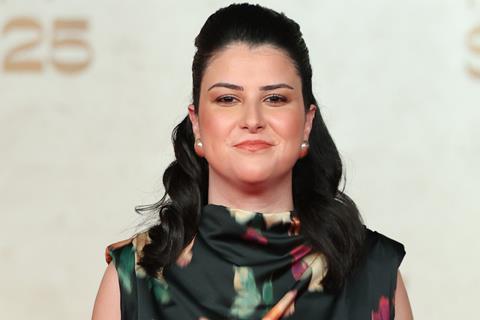
Jordanian filmmaker Zain Duraie brings her debut feature Sink to Red Sea’s Competition, following its premiere at Toronto.
It follows a mother (Clara Khoury) whose eldest teenage son (Mohammad Nizar) descends into a spiralling mental health crisis. Duraie was a Screen International Arab Star of Tomorrow in 2024 and secured backing from the Red Sea Film Foundation’s fund with this first feature.
What inspired you to tell this story?
It’s a deeply personal story drawn from something very close to my own life. I wanted to defy conventional boundaries, weaving layers of nuanced emotions to explore the fragility and resilience of humanity. It examines our collective failures when we refuse to see the truth for what it is, yet reveals that, in the end, love is the force that endures.
Your film focuses deeply on the mother’s perspective and psychological experience. How does this approach shape the story?
My film isn’t what you would call an issue movie. It’s a character-driven psychological drama, exploring how a mother fails to notice what’s happening with her son, gradually loses control, and watches him slip away. The story becomes less about the event itself and more about the mother’s denial, which mirrors a broader societal denial. Through these characters, I explore how the personal intersects with the social, rather than presenting the story in a purely external or issue-driven way.
What were the major challenges you faced while working on the film?
Budget and timing are always issues, but the biggest challenge was the shooting schedule: I had only 22 days to shoot 136 scenes, most of them large and complex. For a first-time feature director, this was intense. Thankfully, my team was extremely prepared, and we rehearsed constantly, so we didn’t need extra days of shooting.
Which scene was the most difficult to film?
The scenes set in the garden. It was an exterior, nighttime shoot with animals and a young actor. The garden sequence was emotionally intense, with high-energy interactions between the mother and son. Night shooting, uncontrolled elements and demanding performances made it one of the most stressful days.
Why do you think films addressing mental health are so rare in Arab cinema?
Mental health is still almost untouched territory in Arab cinema. Unfortunately, many filmmakers focus on familiar narrative such as poverty, social backwardness, oppressed woman or refugees, because that’s often what Western or European funders expect. I’ve faced these many times myself. People ask why I depict a middle or upper-middle-class Jordanian family, or why the mother is well-educated. My film is authentic and doesn’t fit the typical mould. There is often pressure to make films appear exotic for Western festivals, but I refused to compromise my story.
How was your experience working with Clara Khoury and Mohammad Nizar?
Working with them was remarkable. Clara is exceptional. She understood her character deeply and embraced the risks of the role, which could easily slip into cliché or melodrama. Mohammad’s role was even more challenging as he plays a boy with an undiagnosed condition, balancing vulnerability and intensity. We prepared his character for almost three years, doing research with specialists and building a rich backstory. They both carry the emotional weight of the film and excel at performing what exists between the lines.
What does it mean for you to have the MENA premiere of Sink at Red Sea?
The Red Sea International Film Festival is incredibly special for me because the journey of developing this film actually began at the Red Sea Lodge. The support and guidance we received there were invaluable. Later, we also received production funding, and I was honoured to be selected as one of the Arab Stars of Tomorrow. Premiering the film here feels like coming full circle.
What comes next after Red Sea?
We’re planning to go to Carthage Film Festival in the official competition. Some European festivals have shown early interest. The most important next step is securing an international distributor and sales partner.
How do you see the development of Jordanian cinema?
Progress has been slow. Usually, one film comes out every year or two. But with the support of the Royal Film Commission and programmes like the Jordan Film Fund and Doha Film Institute, we’re developing and expanding our cinematic voice. This support helps us move beyond stereotypes and present diverse stories. As the current generation of filmmakers, we now have the opportunity to tell new stories in fresh ways.
Are you working on any new projects?
I have several ideas in development and I’m likely to continue exploring the psychological drama genre, as it adds depth to cinematic storytelling. However, nothing is ready to be discussed yet. It’s all still in the early stages.
‘Sink’ review: Visually striking Jordanian debut offers authentic depiction of mental illness