
Jazz music and a sea of backpacks filled the Brookhaven Commons Courtyard, each one representing survivors or a life lost to suicide. The traveling exhibit, “Send Silence Packing,” invited students, staff and faculty to pause and reflect on the impact of mental health struggles that often go unseen.
Hosted by Dallas College Counseling and Psychological Services in partnership with Active Minds, the event on Nov. 13 aimed to spark conversation, reduce stigma and encourage students to seek support when needed.
“This event is crucial for a campus because it provides a tangible, visual and emotionally impactful representation of the scope of the mental health crisis, specifically the tragedy of suicide,” Katie Neff, a Brookhaven professional counselor, said in an email to The Courier. “It moves the conversation beyond abstract statistics by displaying the backpacks representing loved ones who die by suicide each year.”
Neff, an organizer, said events like this help students talk about mental health more openly. She said, “Events like ‘Send Silence Packing’ help break down the stigma surrounding mental health for several reasons: normalization, conversation starter and shared experience.”
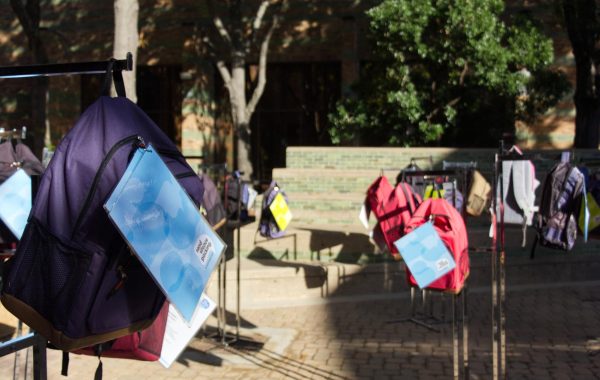 About 100 backpacks were strewn about the commons. Each one had a story of hope (blue) or loss (yellow) revolving around suicide. (Marcos Velez Rodriguez)
She said she hopes students walk away with one message above all, “You are not the only one.” She wants the line of backpacks to show them that their struggle, or their friends’ struggles, are part of a much larger shared human experience.
She added that seeking help is “a fundamentally human response to a challenge that affects countless others.”
Neff also shared advice for students: “If you’re struggling, tell one person. If you’re worried about someone else, ask them directly and compassionately, ‘Are you thinking about suicide?’” She said, “Asking directly and listening without judgment is the most powerful thing you can do.”
Eric Rockwood, who works with Active Minds and helped run the exhibit, said many campuses still avoid conversations about suicide. “Some places aren’t already having this dialogue,” he said. “When we go to places like Hobb County, Kansas, which is as rural as can be, no one’s talking about this.”
He said many of the stories in the exhibit share a common theme. “A lot of them felt like they could not reach out, whether it is stigma or lack of resources,” he said. “That’s why we come out. We bring out national resources and we partner with the campus to bring out local resources, so people know they’re not alone.”
Rockwood hopes students leave with a better understanding that help is available. “College is a weird time, life is weird. But at the end of the day, you don’t have to go through those struggles alone. You don’t have to be in a crisis to reach out,” he said.
 Ronaldo Arriaga, a volunteer from Dallas College, writes a message responding to the prompt, “What would you say to someone who is struggling?” (Marcos Velez Rodriguez)
Amya Waldrop, who represented the National Alliance on Mental Illness and provided additional resources at the event. The NAMI serves many parts of North Texas, not just colleges. “We are your local affiliate, so we service the specific North Texas area,” she said. “We have the opportunity to be in person at any of these places.”
Waldrop said NAMI’s programs are free, nonclinical and peer led. “They’re taught and facilitated by somebody who’s going through what you’re going through or has gone through it,” she said. “We have classes and support groups for peers and we also have separate classes for family members.”
She said she has seen an increase in students wanting to learn how to support others. “We have a lot of college students coming in wanting to be either allies or someone who doesn’t necessarily identify with a mental health condition but wants to help decrease the stigma,” she said.
For students who may not feel ready to seek help yet, Waldrop had one message: “I would say that’s normal. Everybody is on their own journey. Just know that these resources are out there for you and they’re all free.”
CAPS counselors and volunteers encouraged students to read the stories attached to each backpack, write supportive messages for others and pick up information on available mental health services.
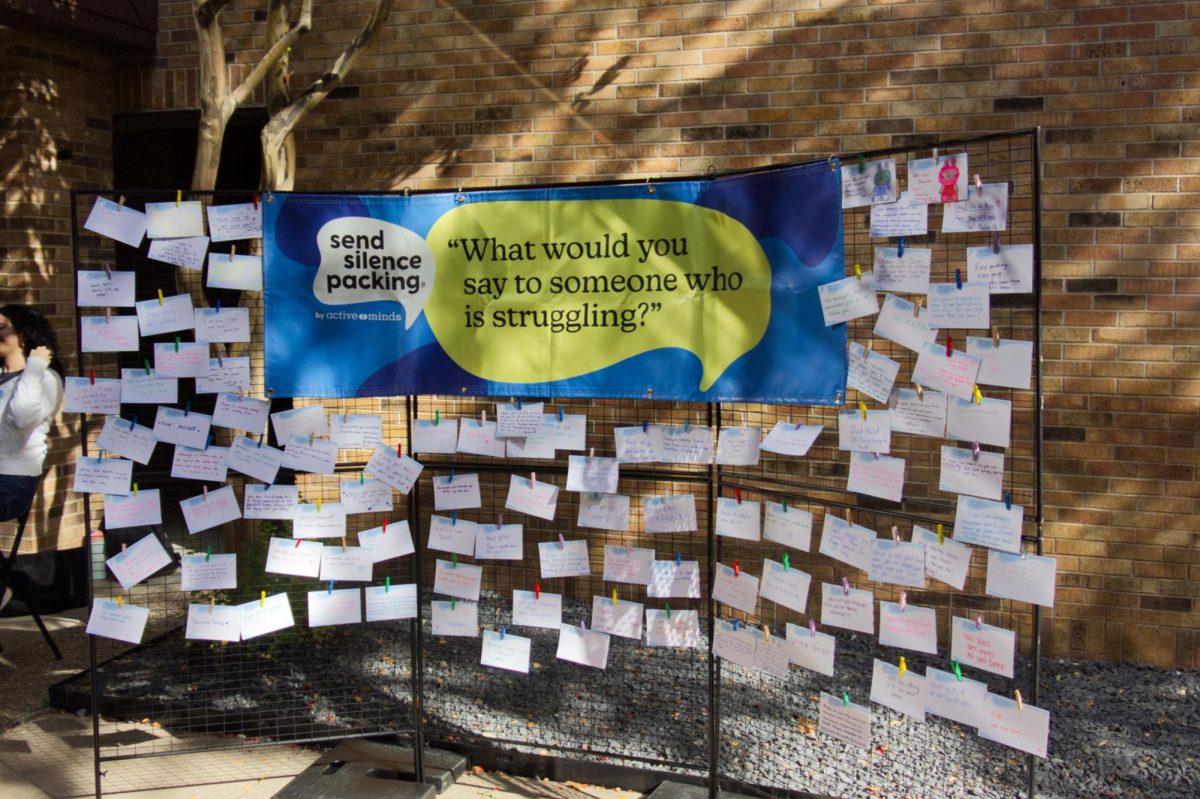
Notes of encouragement responding to the prompt, “What would you say to someone who is struggling?”