
Welcome to the unpopular opinions realm of my articles. As I’ve said, I’m going to try and keep these short but of course, if it’s something I’ve been researching then be prepared for me to go on a bit. I won’t keep you here for too long. Remember: there’s no set schedule for these, they’ll pop up if and when I’m into writing one.
***
I want you to look at this post before I move on…
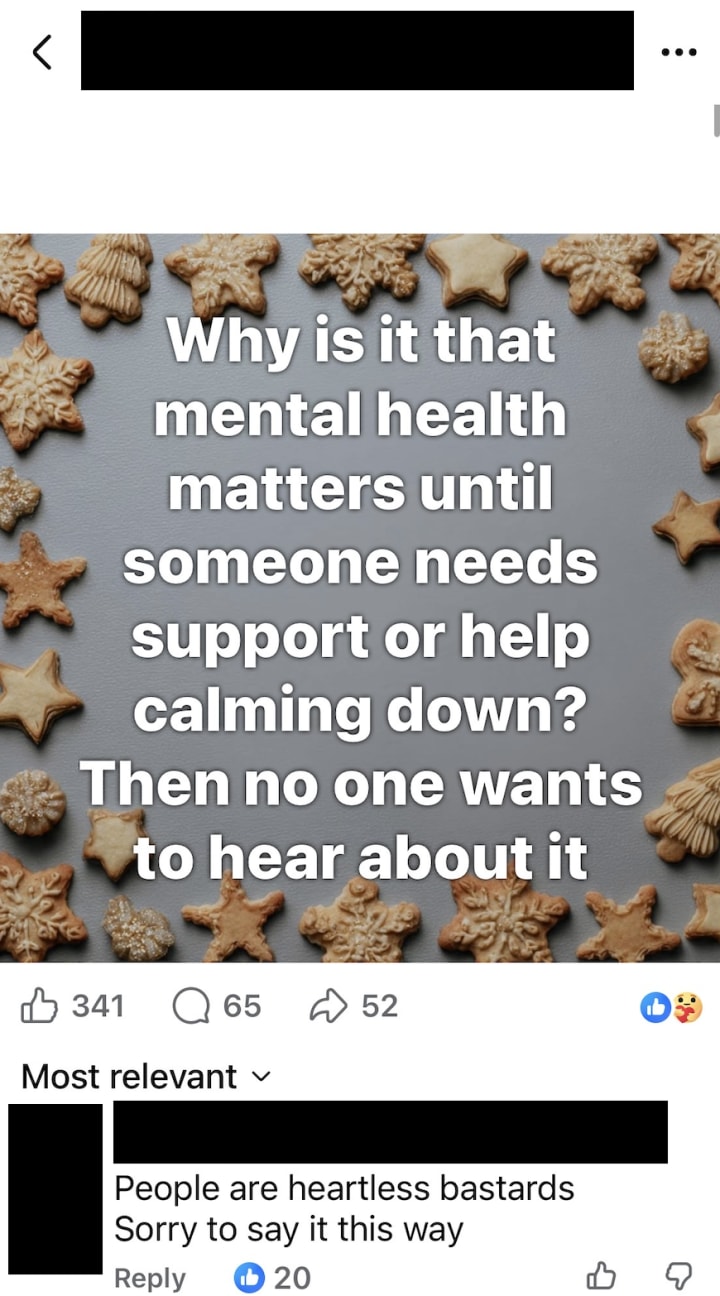 Screenshot taken by me ***Everyone’s Pro-Mental Health Until…
The mental health movement has been a net-positive for society, that’s a fact. But then if that’s the case, why is there worse cases of mental health than ever before and why are more people suffering?
Well, I have my own theories that I want to explore. These include:
access to mental healthcare has widened and thus, more people are moving towards it. This is inherently good for societypeople, especially the young are spending more time online with people who are older and thus, probably depressed. Mass hysteria kicks in with a hint of catastrophe. Knowing you have no future is no funevery aspect of human behaviour is being medicalised and therapy has entered the average person’s lexicon at an alarming rate. Normal human ups and downs have now become a cause for concern. This is inherently bad for society people have often cited feeling a loss of purpose and community in our modern times. Hiding authentic selves at work or in public has caused suicides and breakdowns with little or no support – maybe even blame. This is catastrophic for society as life becomes inherently worse
I think we can all agree that numbers one and two have been heavily researched, especially the mass hysteria of young people reporting depression who perhaps are just experiencing a form of chronically online psychosis where they have convinced themselves they have it because everyone else does. But what about numbers 3 and 4?
Why is it that everyone on earth is pro-mental health until someone with a mental health problem actually needs help? Why do we medicalise every normal behaviour in human beings and then reject those who actually need our help and assistance? Well, it is simple – for that I refer to a book called Bad Therapy by Abigail Shrier…
***

Bad Therapy by Abigail Shrier is normally shirked off as being pseudo-science by the folks who haven’t actually read the book. She’s not trying to make a point about science, she’s trying to make a point about where we are as a society and whether that is a healthy place to be. I personally agree that the over-medicalisation of normal human behaviours is a horrific idea and not only makes waiting times longer for people with actual terrible conditions but also scares the average person into thinking what they are experiencing is something very serious – maybe even causing stress and physical symptoms of ill health.
This is a net negative for society. If more people are worried about the fact that they might have something more serious than they do, they are also more likely to actually get symptoms that are physical. This in turn, makes them take more time off work and more time away from things they would normally enjoy. Do you see where this is going?
Another claim made in Bad Therapy is one that I actually agree with quite a bit: therapists tend to treat people who have less wrong with them because they are easier to treat than the schizophrenic or the suicidal. The more difficult it is to treat someone, the more likely the pathway will be simply medication as a form of sedation. This becomes often, unbearable for the person but at least they can go to a job they hate everyday.
If we extrapolate it on to society and not just on to therapists, we can see that more than often mental health affirmations and advice is plastered everywhere, but when someone actually has something wrong with their mental health and requires support from those around them, they find there is none available. This is usually because of expectation alongside the requirement to ‘keep face’. If someone becomes to ‘difficult’ to handle because of their mental health problems, a wire is cut from them and they are cut off entirely from work, friends or even, family. Therefore, the affirmations and medicalisation of normal human behaviours has not only not helped this person at all, but it has also bought in a misunderstanding of what mental illness actually looks like.
More and more often we see people who are living quite comfortable and happy lives talking about ‘mental health and wellbeing’ and ‘me time’ and all the other Instagram words, but when it comes to the actually mentally ill who are sitting in waiting rooms and hospitals, there is no support. The actually mentally ill are inappropriate to be seen by society – instead, our world is saturated with faux-mental-illness in a manner that is more appropriate for a tumblr post from 2010. The manifestation of actual mental illness is therefore alien and often too much effort for the average person to handle – especially when they are in close proximity to the person who is suffering.
***

So, is putting in the effort to help someone with a terrifying mental illness more effort than sticking ‘affirmations’ on the break room wall? Of course it is. But it is also known that human behaviours being medicalised is not just inherently bad for the person’s own health (ironically, this creates a downward spiral), it’s also bad for the way in which healthcare professionals talk about mental health and how bad it is. Why? If you’re suicidal, affirmations and positive-thinking doesn’t work. The lacklustre intents of cognitive behavioural therapy are a hit-and-miss and as now the entire system caters to the majority (who are having their every beat medicalised by the comfortable middle class), therapy gets watered down. The people who are at the most risk therefore, don’t actually get the help they need.
Therefore, what we have is a strange circle in which those who are the most in need are left to suffer whilst everyone else celebrates ‘small wins’ and saying ‘powerful statements’ in the mirror on a Monday morning. Everyone is pro-mental health until someone actually needs mental health help. Then everyone disappears.