
A few months ago, Rabbi Yoni Rosensweig, founder of the religious mental health nonprofit Maaglei Nefesh, received a phone call from a woman he’d been helping since the Oct. 7 terror attacks. She was calling from a hospital bed following another suicide attempt, struggling with severe post-traumatic stress disorder, he recalled in a recent Facebook post. But, he said, she wasn’t asking for words of comfort or prayer. She had a halachic question: “Rabbi, do I need to say Hagomel for being saved?”
The query — regarding a prayer traditionally recited after surviving a life-threatening event — encapsulates what Rosensweig learned years ago when he began researching the intersection of Jewish law and mental health: that for many religious Jews, psychological crisis triggers spiritual crisis, and treating one without the other leaves patients caught between their faith and their healing.
With Israeli trauma on the rise after more than two years of war, more religious people are seeking help in navigating their mental health struggles within the framework of their religious life. A woman with an eating disorder in recovery can’t maintain the structured eating patterns her treatment requires if she fasts on Yom Kippur or navigates Passover’s complex food rules. A person managing depression or PTSD finds that music is their only effective mood regulator – but what about on Shabbat? Someone in crisis needs to call their therapist on Shabbat – is that permitted?
In 2017, Rosensweig realized there was a dearth of published halachic material on mental health and set about rectifying the situation with his friend Dr. Shmuel Harris, a psychiatrist. Together, they wrote Nafshi BiShe’elati (“My Spirit in My Question”), a halachic work on mental health, which was published by Maggid, first in Hebrew in 2022 and then in English in December 2024. The book serves as a practical guide for rabbis and mental health professionals, offering Jewish legal rulings related to issues like depression, eating disorders, phobias, autism and dementia, among others.
But during the research process, Rosensweig said that he discovered something more troubling: Thousands of religious and traditional Jews felt alone with their mental health challenges, and in many cases, alienated from their communities and religion. Many felt forced to choose between their religious identity and their mental health, Rosensweig told eJewishPhilanthropy last Wednesday, speaking on the sidelines of his organization’s second Vayehi Or (“Let there be light”) conference.
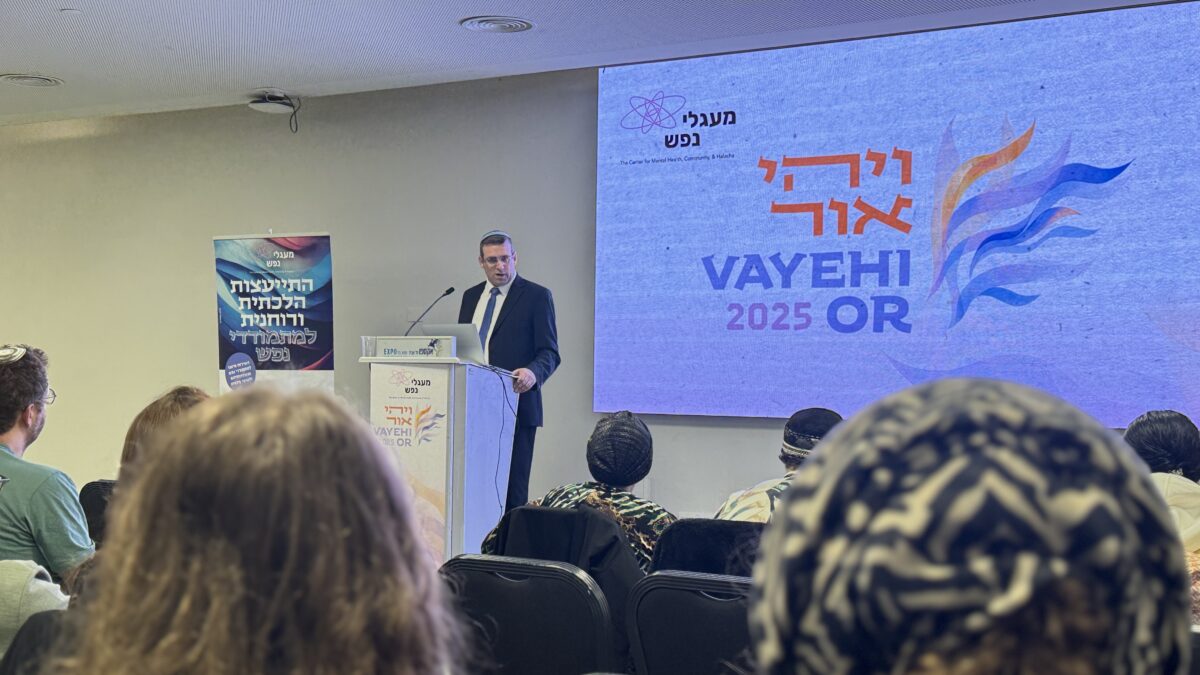 Rabbi Yoni Rosensweig speaks at the Vayehi Or conference, which was organized by his religious mental health nonprofit, Maaglei Nefesh, in Tel Aviv on Dec. 31, 2025. (Courtesy)
The realization led Rosensweig to begin offering spiritual and halachic guidance to hundreds of people who contacted him from around the world. He started speaking publicly about mental health and built a community of thousands on social media. In 2022, sensing the need for a center that would train Jewish community leaders and provide support for those suffering, Rosensweig partnered with Nadav Ellinson, a high-tech executive, to found Maaglei Nefesh – the Center for Mental Health, Community and Halacha.
Now, more than two years after the Oct. 7 attacks, as Israel grapples with unprecedented levels of trauma across its population, Maaglei Nefesh represents a growing recognition that effective rehabilitation for religious communities requires addressing spiritual crises alongside psychological treatment. “The question troubling many of those struggling isn’t just ‘How do I cope?’ but ‘Am I still a religious person if my trauma prevents me from keeping Shabbat? Does God still love me?’” Rosensweig told eJP.
On New Year’s Eve, the Vayehi Or conference at Tel Aviv’s Exhibition Hall drew several hundred attendees – 30% more than the organization’s first conference last year. What makes the conference different isn’t the topic of mental health and Judaism, but the audience. “This event is for people with mental health challenges and their families,” Rosensweig said. “Not for mental health professionals. Not for rabbis. For the people themselves.”
Individuals and their family members packed into convention rooms and mingled with each other and professionals over tables of catered meals and cappuccinos. Several booths offered programs and activities in the sphere of mental health for religious people.
According to Maaglei Nefesh’s new CEO, Yosef Condiotti Shneor, the idea was to create a space where people could feel supported and seen. “We want people to come here and feel that this is a nice and safe space, where they can talk and share and not feel shame. That’s why we give them this conference, so they can have a community feeling,” he said.
The conference program reflected this dual focus: sessions on mediation and communication tools alongside deeply spiritual content. Rosensweig’s session, “The Light Within My Soul,” explored faith and finding light in darkness. Rabbanit Yafit Clymer led a discussion connecting Moses and Viktor Frankl on discovering meaning through struggle. The closing session featured Religious Zionism party parliamentarian Michal Waldiger alongside Rosensweig, suggesting growing political recognition of the issue.
Until recently, many religious organizations shied away from mental health events. But that stigma has started to dissipate in the religious community, according to Rosenweig. “Society is changing,” he said. “People want to be recognized, they want to be seen. And they want their spirituality and religion to be part of what supports them.”
“This is not about [Cognitive Behavioral Therapy, Dialectical Behavioral Therapy] or some sort of other modality,” Rosensweig said, referring to common psychological treatments. “A person has their own therapist. Here, the whole point is to support people spiritually, religiously, because it’s a big part of people’s lives.”
The halachic dilemmas Maaglei Nefesh fields reveal the gap in Israel’s mental health infrastructure for religious populations. Rosensweig argues that the challenge goes deeper than halachic problem-solving. “A lot of times it goes beyond halacha,” he said. “People want to know: If I’m not keeping Shabbat fully, if I’m not fasting on Yom Kippur because of my eating disorder, what does that mean for me? Am I still a religious person? Does God still love me? Does He hate me? Those things trouble people who are going through mental health challenges.”
This is where secular mental health services, however clinically excellent, may be falling short for a significant portion of Israel’s population. A therapist can address the psychological dimensions of trauma, but is unlikely to address the spiritual crisis that accompanies it for religious patients: the feeling of being a “second-class citizen in Judaism,” as Rosensweig put it.
The organization’s approach is to normalize not just mental health struggles, but the religious accommodations that mental health may require. In other words, one can still be a first-class member of the Jewish people, even if trauma or illness prevents them from keeping certain mitzvot.
Maaglei Nefesh trains rabbis to serve as informed first responders for mental health crises in their communities. The organization has trained approximately 300 rabbis and rabbaniot, mostly Orthodox, in a 50-hour program, combining halachic sources, lived experience narratives from people with mental health conditions, communication skills and clinical education from mental health professionals.
“The lived experience part is very impactful,” Rosensweig said. “Everyone knows someone dealing with depression or an eating disorder, but you never sat and listened to an hour, hour-and-a-half story from start to finish, understood how that impacted the person, how it changed, how it morphed over time. It is a different thing.”
The unique training positions rabbis not as therapists but as informed guides who can help people navigate halachic concerns, reduce barriers to seeking professional help and provide spiritual support that complements clinical treatment. In a society where rabbis hold enormous trust and authority, particularly in religious communities, their role in either facilitating or hindering access to mental health care is seen as crucial. In Israel, most Orthodox rabbis do not learn pastoral care in their rabbinic courses.
According to Shneor, Oct. 7 initially had a surprising effect on people turning to Maaglei Nefesh. “It seems they felt that they needed to minimize their experiences because they felt there are people who are struggling more,” he said. In the past few months, however, there has been an increase in people contacting the organization, likely as the immediate pressure of the war has slowed. Shneor noticed that some of the attendees were not from the religious community. Indeed, one conference attendee told eJP that she was there to explore possibilities for her daughter who struggles with her mental health. “I don’t want her to become religious, but this is interesting,” she said.
The organization partners with established mental health institutions, including Machon Dvir and JPsych, and has plans to expand its community reach.
“We have big plans coming up,” said Shneor, “as we are seeking to expand the community and help as many people as possible.”