
As the cold metal of the silver handcuffs closed around his wrists and he was led into the police station, Adam (not real name), a former banker, knew, in that moment, that he had lost his 13-year battle with gambling.
By then, the weight of his losses had become impossible to hide. Debts had piled up, and the bets he placed in the hope of recovery only worsened his situation. The amount he lost to gambling totalled over ₦400 million.
The arrest cost him his freedom, left him with a criminal record and ended his career at the bank. It also exposed the extent of an addiction he had fought in silence for years, one exacerbated by regulatory failures in the gambling industry.
“Losing that amount broke me completely, emotionally, mentally, and financially. It was a turning point that made me confront the full extent of my addiction and the destruction it had caused in my life,” said Adam.
Long before the arrest, Adam’s descent into gambling had begun quietly.
He had watched friends place bets without joining them, but was curious about the excitement they described. That curiosity took hold in 2015, before he got a job at the bank, when he placed his first bet of ₦2,000 on a virtual sports game and won.
His gambling intensified after he became a banker. Virtual sports bets, one of the most popular forms of gambling in Nigeria, became his Roman Empire.
On days when he wanted to wager more than he could afford, he borrowed money from friends and took loans from online apps, hoping to recover losses or stake on what he believed were “sure” games. Each attempt got him hooked on gambling. He battled the addiction silently until his arrest in 2025.
A trillion-naira industry thriving on addiction
Gambling has always been part and parcel of Nigerian culture. Before the advent of formal gambling, people engaged in local games of chance and betting, often tied to festivals, markets, and social gatherings. Bets on local wrestling matches and local competitions were common.
When the British colonised Nigeria, they introduced another style of gambling to the territory. Lotteries and casinos quickly spread across the country, and sports betting platforms sprang up many years later.
Gambling, which was intended as a leisure activity, has spiralled into an unhealthy obsession for many who struggle with an addiction in the shadows.
Nigeria’s online gambling market, now estimated to be worth ₦5.6 trillion, thrives on the addiction of many people, including individuals like Adam, turning their struggles into huge annual profits. According to the Security Exchange Commission (SEC), over 60 million Nigerians gamble daily, spending about $5.5 million.
KingMakers, the sports betting subsidiary of MultiChoice Group and operator of BetKing Nigeria, recorded a 76% growth in revenue for the financial year ended March 31, 2025. MultiChoice also reported a 37% increase in betting customers in Nigeria and a 26% rise in revenue for the 2024 financial year.
Another popular gambling platform in Nigeria, Bet9ja, had an estimated total revenue ranging between ₦500 million and ₦1 billion as of July 2025. Another report pegged the platform’s annual revenue at $653.3 million. Bet9ja also records 31.5 million visits, with an average session duration exceeding 17 minutes.
Surebet247, a betting operator established in 2011, reports annual revenue of $109.1 million, while BetWay records $1.5 billion in revenue. NairaBet and BetKing have annual revenues of $14 million and $8 million, respectively. SportyBet, another prominent player in Nigeria’s gambling scene, records an annual revenue of $6.3 million.
Research revealed that Nigerians gamble to escape the country’s harsh economy, riddled by unemployment, meagre wages and rising costs of living. Although the legal age for gambling in Nigeria is 18 years, underage gambling is rampant.
Studies have also found that employed and self-employed youths are more prone to spend their money on gambling. However, some youths who are more disadvantaged might be most vulnerable and thus seek gambling for their survival.
Although gambling is common among almost all age groups and socioeconomic classes in Nigeria, bankers appear particularly vulnerable to developing gambling problems.
A clinical psychologist, Michael Akinniku, told The Guardian that the nature of the banking environment, with its high volumes of cash, constant financial transactions and easy access to money, creates conditions that can predispose employees to gambling addiction, especially those already involved in the activity.
“The immediate environment of handling cash and financial transactions can greatly increase the risk of gambling addiction,” said Akinniku.
“Constant exposure to money-related cues, normalised risk-taking, and reinforced overconfidence in financial control, high performance demands combined with workplace stress and easy access to funds, can trigger gambling urges, activate reward-driven brain pathways, and impair self-control, leading to repeated gambling behaviour.”
According to him, early warning signs of gambling addiction include constantly thinking or talking about gambling, betting and past wins or losses, an urge to gamble with larger amounts, taking higher financial risks, and using gambling to escape stress or negative moods.
Others are changes in behaviour, such as irritability, secrecy, withdrawal, neglecting work, or unexplained absences, borrowing money, cash advances, or risky financial decisions.
Many bankers are struggling with gambling addiction — Gamble Pause Initiative
The Founder of Gamble Pause Initiative, a social impact organisation and responsible‑gambling initiative in Nigeria, Ladipo Abiose, who launched a walk-in rehabilitation centre for people battling gambling addiction in April 2025, told The Guardian that over 40 bankers and former bankers have sought help from our organisation specifically for gambling addiction.
“We opened our walk-in rehabilitation and recovery centre in April. The centre provides a safe, confidential environment for individuals seeking counselling, therapy, and structured recovery support for gambling addiction. So far, 47 bankers and former bankers have sought help from our organisation specifically for gambling addiction,” Abiose told The Guardian.
“Out of these, several have visited the rehab centre physically, while others reached out through our hotline, online counselling, or confidential virtual sessions. On a weekly or monthly basis, we receive consistent requests for help from banking professionals, reflecting how widespread and often hidden the issue is within the sector.”
How regulatory failure, weak enforcement worsen addiction
For many people battling gambling addiction, the consequences are severe and often worsened by the lack of timely support. Many do not recognise the problem early, only realising its grip after losing money, friendships, family relationships, and even their livelihoods.
This was the case with Salam (not real name), another former banker, who battled addiction for years. Salam’s venture into gambling began in 2010 with a prediction game. With each bet, Salam’s adrenaline surged, and the addiction slowly crept into his life.
When he got employed in a bank in 2020, Salam’s gambling addiction intensified. That was the year he began borrowing from colleagues, loan apps and banks.
“I could stake over 40-50 slips in a day on single livebet games while I was working in the bank. I started getting into trouble constantly in 2020, and there was no hiding place for me. My loans are numerous. The majority are now classified as bad debt by my creditors. I owe the whole world money,” said Salam.
“I started borrowing money from my colleagues when I couldn’t access any of the loan apps and banks anymore. When I realized that I couldn’t pay back, I had to run off. That was when I realised it wasn’t fun anymore. I wanted to stop, but it didn’t end there; rather, it became worse. It drained me mentally.”
He realised the addiction in 2020. His relatives and friends knew he was battling an addiction and counselled him, but every time he tried to leave the world of gambling behind, he found himself drawn back into the dark world his loved ones had advised him to flee from.
He lost his relationship with a friend over the addiction.
“Everyone knew that I had a gambling problem, and I spoke with my friend at that time. He tried his best to liberate me, but it didn’t work out. He doesn’t want to see me now because I caused him so much pain,” he added.
Akinniku, the psychologist, says gambling addiction is classified as a behavioural addiction. According to him, people struggling with addiction could continue gambling despite being aware of the adverse consequences that come with it.
Salam’s addiction also cost him his job at the bank. Shortly after, he got a job at a logistics firm and diverted the company’s funds into his personal account.
He ran off to evade arrest, and his mum was arrested as bait. He spent two weeks in jail and was released after his friends and relatives raised funds to secure his bail.
For some who recognise the addiction, regulatory failure and weak enforcement of legislations meant to protect consumers, like self-exclusion, stand in their way of recovery.
Better Health Channel, an initiative of the Victorian Government, recommends self-exclusion as a measure towards helping people with gambling addiction overcome it.
Self-exclusion is a voluntary way for a person to block themselves from accessing gambling services, especially online sports betting and games. According to Better Health Channel, self-exclusion helps people who recognise they’re struggling with gambling take a break or stop altogether.
Once activated, it prevents a person from logging in, depositing money, placing bets, or receiving marketing from the operator during the exclusion period.
Betting operators in Nigeria offer self-exclusion options, but many fail to comply with the rules governing self-exclusion set out in the gambling legislation.
Before 2025, Nigeria had a central regulator that oversaw the activities of lotteries and gambling platforms. This, however, came to an end when the National Lottery Act was declared invalid by the Supreme Court following a 16-year legal process initiated by the Lagos State Government seeking an interpretation of the Constitution that lotteries fall within the purview of residual matters, which are legislative issues reserved for State Governments.
Following this ruling, the National Lottery Act was nullified, and states were given the authority to regulate gaming platforms and betting operators and to enact laws governing them.
Lottery regulatory agencies in states, such as Lagos, make provision for self-exclusion in their laws governing gaming, betting operators and lotteries.
The Lagos State Lottery Laws 2021 set the minimum self-exclusion period at 90 days and the maximum at lifetime. Section 5 of the law states that licensed operators should make adequate provisions and post on their premises, websites, or links procedures for self-exclusion, which shall include procedures that permit any player to set an irrevocable period of self-exclusion for a minimum of ninety (90) days to a lifetime.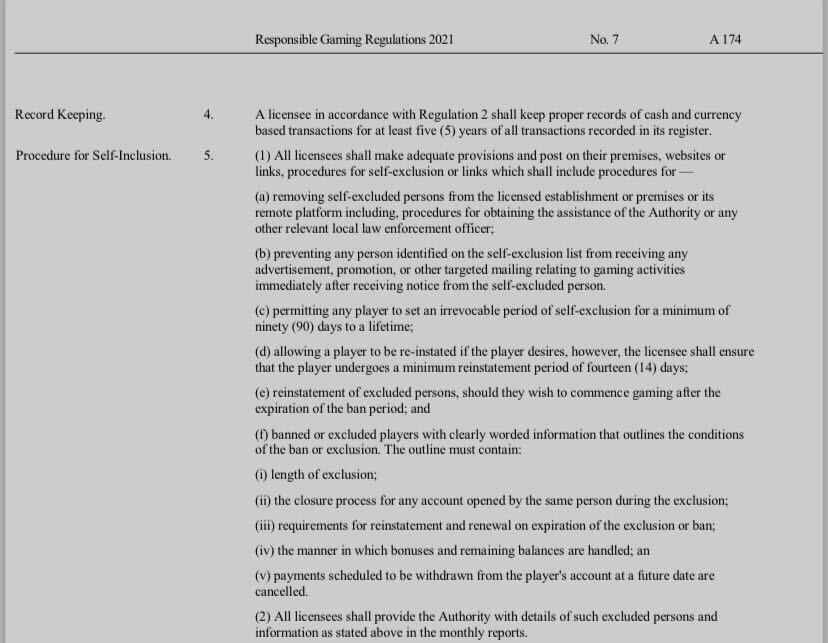 Lagos State Lottery Laws 2021 regulation on self-exclusion
Some betting operators only offer exclusions from 24 hours to 90 days, with no lifetime or irrevocable option.
Findings by The Guardian reveal that some operators that fail to comply with the law on self-exclusion in Lagos State include SportyBet, BetPawa, MSport, and BetWay.
SportyBet sets its minimum self-exclusion period at 24 hours and a maximum of 90 days. Other periods offered to players include 48 hours, 7 days, and 30 days.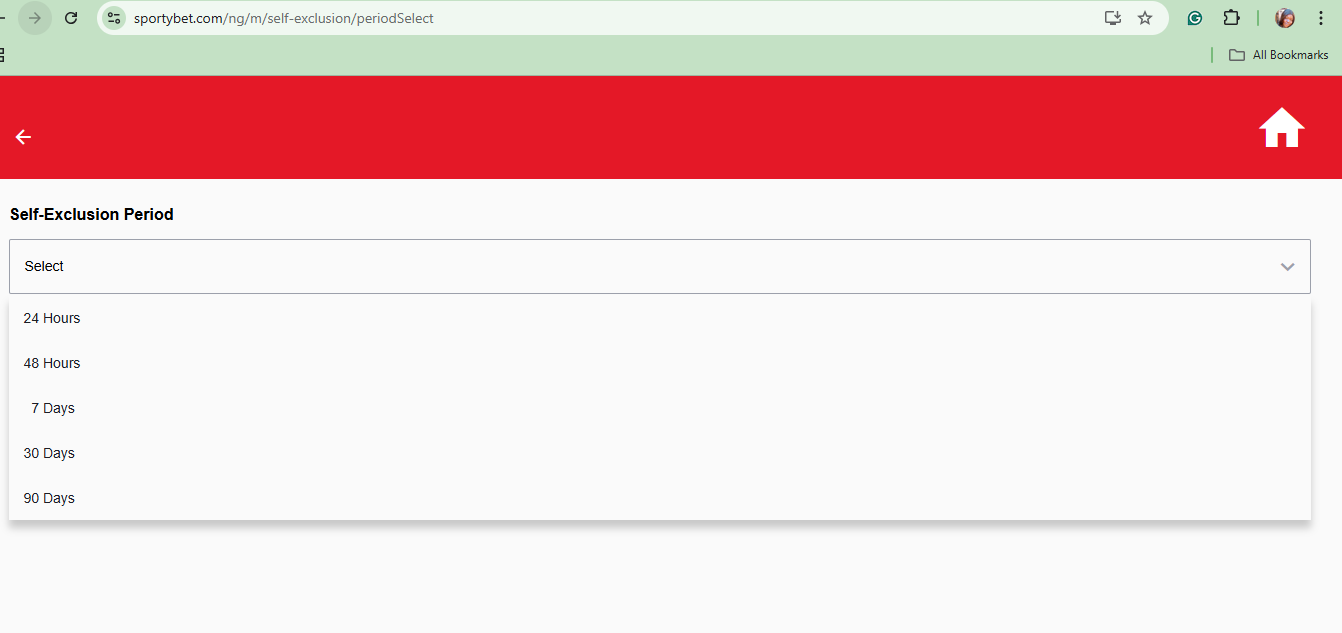 Sportybet self-exclusion
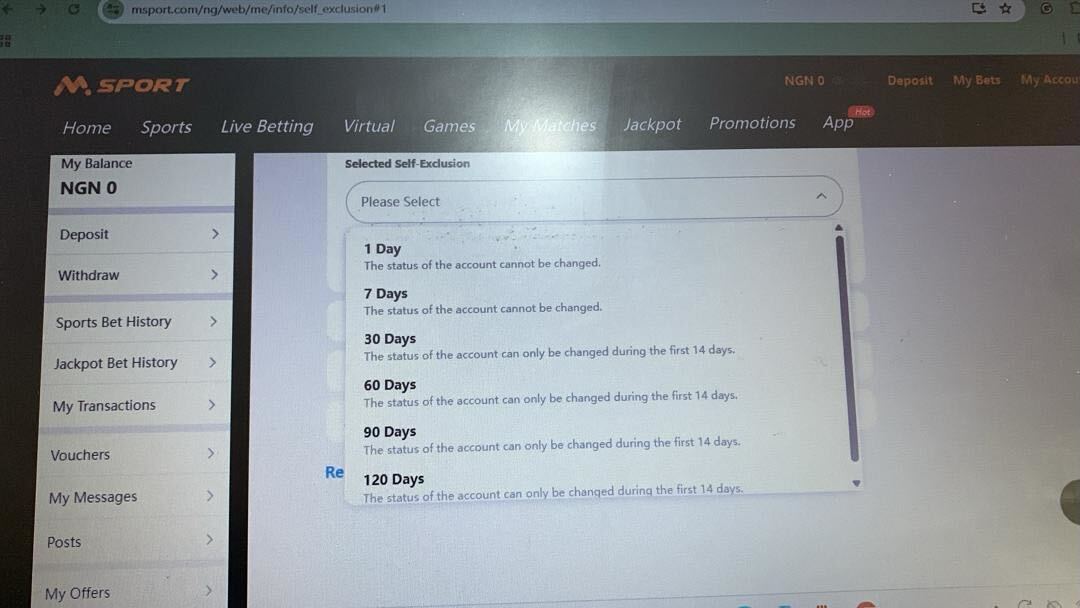
MSport offers self-exclusion for a minimum period of 1 day. Other options available are 7 days, 30 days, 60 days, 90 days and 120 days.
 MSport self-exclusion
BetPawa offers a self-exclusion period of 1 to 90 days.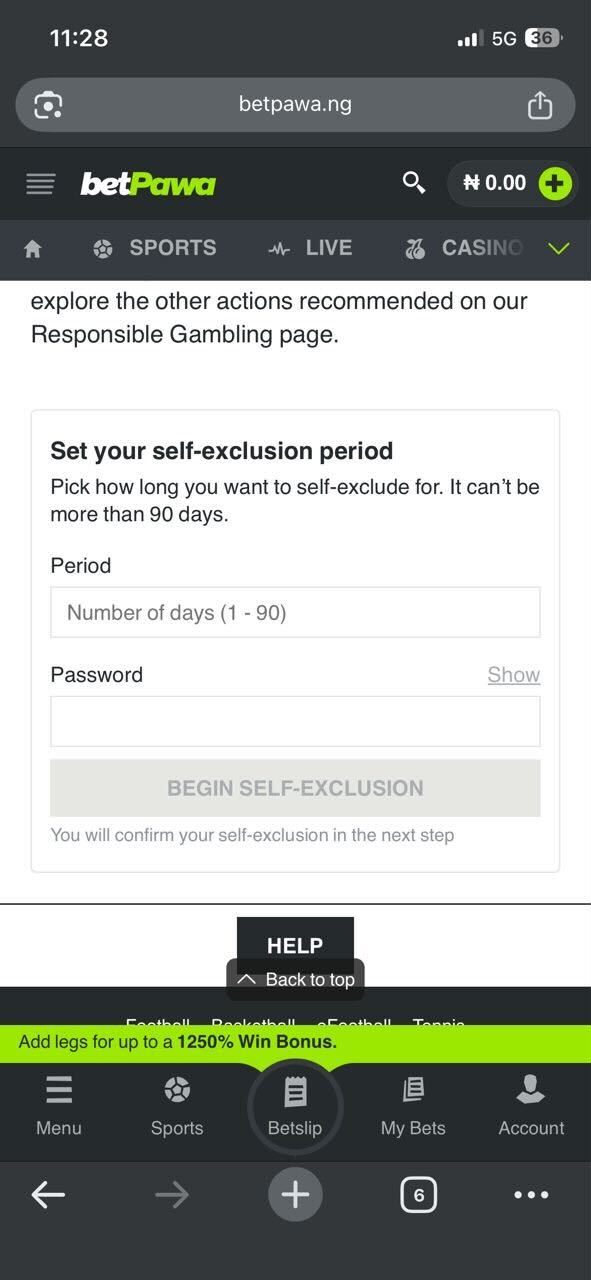 BetPawa self-exclusion
The Guardian contacted all four betting operators for comment. SportyBet did not respond to questions as of press time. A Betway staff member, Eromosele, referred our correspondent to the company’s responsible gaming section on its website, without directly addressing the issues raised.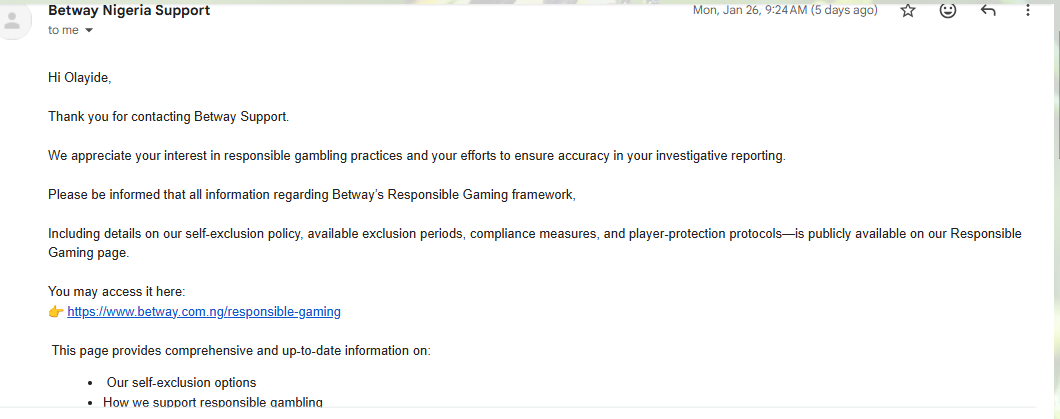 BetWay email response
On its website, Betway sets a “cooling-off” period of at least 24 hours, a “temporary suspension” of at least 1 month, and a “temporary self-exclusion” period of at least 3 months.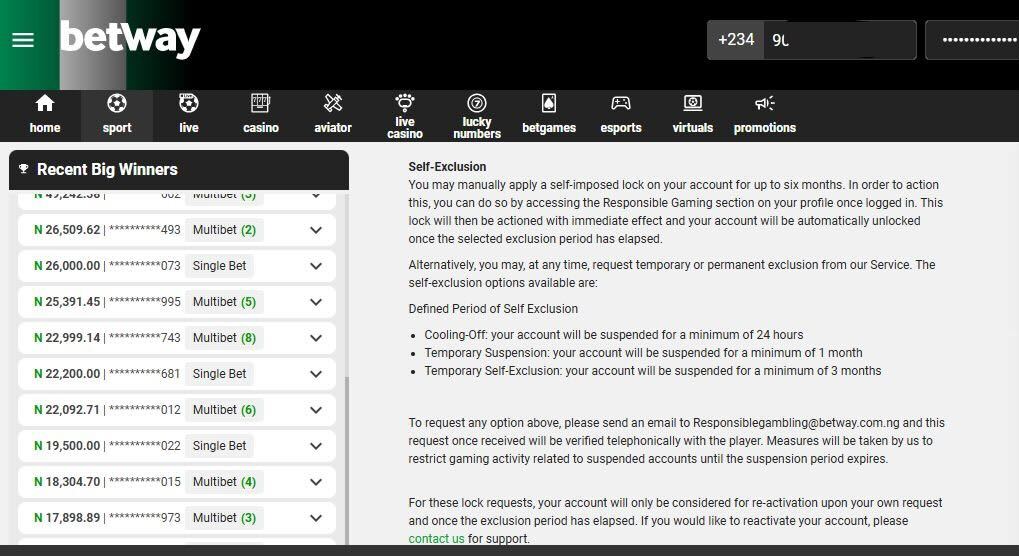 Betway self-exclusion.
MSport, however, openly confirmed what our correspondent uncovered during the investigation—that it is in breach of regulations by limiting its self-exclusion period to 1 day to 90 days.
“This feature allows users to temporarily exclude themselves from accessing specific betting games for a designated period, ranging from a minimum of one day to a maximum of 90 days. During the self-exclusion period, users will not be able to place bets or engage in specific games; however, they can still log in to withdraw any remaining funds from their accounts,” the MSport Customer Service Team stated in an email.
Do banks provide mental health support for staff?
To determine whether banks provide mental health support for their staff, The Guardian surveyed bankers.
A total of 25 bankers from 10 banks participated in the survey.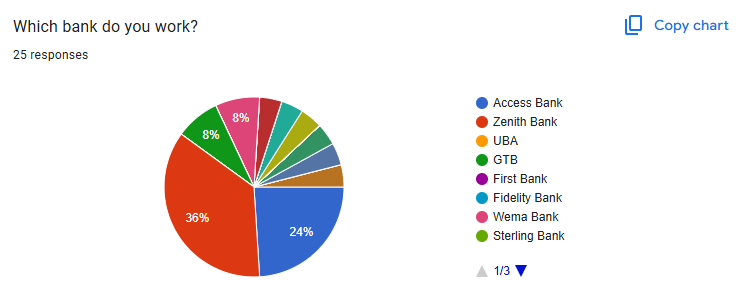 survey responses. Olayide Soaga/Guardian Nigeria
Of these, 11 said their banks provide mental health services, 9 said they do not, 1 responded “maybe,” and 4 said they were not sure.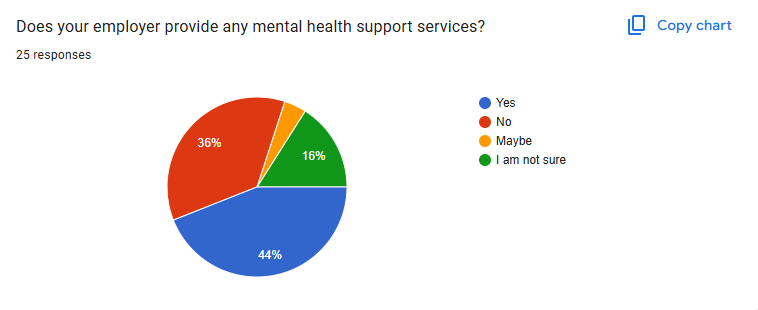 survey responses. Credit Olayide Soaga/Guardian Nigeria
When asked about the type of mental health support available, two respondents cited in-house counselling, one reported access to external therapists, four mentioned employee assistance programmes, three said their banks offer mental health insurance coverage, nine pointed to wellness training and workshops, while one said they receive no mental health support at all.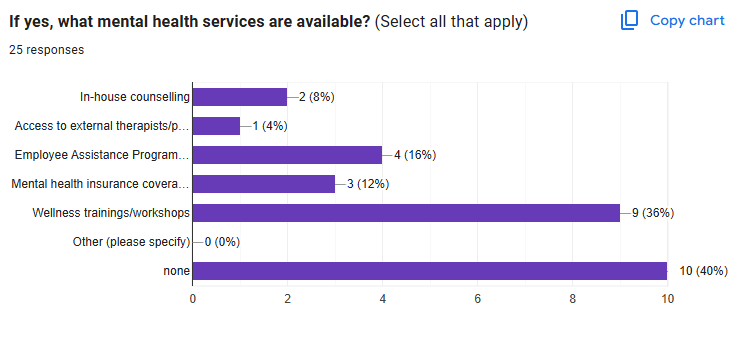 survey responses. Olayide Soaga/Guardian Nigeria
For bankers whose work environment makes them especially vulnerable to gambling addiction, yet, receive no help from their employers, survival feels like being trapped between two bad odds. On one hand, there is little or no psychological support from the banks they work for. On the other hand, weak enforcement and regulatory failures have rendered self-exclusion tools—designed to protect users—largely ineffective.
Therapy, support can help bankers overcome addiction – Abiose
Abiose, the founder of GamblePause, says all hope is not lost for bankers battling gambling addiction, adding that banks have a role to play in guiding affected staff towards recovery.
He recommends that banks provide confidential counselling services, rehabilitation programmes, and financial therapy to help rebuild healthy money habits.
The responsible gaming advocate also urges the introduction of early-intervention systems within banks, as well as awareness programmes aimed at reducing stigma and encouraging help-seeking among staff struggling with gambling addiction.
Abiose further calls on banks to partner with his initiative, GamblePause, to organise structured awareness workshops, establish confidential internal support channels, train human resource personnel to recognise early signs of gambling addiction, integrate gambling and mental health modules into staff training, and promote a workplace culture where seeking help is safe and free from stigma.
“Gambling addiction is a psychological struggle, not a character flaw. My personal experience has shown me that anyone can fall into it, but with the right support and understanding, recovery is absolutely possible,” said Abiose.
“Through GamblePause Initiative Africa, we will continue expanding awareness, strengthening partnerships, especially within the banking sector and ensuring more people receive the help they need.”
As regulatory enforcement remains weak and banks continue to fall short in providing adequate mental health support for their staff, more bankers who gamble habitually risk sliding into addiction and lose their jobs, like Adam, who now works as a security guard, or lose their jobs and relationships with friends, as in Salam’s case.
The names of former bankers were withheld to protect their identity.