
After more than a year of behind-the-scenes negotiating and sometimes contentious debate, Cleveland City Council unanimously passed Tanisha’s Law, which is intended to build on the city’s progress in dealing with emergency calls about people experiencing a mental health crisis.
Tanisha’s Law was named to honor Tanisha Anderson, who died in 2014 after a struggle with Cleveland police officers during a mental health crisis. After the vote, Council Member Stephanie Howse, a sponsor of the bill and its champion at City Hall, teared up as she spoke of Anderson’s daughter Mauvion, who was 16 when her mother died.
 Tanisha Anderson in a family photo.
“I just want to let her know ‘Your mother is not forgotten,’” Howse-Jones said.
The law establishes a new Bureau of Crisis Response within the city’s Division of Emergency Medical Services (EMS). In Cleveland currently, crisis response includes co-response, in which mental health professionals accompany police officers on calls; and care response, which does not involve officers.
EMS is part of the Department of Public Safety. The head of the new bureau will be a deputy commissioner. The law also calls for an yearly public report on the program impact and recommendations and an online dashboard with response data.
The bill originally called for a new city department with its own director. Mayor Justin Bibb’s administration opposed that, arguing in a memo to council that it would create “duplicative bureaucracy.” Between December and January, the administration and council members reached the deputy commissioner compromise.
Council Member Mike Polensek, chair of council’s Safety Committee, called the process to pass the legislation a reminder that “reasonable people can come up with reasonable solutions.”
Working “hand in hand” to pass Tanisha’s Law
In an interview after the vote, Michael Anderson, Tanisha’s uncle and the family’s representative throughout the process, admitted there were times when “I had my doubts” about it ever passing.
“But it’s strange,” he added. “The longer it took, the more confident I was that it was going to happen.”
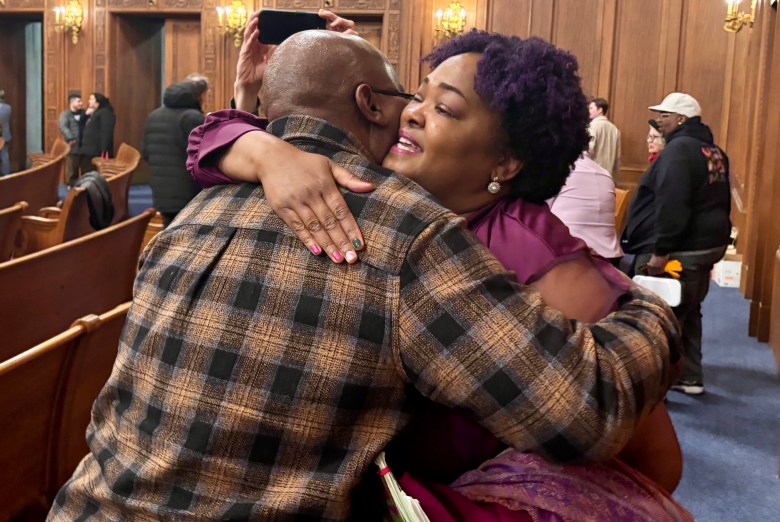 Council Member Stephanie Howse-Jones embraces Michael Anderson after the passage of Tanisha’s Law, named after Anderson’s niece at the Cleveland City Council meeting on Feb.2. Credit: Frank W. Lewis
Anderson approached Council Member Stephanie Howse-Jones in 2022. She invited Case Western Reserve University’s Student Legislative Initiative of Cleveland (SLIC) to help research and write a bill. Howse-Jones, Council Member Charles Slife and former member Rebecca Maurer introduced Tanisha’s Law in November 2024.
For a year, nothing happened. But Anderson and other supporters of the bill kept the pressure on council and the Bibb administration, behind the scenes and in council chambers.
In November 2025, Howse-Jones rose in council chambers to express her frustration and to vow to keep fighting.
About two weeks later, council’s Safety Committee discussed the bill for the first time. Council members challenged administration officials’ objections and their pleas for more time to study 911 call patterns. That meeting ended with Polensek advising the officials to “get on board [the train] or get run over.”
The next time the Safety Committee met, in January, the two sides agreed to compromises, including creating a bureau within EMS instead of a new department.
At Monday’s meeting of council’s Finance, Diversity, Equity and Inclusion Committee, Wayne Drummond, the city’s director of public safety, said he and Assistant Director Jason Shachner “worked hand in hand” with Howse Jones to finalize the bill.
At the same meeting, Council Member Brian Kazy praised Howse-Jones’ commitment to getting the bill passed.
“We don’t always see eye to eye, but I have to commend you immensely on this, as well as the administration,” he said. “You should wear this one as a badge of honor.”