
By GREGORY ZELLER //
To properly study the effects of booze, weed and other drugs on behavioral health and neurological impairment, the Feinstein Institutes for Medical Research would like to get you drunk and high and then check you out.
 Welcome to mid-21st Century New York State, where weed is legal, psychedelic mushrooms are as potent as ever, drunk driving kills 17,000 people every year and, while Albany has made overall progress, Long Island continues to slog through an opioid crisis.
In short, the use of mind-altering substances is as prevalent as ever.
Recognizing both the persistence of illicit habits and the potential of therapeutic benefits, the Feinstein Institutes for Medical Research has thrust itself onto the front lines of this societal conflict – and it sounds like quite a party.
Northwell Health’s R&D mothership has announced the official opening of the Center for Psychedelics Research and Treatment at Zucker Hillside Hospital in Glen Oaks. Of course, it’s not a party, but a serious scientific effort drilling deep into the therapeutic possibilities and impairing realities of alcohol, cannabis, psilocybin mushrooms, 3,4-Methylenedioxymethamphetamine – you know it as ecstasy, or maybe molly – and other controlled substances.
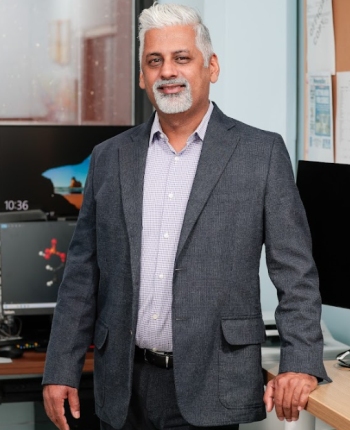
Nehal Vadhan: What’s your poison?
To write the definitive book on both heightened therapeutic applications and fritzed motor functions … well, the researchers may be sober as a judge, but the study subjects will absolutely party on, in an environment that’s safe and monitored and maybe the hottest nightspot in all of Glen Oaks.
The CPRT boasts a fully stocked bar – beer, wine, vodka, whisky, appropriate mixers – served from behind a sliding glass partition in a pub-like setup (an actual bar, stools, big-screen TVs, booze posters). There’s a fine selection of smokables and edibles, depending on the particular research at hand (one initial study explores psilocybin as a treatment for social anxiety disorder), plus two separate “administration rooms” specially equipped to ventilate marijuana smoke.
There’s music and headphones and comfy chairs, and a kitchen for, you know, the munchies. And there’s a state-of-the-art driving simulator, because researchers don’t let friends drink and not drive – at least virtually, to study potential lags in those hand-eye reflexes.
To legally serve up the spirits and dope, the Feinstein Institutes had to undergo a significant sobriety test. The new center meets stringent ventilation and storage requirements and is in the process of obtaining a series of high-level permissions – and it must acquire its controlled substances through the government, via a series of special licenses.
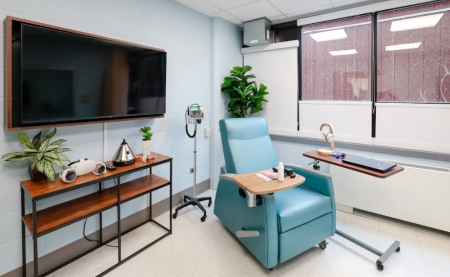
Creature comforts: Make yourself at home in the Center for Psychedelics Research and Treatment.
To these ends, the CPRT has already earned a New York State Bureau of Narcotic Enforcement Class 7 Research License, plus National Institute on Drug Abuse National Drug Supply Program authorization and a host of provisional Northwell Health Internal Review Board approvals.
Still pending: a federal Drug Enforcement Agency Schedule 1 Controlled Substances Research Registration and a NYS Office of Cannabis Management Research License.
While the center is physically in Glen Oaks, its overarching mission reaches across Northwell Health’s 28-hospital footprint and diverse patient population. Study subjects – including participants in a current exploration of MDMA tolerability in schizophrenia patients and an ongoing assessment of naturalistic psychedelics use among psychiatric outpatients – will hail from across Northwell’s domain.
The goal is to significantly advance science’s understanding of psychedelic agents, perchance to utilize them better as treatments for severe mental-health and substance-use disorders – “conditions in desperate need of effective therapies,” according to behavioral health researcher Nehal Vadhan, who co-directs the CPRT with fellow behavioral specialist John Kane.
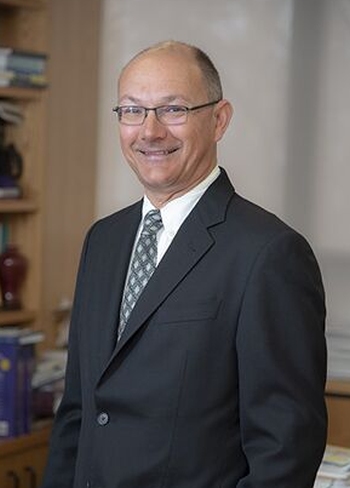
Anil Malhotra: Innovative approach.
“This new facility and planned research are crucial for uncovering novel treatments for difficult-to-treat disorders and symptoms,” noted Vadhan, an assistant professor in the Feinstein Institutes’ Institute of Behavioral Science and director of the new Feinstein Family Human Neuropsychopharmacology Laboratory. “We are committed to conducting careful and meaningful studies that will ultimately help educate patients on the pros and cons of these substances.”
With the initial psilocybin, MDMA and psychedelics-among-psychiatry-patients studies underway, the center is already embracing its quest to “increase [public] knowledge and reduce stigma,” Vadhan added – and thoughts are already turning to future clinical-treatment programs and larger studies leveraging federal support.
Anil Malhotra, the Susan and Leonard Feinstein Chairman of Psychiatry Research and Institute of Behavioral Science co-director, called the CPRT “a significant step in our commitment to explore and develop innovative approaches for mental healthcare.”
“The work led by Dr. Vadhan and his lab will be important to expand our understanding of the impact of these therapies for psychiatric and substance use disorders,” Malhotra added.