
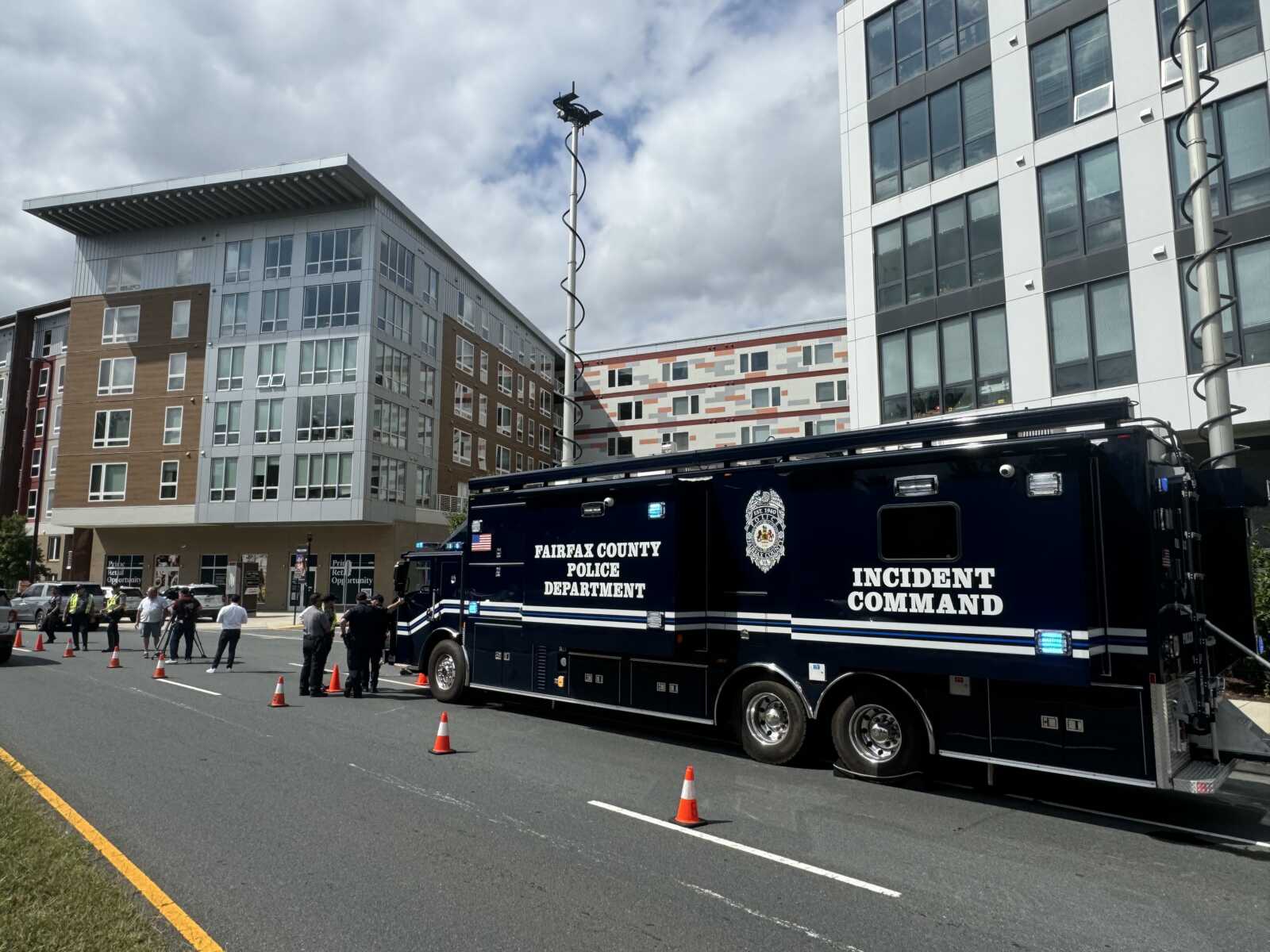
 The Fairfax County Police Department investigating an officer’s fatal shooting of a woman at the VY Reston Heights apartments on Sept. 16, 2024 (staff photo by James Cullum)
Fairfax County’s independent police auditor has recommended that the role of police officers on mental health crisis-related calls be reconsidered.
Richard Schott, who has served as the police auditor since the role was created in 2017, suggested the county reevaluate how it approaches behavioral health calls as part of his review of a fatal shooting by police in Reston in September 2024.
While Schott agreed with the Fairfax County Police Department and Commonwealth’s Attorney Steve Descano’s determination that the use of deadly force in that case was reasonable, he questioned whether it’s always appropriate to involve law enforcement when dealing with subjects in a mental health crisis.
Schott noted that the county “has a multitude of programs, resources and initiatives in place to address mental and behavioral health crisis calls” that could supplement or replace a police response and, perhaps, lead to more positive outcomes.
“There is a growing number of non-police response program with positive outcomes that support the efficacy of expanding the use of purely civilian response,” Schott wrote in a report released last week. “Therefore, local governments must continue to explore ways to increase the use of civilian first responders and reduce the role of police.”
Schott’s report, released Jan. 29, detailed his analysis of the FCPD’s investigation into the Sept. 16, 2024 death of Sydney Wilson, a Reston resident who was shot and killed after slashing a police officer with a knife.
Police Officer First Class (PFC) Peter Liu responded to the VY Reston Heights apartments — which have subsequently been renamed The Point at Rise — around 10 a.m. that morning after a mental health professional requested a welfare check on Wilson, who reportedly “displayed grandiose delusions,” police said at the time.
After knocking on her door and identifying himself as a police officer, Liu attempted to explain to Wilson that she was “not in trouble” and that officers wanted to “make sure you’re OK, that’s all,” according to prosecutors.
When she opened the door, however, Wilson was armed with a kitchen knife that she swung at Liu, striking him in the forehead, body camera footage showed. Wilson then began to pursue Liu, an officer trained in crisis intervention, down the hallway.
Ignoring commands for her to stop, Wilson struck Liu again with the knife before Liu fired his gun at her five times. She was shot three times before collapsing in the hallway.
Wilson was transported to an area hospital a short time later, where she was pronounced dead.
Descano opted not to bring criminal charges against Liu for the shooting. Schott, a 27-year veteran of the FBI, noted in his report that Liu had attempted to deescalate the situation and only took lethal action when absolutely necessary.
“Non-deadly force options were not viable after [Wilson] attacked [Liu] with a knife,” Schott wrote. “He did nothing prior to his use of deadly force that intentionally increased the risk of the confrontation resulting in deadly force.”
Schott acknowledged the benefit of Liu’s training in crisis intervention for this specific incident, but noted that there has long been a “hearty debate” around whether police should respond to behavioral health incidents:
… with one side expressing an interest in reducing police involvement in responding to mental health calls to allow them to focus on crime and violence, and the other side expressing concerns that removing officers from these calls will put civilian responders at risk of getting hurt. In spite of the risks involved, and because individuals in crisis are often hurt (or killed) during their interactions with the police, jurisdictions across the country must decide when law enforcement officers are needed on such calls and when the presence of police on them may actually be detrimental (if not illegal).
Fairfax County introduced a co-responder program in 2021 that pairs police officers with trained behavioral health specialists from the Fairfax-Falls Church Community Services Board for certain 911 calls.
When reviewing a fatal shooting by police that occurred in McLean in 2022, Schott recommended that the county speed up its expansion of the co-responder program, something that was accomplished with the addition of a fourth officer/clinician team in October 2023.
Based on current call volumes, Schott says there doesn’t appear to be a need for additional teams to be available around the clock, but he believes county leaders should consider whether they’re “satisfied with the current level” of police versus civilian involvement in welfare checks with no suspected criminal activity.
Some cities around the country, including New Orleans and Denver, have implemented programs that only send civilian crisis workers on mental health-related calls for service, though Eugene, Oregon, severed ties with its landmark CAHOOTS initiative last year. Established in 1989, the program still operates in nearby Springfield.
“Continuous improvement in responding to these calls in an appropriate and legally compliant way is of paramount importance to the Board of Supervisors, individuals in crisis, the FCPD and the community at large,” Schott wrote.
Since 2016, Fairfax County police officers have been involved in one or two shootings each year. That number peaked at six in 2022, but dropped to two the following year, one in 2024 and two in 2025.