
Find your next quality investment with Simply Wall St’s easy and powerful screener, trusted by over 7 million individual investors worldwide.
Neurocrine Biosciences started a Phase 2 clinical study of NBI-1065890, a next generation VMAT2 inhibitor for tardive dyskinesia.
The trial focuses on evaluating safety, tolerability, and potential treatment effect in patients with this movement disorder.
NBI-1065890 builds on Neurocrine’s established expertise in VMAT2 inhibition.
For investors tracking Neurocrine Biosciences, ticker NasdaqGS:NBIX, this new Phase 2 study adds another clinical asset to watch alongside the existing portfolio. The stock is currently trading at $141.2, with a 1 year return of 15.2% and a 3 year return of 36.8%, which provides context for how the market has treated the name over a longer window. The 5 year return of 23.8% offers an additional reference point for investors evaluating the company’s track record.
The move into Phase 2 for NBI-1065890 may be important for how Neurocrine positions its VMAT2 franchise in tardive dyskinesia over time. As data from this trial emerges, investors will likely focus on how differentiated and durable the treatment effect appears compared with existing options, and how that might influence future product breadth for NasdaqGS:NBIX.
Stay updated on the most important news stories for Neurocrine Biosciences by adding it to your watchlist or portfolio. Alternatively, explore our Community to discover new perspectives on Neurocrine Biosciences.
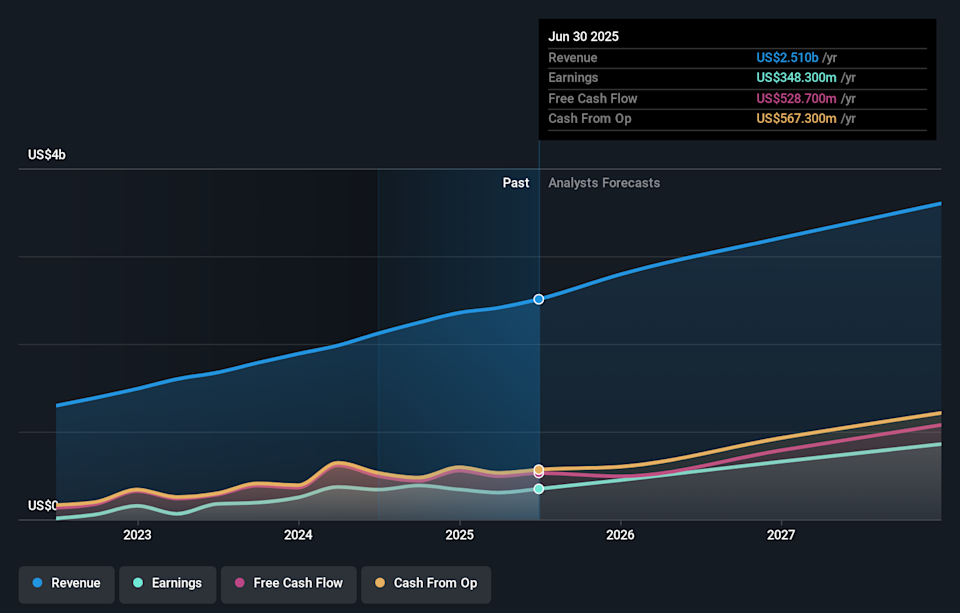 NasdaqGS:NBIX Earnings & Revenue Growth as at Feb 2026
How Neurocrine Biosciences stacks up against its biggest competitors
For Neurocrine, moving NBI-1065890 into a randomized, double-blind, placebo-controlled Phase 2 study gives the company a second TD-focused VMAT2 asset to develop alongside valbenazine, in a market where Teva’s Austedo and generic tetrabenazine are already established options. The focus on a potentially longer-acting profile and an 8 week Abnormal Involuntary Movement Scale endpoint indicates that management is testing whether a more convenient or differentiated dosing approach could matter for real-world use and future revenue mix.
This study aligns with existing investor narratives that emphasize Neurocrine’s effort to build on INGREZZA and broaden its neurology and psychiatry portfolio, rather than relying on a single TD product. Alongside commentary about commercial execution for INGREZZA and CRENESSITY and a deep CNS pipeline, another TD candidate gives investors one more potential driver within the same clinical area if it progresses successfully.
A next generation VMAT2 inhibitor could strengthen Neurocrine’s TD franchise if it ultimately offers a meaningfully different profile from valbenazine and competitors such as Austedo.
Positive Phase 2 data in a controlled trial of about 100 patients could support optionality around future TD product positioning and lifecycle planning.
As with any mid stage trial, there is a risk NBI-1065890 does not meet efficacy or safety expectations, which would limit its contribution to the broader pipeline story.
Analysts have highlighted broader risks around pricing pressure, payer scrutiny, and portfolio concentration, which can affect how much value investors ultimately assign to additional TD assets.
From here, the key things to watch are recruitment progress, any interim safety commentary, and, over time, whether the Week 8 AIMS results point to a clear difference versus placebo and currently approved VMAT2 inhibitors like Austedo. To see how this trial fits alongside INGREZZA, CRENESSITY, and the rest of the CNS pipeline, you can review community narratives and analyst views through the Neurocrine Biosciences narrative page.
This article by Simply Wall St is general in nature. We provide commentary based on historical data and analyst forecasts only using an unbiased methodology and our articles are not intended to be financial advice. It does not constitute a recommendation to buy or sell any stock, and does not take account of your objectives, or your financial situation. We aim to bring you long-term focused analysis driven by fundamental data. Note that our analysis may not factor in the latest price-sensitive company announcements or qualitative material. Simply Wall St has no position in any stocks mentioned.
Companies discussed in this article include NBIX.
Have feedback on this article? Concerned about the content? Get in touch with us directly. Alternatively, email editorial-team@simplywallst.com