
The complicated relationship between mental health and risky behavior among teens and young adults was one area of focus for a panel discussion led by health economist John Cawley at the Syracuse University Center in Washington, D.C., held in recent days. Cawley, professor of economics and of public administration and international affairs, and the Daniel Patrick Moynihan Chair in Public Policy, studies the economics of risky health behaviors such as poor diet, inactivity and obesity. He began the wide-ranging conversation by sharing data on risky health behavior and young people.
“We have seen some unfortunate trends, like the rise of obesity, the rise of suicidality,” said Cawley, who was joined by Maxwell colleagues Monica Deza and Sarah E. Hamersma for the event aptly titled, “Are the Kids Alright?” He noted that the prevalence of obesity among teenagers in the early 1970s was less than 5%, and it is now more than 22%. “But some things have gotten better,” he added.
Cawley pointed to decreases in marijuana use, cigarette smoking and binge drinking among high school students since the 1970s. He also noted a drop in teen pregnancy in the past 50 years, a trend that continued over the last 10 years as well. He asked Deza, associate professor of economics, and Hamersma, associate professor of public administration and international affairs, the recurring question from the discussion, “Are the kids alright?”
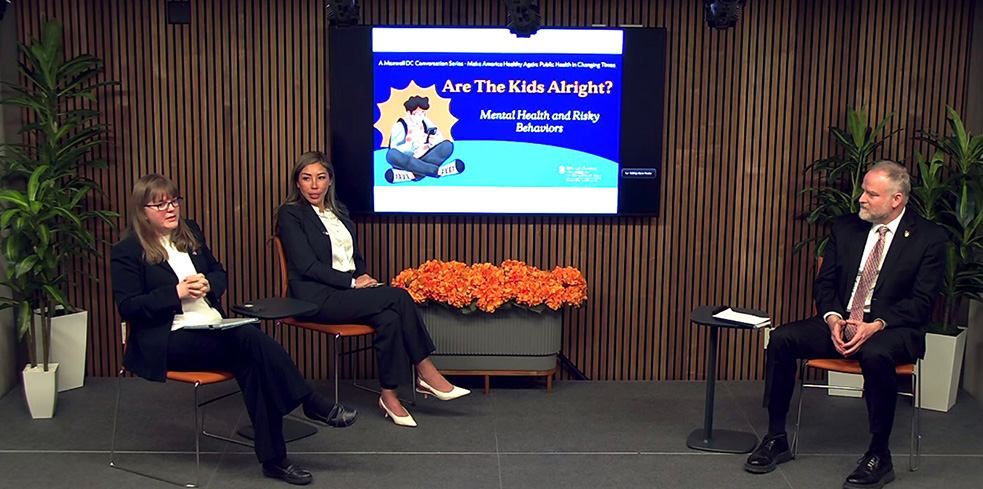 From left to right, Maxwell professors Sarah E. Hamersma, Monica Deza and John Cawley participated in a panel discussion about mental health and risky behavior among teens and young adults.
“I will say surprisingly, no,” Deza replied. She explained that if you had told her earlier in her academic career that all these numbers would go down, it would be safe to assume that young people were doing better. “And yet, clearly they are not. Depression, definitely, has gone up.”
Deza emphasized that it is not simply the case that young people were happier when risky health behavior was more prevalent. Rather, she said, “What has happened is the world has changed.” She cited increasingly complex challenges like lack of employment or underemployment combined with high student debt as contributing factors leading to feelings of hopelessness and depression among young people.
When asked, Hamersma agreed that she does not think the kids are all right, noting that many of these unhealthy behaviors were bundled with other healthy activity that is now less common.
“It’s great that kids are not going somewhere to somebody’s house and getting alcohol poisoning,” Hamersma said. “But the thing is, they’re not going to anyone’s house at all. They’re not going anywhere. They’re isolated. They’re lonely. And so, by losing the risky behavior, we also lose the parts of that behavior that might have been part of their healthy development.”
The panelists went on to discuss how other societal changes are impacting young people, including changes in technology, like smart phones and AI, as well as the overall impact of the pandemic. They also examined their research in policies intended to improve behavior—including regulations and use taxes—to varying degrees of success or failure.
Students and alumni in attendance participated in the conversation, sharing their own concerns about mental health among young people and the many challenges they face as a generation.
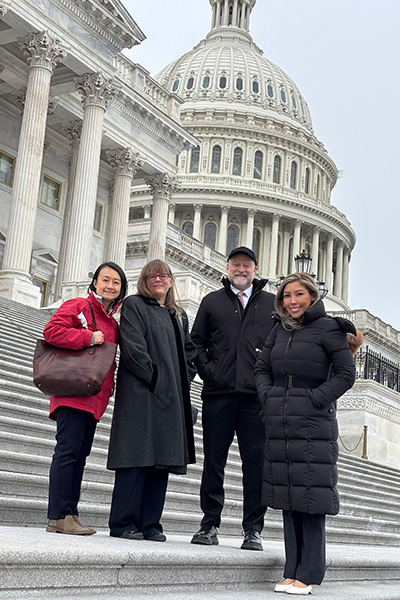 Maxwell faculty members, from left to right, Jun Li, Sarah E. Hamersma, John Cawley and Monica Deza visited Capitol Hill.
The panel discussion was part of a full day of activities at Maxwell’s facilities at the Syracuse Center in Washington, including a meeting to share individual research focus areas and possible opportunities for collaboration, during which they were also joined by Jun Li, assistant professor of public administration and international affairs.
The group of health economists also visited Capitol Hill, sharing information about their research and expertise with the offices of Senator Kirsten Gillibrand (D-NY) and Representative John Mannion (D-NY 22).
The day concluded with a reception at the center for the panelists and the audience.
Cawley joined the Maxwell School in August 2025 and additionally serves as a senior research associate in the Center for Policy Research (CPR). He is the president-elect of the American Society of Health Economists.
Deza is a senior research associate for CPR. Her work examines determinants of risky health behaviors among youth, particularly drug use and criminal behavior. She is a faculty research fellow at the National Bureau of Economic Research’s Economics of Health program.
Hamersma is an O’Hanley Faculty Scholar and senior research associate for CPR. Much of her recent research focuses on health and nutrition programs, examining their consequences for food insecurity, health outcomes and labor supply.
By Cort Ruddy