
Real journalists wrote and edited this (not AI)—independent, community-driven journalism survives because you back it. Donate to sustain Prism’s mission and the humans behind it.
On Jan. 26, Jabez Chakraborty was shot by New York City Police Department (NYPD) Officer Tyree White four times less than a minute after he entered Chakraborty’s home in Queens. His family had called 911 to request an ambulance because Chakraborty, a 22-year-old Bangladeshi man, was experiencing a mental health crisis.
Bodycam footage released by the NYPD last week shows White and an additional officer entering the house at 10:32 a.m. after a family member answers the door. Chakraborty, who is in the kitchen holding a knife, charges toward the officers. They yell at him to put the knife down several times, and then move into the vestibule of the house and close the door. Chakraborty goes to open the door, and White shoots him.
Chakraborty is in critical condition at a Queens hospital, where he is in handcuffs and leg cuffs, and NYPD officers are stationed outside his room, according to a Feb. 4 statement from his family released by Desis Rising Up and Moving (DRUM), a grassroots organization for low-income South Asian and Indo-Caribbean New Yorkers.
“As everyone can see from the body cam footage, we were all calm as the officers arrived. The presence of cops did the opposite and caused the situation to escalate quickly and unnecessarily,” the family said. “Within a minute of NYPD’s arrival, Jabez was shot multiple times and almost killed, while he was calmly eating food just minutes earlier. This is why officers should not be responding to medical support calls.”
The NYPD did not respond to Prism’s request for comment.
The NYPD has a long history of responding to mental health crises with violence: Advocacy groups have pointed out that in the last decade, 24 people have been killed by the NYPD while experiencing a mental health crisis. During his campaign for mayor, Zohran Mamdani proposed a “public health approach to safety” with the creation of the Department of Community Safety, which would prioritize sending teams of mental health workers and paramedics to respond to crises instead of police.
In the wake of the NYPD’s shooting of Chakraborty, mental health advocates, Mamdani supporters, and Chakraborty’s neighbors are calling for an alternative response without police involvement that could prevent harm against New Yorkers in crisis. But some worry that Mamdani’s plan will not entirely remove police from the equation.
Mamdani’s Department of Community Safety
Chakraborty’s shooting has become an early indicator to some New Yorkers of how Mamdani will walk the tightrope between his base of South Asians, leftist progressives, and rent-stabilized tenants, and the NYPD and the powerful interests behind them.
Tensions arose after Mamdani announced that he would keep Jessica Tisch on as NYPD commissioner from former Mayor Eric Adams’ administration, a move that was widely criticized by grassroots groups and police accountability advocates as counter to Mamdani’s campaign promises for police reform.
After Chakraborty was shot, Mamdani said he was “grateful to the first responders who put themselves on the line each day to keep our communities safe.” This response was met with outrage across the city, including from Chakraborty’s family.
“Why is the Mayor applauding officers who recklessly almost killed our son in front of us?” they said in a statement via DRUM.
Days later, Mamdani issued another statement after speaking with Chakraborty’s family and visiting Chakraborty in the hospital, adding that he would “expedite” plans for the Department of Community Safety and that Chakraborty should not face prosecution.
The shooting is being investigated by the NYPD’s Force Investigation Division, which handles encounters between police and members of the public involving use of force. The Queens District Attorney’s Office told Prism in an email that it does not comment on investigations.
The administration has reportedly begun hiring people to develop the Department of Community Safety, estimated to cost $1.1 billion annually, and legislation is advancing through City Council to create it.
Under the current protocol, the NYPD responds to the vast majority of 911 mental health calls, even when callers request ambulances. A 2017 report by the city’s Department of Investigation said that the NYPD’s policies for responding to mental health crises focused on “containment and placing the individual into custody.”
As 911 mental health calls have increased in recent years, the city created the Behavioral Health Emergency Assistance Response Division (B-HEARD) to dispatch teams of mental health clinicians and paramedics, instead of police, to handle emergency situations deemed nonviolent. However, B-HEARD only operates in 31 of the city’s 78 precincts and does not run overnight. B-HEARD does not operate in the Queens precinct where Chakraborty was shot.
Mamdani seeks to expand B-HEARD citywide under the Department of Community Safety, adding peer counselors to every B-HEARD team and reforming the dispatch system to direct more calls to B-HEARD.
Mamdani has traced the idea to the success of Crisis Assistance Helping Out On The Streets (CAHOOTS) in Eugene, Oregon, the first program of its kind in the U.S. Since 1989, the program has sent teams of mental health workers and medics to respond to mental health calls. In 2019, CAHOOTS responded to roughly 24,000 calls, with less than 1% requiring police backup. The initiative has inspired similar efforts in cities including San Francisco and Minneapolis.
“There are situations, especially during a mental health crisis or with individuals who have had poor experiences with police in the past, where a police officer being there can exacerbate the risk,” said Justin Madeira, the CAHOOTS program coordinator. “Having a clinician and a mental health professional be that first point of contact can be a helpful and safe way to start that interaction.”
Some mental health and police accountability advocates say Mamdani’s plan to expand B-HEARD will not fix the underlying problems with how 911 dispatchers handle mental health calls.
“This expansion is not going to lead to the removal of police from responding to mental health calls,” said Samy Feliz, program associate for the police accountability group Justice Committee and whose brother was killed by an NYPD lieutenant in October 2019. “The majority of mental health calls in B-HEARD precincts still get a police response instead of clinicians or mental health workers.”
THE CITY reported last week that 86 percent of mental health calls in B-HEARD precincts resulted in police response because dispatchers defaulted to sending police, even for calls deemed nonviolent. A May 2025 city comptroller audit of B-HEARD also found that 35 percent of eligible calls were not handled by B-HEARD teams for reasons the Mayor’s Office of Community Mental Health, which administers the program, does not track.
B-HEARD did not respond to Prism’s request for comment.
The only way this works is if there’s a non-police crisis response.
Maggie Mortali, CEO of the National Alliance on Mental Illness of New York City
In Chakraborty’s case, the family member who requested an ambulance mentioned that “glass had been thrown at the wall.” Jessica Gillooly, an assistant professor at Suffolk University who studies 911 dispatch systems, said that kind of detail can trigger a police response even when the caller says the person isn’t violent. “In ambiguous situations, the default is to send the police,” she said.
The mayor’s office did not respond to questions about how the Department of Community Safety would handle cases in which no weapon is mentioned in a 911 mental health call.
Maggie Mortali, CEO of the National Alliance on Mental Illness of New York City, said that B-HEARD needs reform before it’s scaled citywide.
“The only way this works is if there’s a non-police crisis response,” Mortali said. If police remain involved, she said, there must always be a mental health professional with them.
Police shootings in South Asian communities
Chakraborty’s shooting is all too familiar to South Asian New Yorkers, a community that was central to Mamdani’s mayoral win.
In March 2024, Win Rozario, a 19-year-old Bangladeshi immigrant who lived in Ozone Park in Queens, was shot and killed by the NYPD after his family called 911 to report a mental health emergency. The officers opened fire after Rozario picked up a pair of scissors and moved toward them. Last December, the office of New York State Attorney General Letitia James announced that it would not pursue criminal charges against the officers.
There was widespread condemnation from South Asian advocacy groups and protests in Queens in response to Rozario’s killing.
In Jamaica Hills, the Queens neighborhood where Chakraborty lives, 67% of voters supported Mamdani in the mayoral election. The neighborhood runs along Hillside Avenue, which is lined with businesses owned by Bangladeshis.
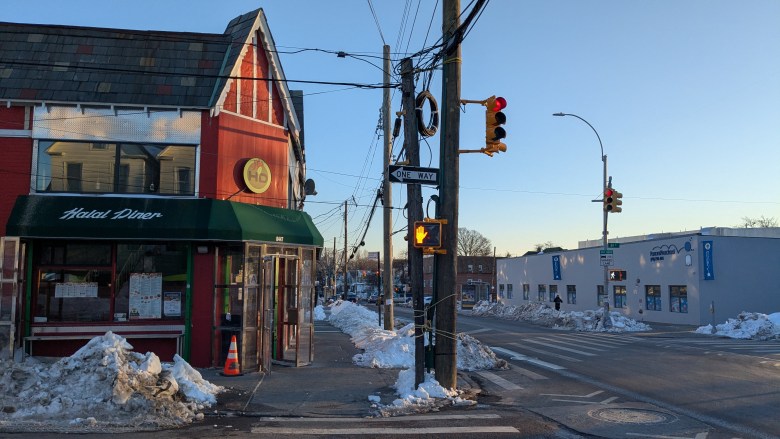 The neighborhood of Jamaica Hills, in Queens, N.Y., where Jabez Chakraborty was shot by an NYPD officer in his home. Credit: Biplob Das Kumar
Mohammed Alin, 60, runs a grocery store around the corner from Chakraborty’s home, where a bright orange Mamdani campaign poster still hangs on the window. He told Prism that Chakraborty’s and Rozario’s shootings were “the same thing, same incident.”
Rekha Biswas, 48, a mother of two who works as a cashier at a 99-cent store in the neighborhood, said she feels that the police view the South Asian community with suspicion.
Officers questioned Chakraborty’s family about their immigration status and what country they were from, and demanded they hand over their phones and passwords, according to Simran Thind, a DRUM organizer. “As you can imagine, any family who just witnessed their family member be shot multiple times by the police is in shock and was just trying to comply,” she told Prism.
An NYPD spokesperson reportedly denied that its officers asked immigration-related questions to Chakraborty’s family.
When Hannan Mia, 65, watched the video of Chakraborty’s shooting, he wondered why police didn’t try to deescalate with “a person who was only carrying a knife.” The Bangladeshi New Yorker from Jackson Heights has a son with autism and has called 911 for help with him.
“Both times that I needed help, ambulances came with police,” he said. The city’s dispatch services need professionals who can distinguish a mental health crisis from possible criminal violence, he added.
In the wake of Chakraborty’s shooting, Biswas questioned whether to call 911 at all. “From now on, I will think twice,” said Biswas. “What is the point of calling 911 knowing that you might lose a family member?”
Editorial Team:
Rashmee Kumar, Lead Editor
Lara Witt, Top Editor
Kyubin Kim, Copy Editor
Related