
Long-term Gwinnett educator and mental health advocate Astrid Ross is preparing to launch her campaign for Georgia State Senate District Seven. The Atlanta Voice talked with the first-time candidate and Atlanta native about the issues impacting families across one of Georgia’s most diverse districts, including educational funding and mental health resources.
As a mother of five who has built a life in Gwinnett, Ross’s focus is on helping District Seven sustain its status as a good place to raise a family.
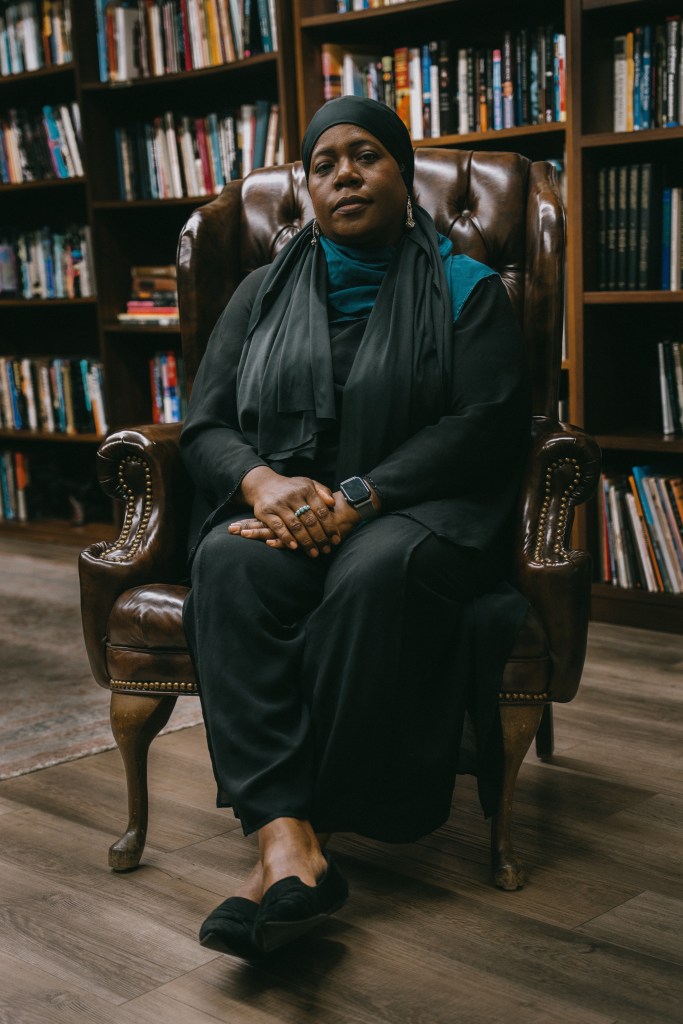 The Atlanta Voice talked with first-time candidate and Atlanta native Astrid Ross (above) about the issues impacting families across one of Georgia’s most diverse districts, including educational funding and mental health resources. Photo by Tabius McCoy/the Atlanta Voice
The Atlanta Voice: You’re launching your campaign as a first-time candidate for Georgia State Senate District Seven on Saturday. How are you feeling as you begin this campaign?
Astrid Ross: “I’m excited and relieved. It’s time.”
AV: You’re a longtime educator. Can you talk about what inspired you to go into education?
AR: “There are a number of things that pushed me into that, including that I’m a mother of five children. All my children are adults. My oldest is 35, my youngest is 25. Education is very, very important, and it always has been, generation after generation in our family. It has been a way that we have broken the generational curses of poverty by using education as a way of lifting ourselves out of those spaces.”
AV: You name this a people-powered campaign. What does that mean for you and the people of District Seven?
AR: “As a Black girl from Atlanta, I have always looked at politics as a space that we should not exist in, because it has been encrypted and decoded. And a lot of times, we look at that as a space that we are not supposed to venture into. So, I was nominated a couple of years ago to the Emerge Georgia cohort. We had to do an entrance exam and compete against like 100 people for 25 spaces. I was blessed to get in. And this program is so holistic and comprehensive, it really decoded or demystified the whole field of politics.”
“As far as my intentions to run, what I got was a lot of pushback from everybody. I had to look at the past 30 years. I’m a community activist and advocate, suicide loss survivor — my dad was a Vietnam vet who took his own life. He was a pre-med student and just didn’t get the opportunities, healthcare, and economics in every sphere. Over the past 36 years working with food drives. We feed the homeless. We do all these things at a grassroots level. So, when I actually went through this process of seeing how those things look from the top down, it was a no-brainer. Why not do things at a higher level so we can get a greater impact? It’s one thing to feed 100 people per month, and it’s another thing to help change legislation so that resources become available to millions of people. It’s kind of a ‘work smarter, not harder.’
“And as an educator, my children, my students, over the past 20 years, were asking me after this last administration was elected: ‘You’ve taught civics and government. This is not what you taught us. It’s not supposed to work this way.’ I was really dumbfounded, and I really had to credit my students for realizing that, no, we can’t make those kinds of decisions. No, we can’t unhinge the Constitution. Being an educator in our community, I’m the only Black person there. There has been a ton of diversity in our school enrollment for the past 20 years that I’ve been there. And we have children from 13 countries this year. So to have a little Iraqi boy ask me, ‘Why does the government run this way when we weren’t taught that,’ it really was an eye-opener for me. Looking at that next generation, looking at my why, how would I tell my grandkids that I figured out how to decode it, but I wasn’t a part of that process of changing those things that don’t benefit us?”
AV: We talked about your father, and we talked about growing up as a Black girl in Atlanta and navigating this role that historically you wouldn’t be in. How have you been able to navigate the mental health advocacy of it all, especially with the stigmas within the Black community? How do you hope to bring that into your campaign?
AR: “I credit NAMI. Nami is the National Alliance on Mental Illness. It is the largest grassroots organization geared towards advocacy resources, collection of data, and education in the nation. I joined NAMI in 2020, and it gave me my voice. It wasn’t until we sat down and looked at our own mortality during that time that I actually let the word suicide-loss survivor come out of my mouth. And then that same year, our children were all going into behavioral health fields. We saw all of this movement in healthcare and behavioral health, and started a nonprofit in 2020 called the Mental Health Support Network. I’m NAMI Gwinnett’s advocacy chair, so I’m the one who has gone to the Capitol for the past five years, talking to legislators about mental health. I also participated in the passing of HB 1013, which became the Mental Health Parity bill.
“With our nonprofit, we do a lot of advocacy and education as well, a lot of free programs, seminars, and we work with Gwinnett County schools and our community. We haven’t charged for one thing yet. And then the lived experience with growing up as a little poor Black girl in Atlanta, whose dad [took his own life]. I felt robbed of our lives because we had a very high future in our midst. As Black people, what we traditionally don’t have in disenfranchisement is access to health care, and the stigma of mental health in the Black community. So I decided to break the curses. It was a lot, and it was coming from all those different directions. And instead of letting it happen to me, I decided to do something about it, and just use those spaces that I exist in now to kind of level up.”
AV: On the other side of things, what type of perspective does being a long-term educator award you about the issues that are impacting residents in Gwinnett?
AR: “I come with a unique perspective as an educator and as a mother of five children, because before my children went to public school, I was a homeschooling mom. I’ve been in private school now for 23 years. I ran a daycare, so I’ve been from pre-K all the way through 12th grade. So in all those spaces, this is what makes me a child advocate. As a legislator, I have to advocate for all the spaces where children learn. I get very frustrated because I’ve put my children through public school, I’ve supported children through a nonprofit private school, and I’ve been in homeschool groups. Why are we not supporting all the places that children learn? Because right now in Georgia, we’re about 36 when it comes to education nationwide. So instead of picking and choosing where we’re going to put that funding, fund them all. Make sure that we can raise the level of education. Even in the private school sector, when we looked at schools with the best models, we had to look North. We look at Vermont and Massachusetts, which have some of the best school models in both the public and private sectors. So, I’m for making sure that children have what they need in every space that they learn in.”
AV: If you win this seat, what is your ideal hope and future for Gwinnett County residents?
AR: “As a resident and graduate in Fulton County, I’ve been in Gwinnett County since 1999. I’m seeing some trends that we’ve seen decades before in some of the other counties. Gwinnett had this appeal to us as business owners. We moved to Gwinnett to raise our kids and to open a business. My husband opened his first barbershop in 1999 in Gwinnett County. We’re seeing downward trends for families in the economy. The diversity, of course, is so beautiful. That’s another reason why I love Gwinnett County, but that diversity itself is now being used against the residents.
“So, you’re seeing a lot of ICE activity, you’re seeing drops in funding in the public schools, you’re seeing the economy drop. Certain areas of Gwinnett County are now changing, just like areas in Fulton County. East Point used to be thriving. Not anymore. Gwinnett County is going to look like the Greenbrier area in a while if we don’t put those safeguards in place and make sure that the economy is up and moving. If we don’t make sure that we secure that funding for the public schools, then families won’t look at it as the place now to raise their kids. As an Atlanta native, I want to make sure that Gwinnett doesn’t follow the trends that some of the other older counties have.”
AV: As you prepare to launch this campaign, is there anything you want to say directly to the people who want to support you, or the people who are learning more about you?
AR: “No. 1, I’m a mother. I’m a grandmother. I am not a politician. I am a person who has sneakers that will run down because I stay on the streets. I’m the one who can call someone and say, ‘We’ve got ICE and snow coming, I need a couple of people to fill the van. We need to come down and bring food and resources Downtown to some of the homeless before the snow hits. And now, in Gwinnett County, where we first moved here there were no homeless people. And I hate to say that, because of course, there were homeless people, but it wasn’t as visible or as widespread as it is right now. So, that won’t stop me, because for me, this is about public service. My grandmother was a police officer at East Point. Community policing was what she did, which meant that if this family didn’t have diapers or if this family had a dispute, she would go there, and we were literally in the car with her all those times. For me, this public service is really a part of helping and sustaining our communities. Now, politics is a vehicle and an avenue to do that through. So, I don’t want to become a career politician. That’s a conversation for a later date, but it does afford legislators the opportunity now to help grow their spaces in their districts, so I hope to do that as well.
“I’m a human. I want to connect with people in that human space, just to let them know I’ve done the work. We know how to do the work. Now, we want to do it at a higher level.”
Related