
Andrea Brochu and her son’s father both had employer-sponsored private insurance, and their son was covered under their plan.
But the mental health services he needed – supports designed to stabilize children and prevent their conditions from worsening to the point of requiring inpatient hospitalization – were not covered.
Brochu had to apply for a Medicaid waiver to get the services her son needed covered. That meant more paperwork, more stress and more time spent navigating systems instead of caring for her child.
“My mind was just blown. Here we are, both of us with employer-sponsored insurance that we pay premiums for, and this isn’t covered,” Brochu said. “It was just another added burden of administration.”
Brochu said her son has faced mental health challenges since first grade, and despite trying therapy, psychiatric care and out-of-state residential treatment, the only program that brought a sense of normalcy to their family was New Hampshire’s Families and Systems Together (FAST) Forward.
The wraparound program provides coordinated, individualized care for patients aged 5 to 21, including peer support, crisis planning and family-centered services.
But private insurance typically does not cover these services. For families who do not qualify for a Medicaid waiver, the state spends roughly $2 million annually in taxpayer dollars to cover the program for commercially-insured children.
A bill sponsored by Sen. Regina Birdsell, Senate Bill 498, aims to close this coverage gap by requiring private insurers to cover FAST Forward’s wraparound services.
Morissa Henn, deputy commissioner of New Hampshire’s Department of Health and Human Services, said the state is subsidizing the program costs in an “increasingly constrained budget environment.”
“Care management entities are already having to pull back,” she said. “When the model is weakened due to funding constraints, it means that we can’t serve as many kids as may need the program, and those who receive the program may not receive as robust a service array as the care management entity tries to spread out its scarce resources.”
Insurers push back
Some private insurers say it’s inaccurate to claim they don’t cover wraparound services at all.
New Hampshire has contracted with two care management providers under Medicaid, and Maria Proulx, president of Anthem Blue Cross and Blue Shield in New Hampshire, said her company has worked with other providers like Easterseals NH to cover wraparound services.
According to Proulx, conversations are underway at Anthem, the largest insurer in the state, to bring providers into the network so their services can be covered. She said her company wasn’t aware of any of its members participating in the FAST Forward program until the state agency shared that information in December.
She believes the legislation to be unnecessary, describing it as a potential “tax on insurance.”
Exactly when insurers would be required to cover those services remains unclear. Proulx said a careful process must be followed, especially since these services are for children.
“We would never just overnight sign a contract with a provider because someone else said that they’re good,” said Proulx. “We have to go through a process where we understand exactly what services are being provided to these children. Are they quality services? Is there oversight? Who is there with the children?”
A similar legislative attempt was made last year, but it failed.
Michele Merritt, president of New Futures, a public health advocacy nonprofit, disagrees with Proulx’s assessment. She believes that given families’ past experiences with insurance carriers, legislation is necessary to avoid leaving the issue to be resolved in behind-the-scenes discussions.
“There still is not a firm commitment that we are going to eventually get to that place,” Merritt said. “I don’t think an amendment of any kind or concessions are a place where we’re feeling like it’s a good decision for the kids of this state right now to be doing that.”
Cost of care
State data show that over a 12‑month period, New Hampshire’s general fund covers wraparound services for about 89 commercially insured children. Anthem Blue Cross and Blue Shield insures the largest share of kids enrolled in the FAST Forward program: 25.
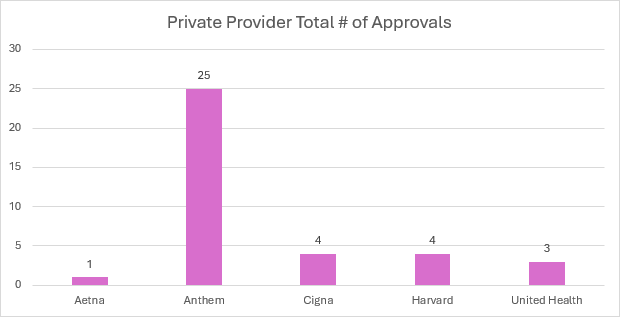
NH DHHS data show the number of privately insured children enrolled in the FAST Forward program over a 12-month period.
The cost for a child in the FAST Forward program ranges from $45,000 to $65,000, while an inpatient psychiatric hospitalization, like one at Hampstead Hospital, costs roughly $1,500 per night.
The program is designed to prevent children with complex challenges from reaching that costly level of institutional care.
Henn said the payment for these acute services is a mix of insurance and state funds.
“It’s definitely has a drain on general funds, which are taxpayer dollars, when it comes to paying for many of the downstream acute services, and we have missed opportunities to intervene with much greater effectiveness and cost efficiency by the time we get to that point,” she said.
The state’s Department of Health and Human Services is already struggling to make cuts following a $50 million reduction in its budget, funding that was slashed as part of the state budget process last summer.
Brochu knows this firsthand: She sent her son to a residential treatment center in Connecticut for eight weeks and had to dip into her family’s retirement savings to do so, paying six figures out of pocket.
It was only after that experience that she learned about FAST Forward and the Medicaid waiver. Despite having private insurance, she felt conflicted about needing to use Medicaid to cover her son’s needs.
“I didn’t want to take it away from somebody else who does need it,” Brochu said. “We kept his private insurance, and we used the Medicaid only for the wraparound support, and we ensured that all of his other practitioners and everything else we were billing his private insurance.”