

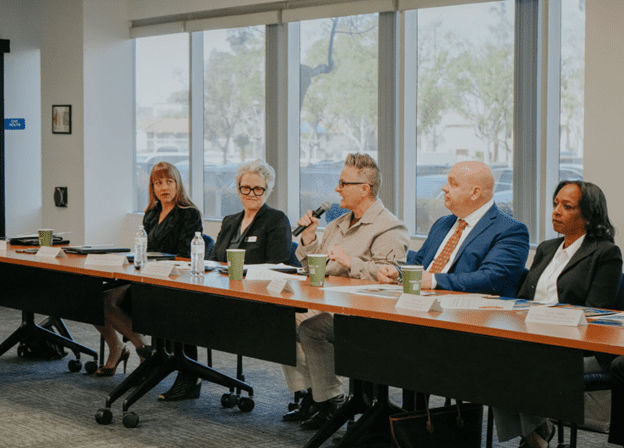
 San Bernardino County Assistant Executive Officer Diane Rundles; Judge Michelle H. Gilleece of San Bernardino Superior Court; Dr. Alyce Belford-Saldana, deputy director of the San Bernardino County Department of Behavioral Health; and Gregory Armstrong and Sara Boger of the Legal Aid Society of San Bernardino.
On Feb. 23, the San Bernardino County Behavioral Health Department, in partnership with the County Administrative Office and multiple Community Assistance, Recovery and Empowerment (CARE) partners within the county welcomed representatives from the California Health and Human Services Agency (CalHHS), Judicial Council, state partners and community collaborators for a CARE Act site visit. The visit underscored San Bernardino County’s commitment to advancing the Community Assistance, Recovery and Empowerment (CARE) Act through cross-system coordination, field-based engagement and integrated care pathways.
Since launching the CARE Act on Dec. 1, 2024, San Bernardino County has implemented a coordinated framework designed to bridge behavioral health and the judicial system. Participants have been integrated into the county’s Recovery-Based Engagement Support Teams (RBEST) model, and the Fontana Court District began accepting petitions on Dec. 2, 2024. This rapid alignment between behavioral health services and the court system, County Counsel, Public Defender, and Legal Aid represents a significant step toward addressing serious mental health needs through structured, collaborative interventions.
The CARE Act framework in San Bernardino County rests on three primary pillars: cross-agency coordination, training and capacity building and community outreach. Through sustained collaboration among behavioral health professionals, judicial partners and community-based providers, individuals eligible under the CARE Act are connected to treatment, housing support and comprehensive case management. Field-based outreach conducted through RBEST reduces barriers to engagement and builds trust among individuals who may have previously experienced fragmented systems of care.
Early outcomes reflect meaningful progress. Participants are actively engaging in treatment, stabilizing housing situations, and benefiting from coordinated support services. Legal agreements have been established to ensure care plans integrate clinical treatment with community-based resources. These developments highlight the importance of structured partnerships that prioritize dignity, recovery and long-term stability.
The site visit brought together leaders across state and local systems, including Austin Dickman, a CalHHS policy analyst; Kim Johnson, CalHHS secretary; Stephanie Welch, CalHHS deputy secretary; John Freeman, a consultant with Desert Vista Counseling; Karen Linkin, co-founder and principal of Desert Vista Counseling; Ruby Spies, a senior associate with Desert Vista Consulting; Tina Flores of the Department of Health Care Services Evaluation Department; Kate Warburton, medical director of the Department of State Hospitals; Cassie McTaggart of the Judicial Council of California; Tyler Shill of the Judicial Council of California; Serene Olin of HMA and DHCS; Roxanne Cordova, a clinician with the California Department of Corrections and Rehabilitation; Carey Haidl, chief deputy regional administrator for CDCR; Stephanie Clendenin, director of the Department of State Hospitals; and Chris Edens, chief deputy director of the Department of State Hospitals. Their presence reflected a unified statewide commitment to improving systems of care for individuals living with serious mental illness.
The significance of this visit extends beyond policy implementation. For residents of San Bernardino County, the CARE Act represents expanded access to treatment, earlier intervention, increased housing stability and improved coordination between systems that historically operated in silos. By aligning judicial processes with behavioral health services, the county is creating pathways that emphasize recovery and empowerment rather than crisis response alone.
While meaningful progress has been achieved, continued collaboration remains essential. The CARE Act is not a single program but an evolving framework that requires sustained coordination, training and evaluation to ensure equitable access and measurable outcomes. The Feb. 23 site visit reaffirmed San Bernardino County’s leadership in operationalizing the CARE Act and highlighted the shared responsibility across agencies to support some of the community’s most vulnerable residents.
Through partnership, innovation and a commitment to recovery-based care, San Bernardino County continues to advance a model that strengthens systems, builds trust and improves lives.
For more information about San Bernardino County’s CARE Act implementation, visit: https://wp.sbcounty.gov/dbh/careact/
Additional County Update News – Feb. 26, 2026